
Free Risk Assessment Template
Download our free Risk Assessment Template. Identify hazards and assess risks in your workplace.
Download Free Risk Assessment Template
DOCX + PDF
Updated Oct 2026
No signup required
By downloading you agree to our Free Resources Licensing Agreement.
Download our free Risk Assessment Template:
*For internal use only. Not for resale or redistribution. By downloading, you agree to our Free Resources Licensing Agreement.
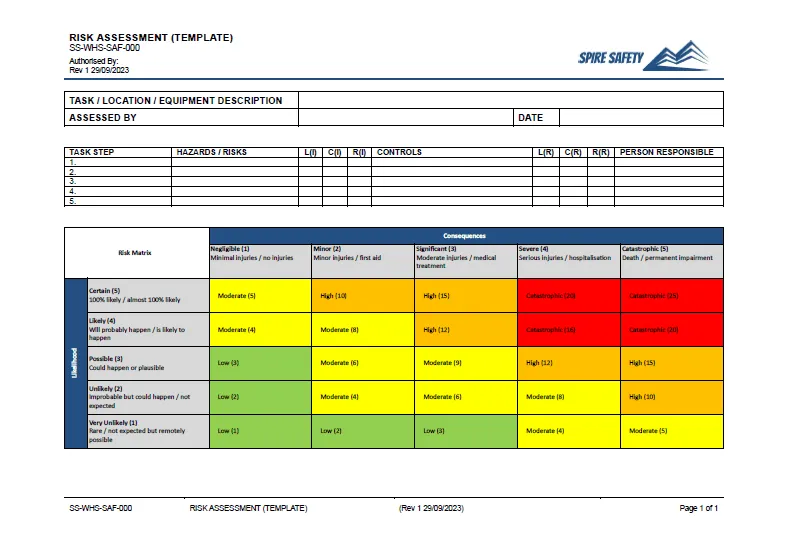
Risk Assessment Template
Video Tutorial
Our free WHS resources have helped over 30,000 businesses manage their WHS compliance. If you find these free resources helpful, consider leaving a review on google.
Your browser does not support the video tag.
Why is a WHS Risk Assessment Important?
A WHS Risk Assessment can help with the following:
Identifying hazards and risks: Helps prevent accidents by recognizing potential dangers.
Identifying safety controls: Ensures effective measures are in place to mitigate risks.
Meeting legal requirements: Assessing risks is a legal requirement in many situations.
Educating workers: Enhances staff awareness of safety procedures.
Assigning responsibility for controls: Clarifies who is accountable for risk management.
Increase productivity: A safer workplace leads to improved productivity.
A WHS Risk Assessment is an evaluation of potential hazards in your workplace that can lead to injury or illness. A risk assessment helps you identify potential risks, and develop solutions to reduce them as much as possible. It also prompts you to think critically about how your business operates, what tasks are performed in each area of the business, who is permitted access to those areas, and so on.
What is Contained within a WHS Risk Assessment?
A WHS Risk Assessment typically contain:
The task details (i.e. what task or thing is being assessed). For example:
Digging a concrete slab
Operating a forklift
Installing skylights
The task steps (i.e. a step-by-step sequential breakdown of the process or task). For example:
Step 1 – Access site
Step 2 – Setup equipment
Step 3 – Perform task
Step 4 – Packup and clean up
The hazards or risks (i.e. the things that can hurt people or cause damage / harm). For example:
Overhead hazards (e.g. powerlines)
Underground hazards (e.g. buried pipes)
Plant movement
The controls (i.e. the things that we do to protect ourselves and others). For example:
Exclusion zones around plant and powerlines
Dial before you dig
High-vis clothing
The risk scores (i.e. the likelihood and consequence before and after controls are implemented). For example:
Catastrophic
High
Moderate
Low
Responsibilities (i.e. who is responsible for implementing the safety controls). For example:
Workers
Site supervisor
Safety officer / advisor
A WHS risk assessment is a process that identifies potential hazards that could lead to an accident or illness. A hazard is anything that poses a risk to people—whether it's people inside or outside the workplace.
Hazards can be:
Physical,
Mechanical,
Chemical,
Biological,
Psychological,
Ergonomic, or
A combination of any of these things.
It's important to identify potential hazards in your workplace because they can be the cause of injury or illness.
Types of WHS Risk Assessment
A WHS Risk Assessment is often conducted as a broad overview of your workplace (sometimes called a broad-brush risk assessment).
Other types of WHS Risk Assessment Include:
Site Specific: Focuses on one particular location, site or facility. A risk assessment for a specific site is useful for determining what hazards exist at that one location, and what solutions can be put in place to reduce those hazards.
Task Specific: Focuses on identifying and evaluating potential hazards associated with a particular task or activity.
Plant Specific: Focuses on identifying hazards related to specific machinery or equipment. This type of assessment evaluates the risks posed by the operation, maintenance, and interaction with the plant or machine.
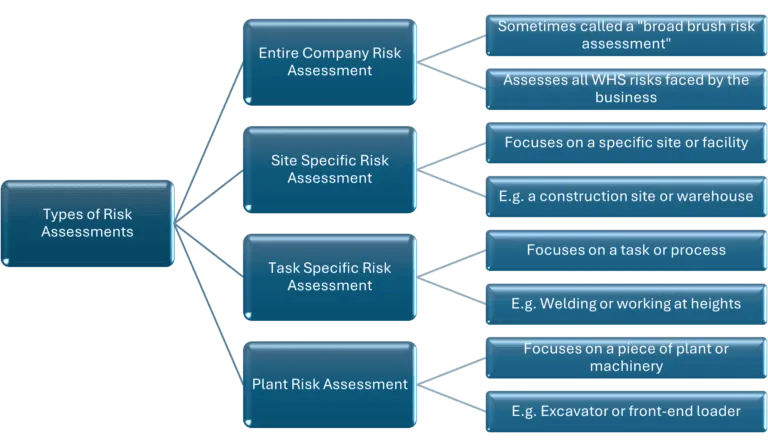
Types of WHS Risk Assessment
How to Conduct a WHS Risk Assessment
Step 1 – Fill in The Details
Fill in:
The task or thing being assessed,
Who is doing the assessment, and
The date.
Step 2 – List the Task Steps
List the task steps in sequential order.
Step 3 – List the Hazards and Risks
List the hazards and risks for each task step.
Step 4 – Score the Initial Risk (with a risk matrix)
Using a risk matrix, score the initial risk (i.e. the risk before any safety controls have been implemented)
Step 5 – List the Safety Controls
List the safety controls, i.e. the things that we will do to keep ourselves (and others) safe.
Step 6 – Score the Residual Risk (with a risk matrix)
Using a risk matrix, score the residual risk (i.e. the risk after safety controls have been implemented).
Step 7 – List the Person/s Responsible
List the person/s responsible for implementing the safety controls
Step 8 Colour the Cells
Beautify your risk assessment by colouring the risk cells with the corresponding colour from the risk matrix.
Is a WHS Risk Assessment a Legal Requirement?
You may think the answer is "Yes". However, its more complicated than that.
There are specific regulations that state a risk assessment must be completed, for example:
Confined space risk assessment – (WHS Regulations s(66) Managing risks to health and safety)
In general, risk assessments assist in the risk management process, which is outlined within WHS Regulations Part 3.1 – however "risk assessments" are not specifically mentioned in Part 3.1.
The code of practice " How to manage work health and safety risks" describes the 4 step risk management process where step 2 is to assess risks.
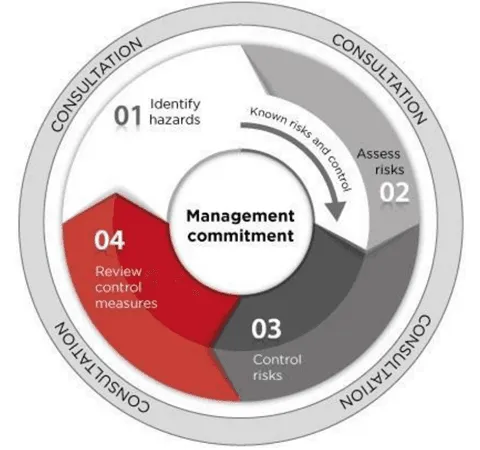
Risk Management Process
The code states that a risk assessment should be done when:
there is uncertainty about how a hazard may result in injury or illness, or
the work activity involves a number of different hazards and there is a lack of understanding about how the hazards may interact with each other to produce new or greater risks, or
changes at the workplace occur that may impact on the effectiveness of control measures.
The code also states that in some circumstances, a risk assessment will assist to:
identify which workers are at risk of exposure,
determine what sources and processes are causing the risk,
identify if and what kind of control measures should be implemented, and
check the effectiveness of existing control measures.
Purpose of Document
Risk Assessment templates are used to identify hazards and assess risks within the workplace. The primary goal is to protect workers from injury or illness by facilitating formal hazard identification and risk assessment. This form is broadly aligned with AS45001:2018.
How to Use
Complete the relevant sections of the form, including the site / location and who is completing the relevant risk assessment. Add an overview of the work being conducted / task steps and what hazards and risks exist for these steps. Assess the risks using a risk matrix.
NOTE: This document is a template only and it must be customised for your business. Other aspects that may need to be considered include, but are not limited to, ensuring that:
Relevant legal requirements have been met,
Workplace specific risks are identified and managed, and
Workers are consulted with during the customisation / review process.
When to Use
Risk assessments should generally be completed prior to work commencing, or at any time the work requires a documented a risk assessment.
Who Should Use
This Risk Assessment Template can be completed by your workers, Safety Advisor, Project Manager or other competent person in your organisation.
Legal Considerations
Legally, workplaces (or PCBUs) need to identify hazards and assess risks (in certain situations). It is best practice to document these risk assessments, especially for larger companies. It can help meet general legal duties, including:
s(19) WHS Act – Primary Duty of Care
s(34) WHS Regulations – Duty to Identify Hazards
FAQ
What is a risk assessment?
A risk assessment is a systematic process for evaluating potential risks associated with a specific activity or situation. The main steps involve identifying and assessing hazards, determining potential sources and processes causing the risks, and implementing control measures to mitigate those risks.
What is a risk assessment template?
A risk assessment template is a word document that can be used to conduct a risk assessment.
Why should I conduct a WHS Risk Assessment?
WHS Risk Assessments help ensure compliance with safety regulations, protect employees from harm, reduce accidents and injuries, and promote a safe work environment.
What is a risk matrix?
A risk matrix is a visual tool used in risk assessment to categorize and prioritize potential risks based on their likelihood and severity.
Who is responsible for conducting a WHS Risk Assessment?
Employers are responsible for conducting WHS Risk Assessments in their workplace. They may seek assistance from qualified professionals, but the ultimate responsibility lies with the employer.
How often should I conduct a WHS Risk Assessment?
WHS Risk Assessments should be conducted regularly, especially when there are changes to the workplace, work processes, or introduction of new hazards. Generally, it is recommended to conduct assessments annually, or whenever significant changes occur.
How should I prioritize risks in a WHS Risk Assessment?
Risks should be prioritized based on the likelihood and severity of potential harm using a risk assessment template. High-risk hazards that are more likely to cause severe harm should receive greater attention and be addressed promptly.
Article Sources and Further Reading
Legal references
Legal considerations
The following legal requirements may be relevant to this type of work.
- Work Health and Safety Act (Harmonised) — Provides the primary duties for protecting workers and other people from work health and safety risks.
- Work Health and Safety Regulations (Harmonised) — Sets out requirements supporting the management of workplace hazards and risks.
The following codes may be relevant to this type of work.
- Managing WHS Risks Code of Practice — Provides practical guidance on identifying hazards, assessing risks and applying effective controls.
- Work Health and Safety Consultation, Cooperation and Coordination Code of Practice — Provides practical guidance on consulting workers and coordinating with other duty holders.
- Managing the Work Environment and Facilities Code of Practice — Provides practical guidance on safe work environments, workplace facilities and related controls.
Share this resource
Browse Categories
How To Use It
- 1Download and open in Word or PDF.
- 2Replace the placeholders with your business details.
- 3Get it reviewed by a WHS specialist before rollout.
Need it customised?
Our WHS consultants can adapt this template to your site, run a gap analysis, or audit what you already have in place.
Book a Free Consultation WHS consulting servicesor call 1300 156 382