
The Work Health & Safety Act 2011 Australia
The Work Health and Safety Act 2011 is legislation that governs workplace safety in most Australian states. It sets the framework for WHS regulation including duties, consultation, powers, notifiable incidents, and penalties.

What is the Work Health and Safety Act 2011?

The Work Health and Safety Act 2011 (the Act) is legislation that governs workplace safety in most Australian states.
Harmonisation Between States
Each state has the powers to write its own WHS legislation and each state has its own WHS regulator. Most states are now on the "harmonised" or "model" WHS legislation.

Most of the Acts and Regulations are identical interstate (except Victoria). But there are some differences. For example, in WA:
Union Right of Entry is covered under the Industrials Relations Act 1979, and hence not included in the WHS Act or Regs, and
HSRs have the right to choose their own course of training
Links:
Safe Work Australia (Model WHS laws)
Comcare (Scheme and legislation – Comcare)
QLD (Work health and safety laws)
NSW (Legislation – SafeWork NSW)
ACT (Acts and regulations)
SA (Legislation)
WA (Work health and safety legislation)
NT (The legislative framework – NT WorkSafe)
TAS (Acts and Regulations)
VIC (Occupational Health and Safety Act and regulations)
Who is Safe Work Australia?
Safe Work Australia is the federal body that is tasked with publishing the model Act, Regs and Codes. Each state then "adopts" the model legislation.
Who is Comcare?
Comcare is the regulator that covers federal employees, e.g. defence force personnel.
Key Provisions of the Work Health and Safety Act 2011
The WHS Act sets the framework for WHS regulation and includes:
Duties of certain parties
PCBUs (businesses / business owners)
Officers (e.g. CEOs)
Workers (the rest of us)
Consultation requirements
Powers and functions of the regulator, inspectors, HSRs and union representatives
Notifiable incidents
Offences and their penalties
Duties Under the WHS Act
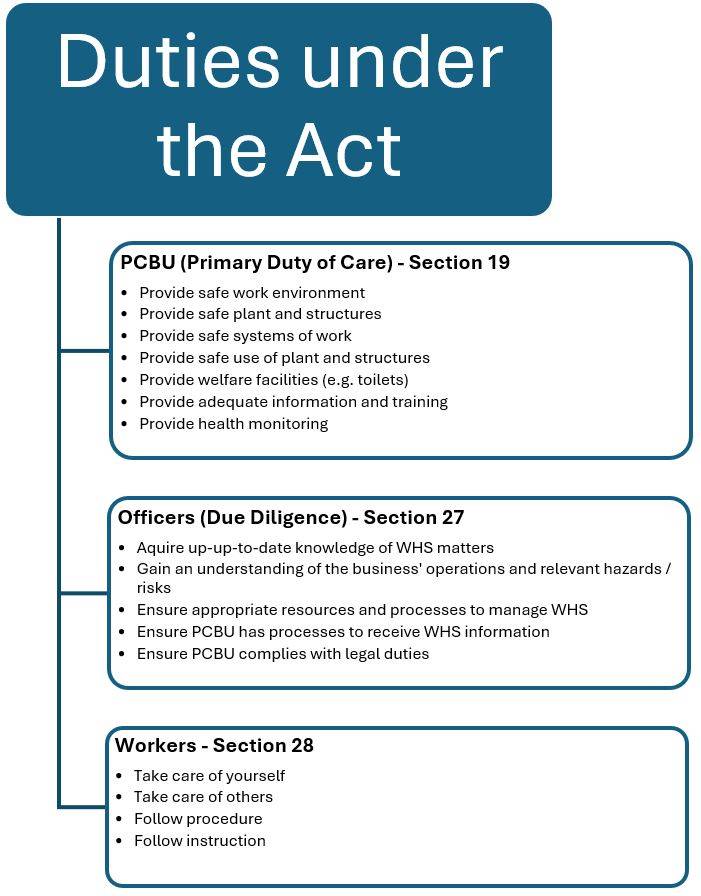
The following sections dictate how duties are applied:
Section 14 – Duties are not transferable (by way of contract or other agreement)
Section 15 – A person can have more than 1 duty (e.g. a person can be an Officer and a Worker)
Section 16(1) – More than 1 person can concurrently have the same duty (e.g. a labor hire PCBU and host PCBU)
Section 16(3) – Each person with a duty must discharge that duty to extent they have influence and control over the situation (e.g. high level of influence / control means the person must comply to a high level)
Primary Duty of Care (PCBUs)
The primary duty of care is owed by the PCBU to workers. This means that the PCBU must take all reasonable measures to ensure the safety of workers (or others who may be impacted by the works).
Due Diligence (Officers)
Officers must exercise due diligence to ensure the business complies with its legal obligations.
Duty of Workers
Workers have 4 main legal duties. Taking care of themselves and others as well as following procedure and instruction.
Consultation Requirements
Consultation (or talking / information sharing) is a requirement under section 46 and section 47 of the Act. We have a detailed guide on WHS consultation.
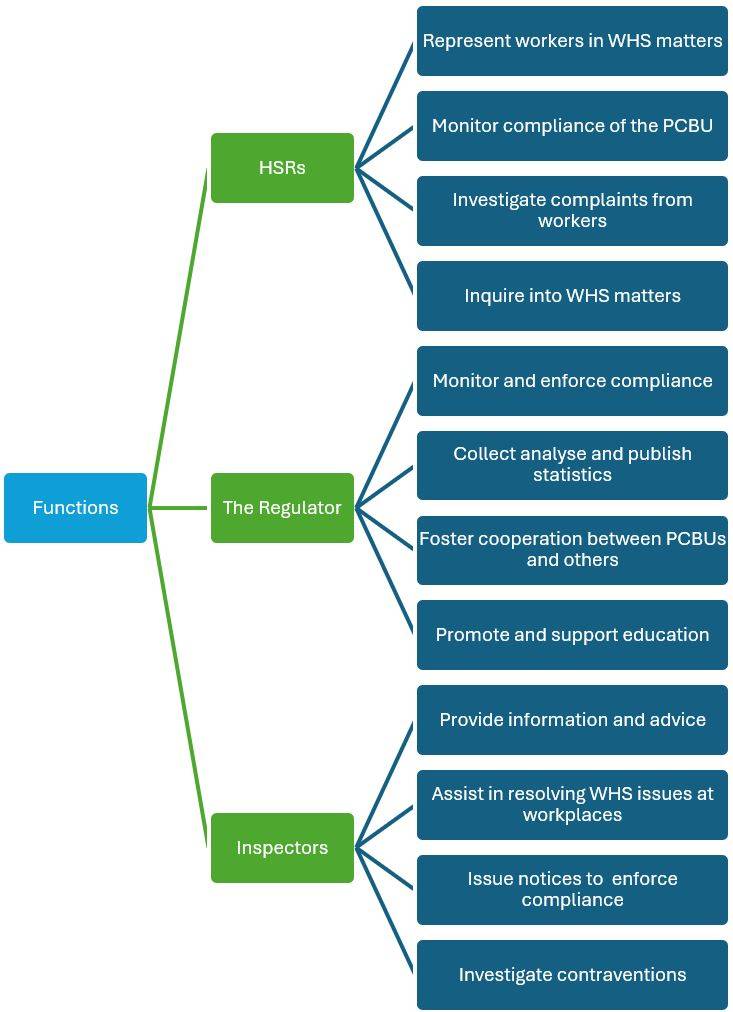
Functions and Powers
Different persons / entities are given powers and functions under the Act. For example, who says that a WHS Inspector / Regulator can enter you workplace with your permission? The Act does. (This diagram is not exhaustive).
Notifiable Incidents
Certain incidents (including dangerous events and near-misses) require notification to the regulator. E.g. serious burns or lacerations. We have a detailed guide on notifiable incidents.
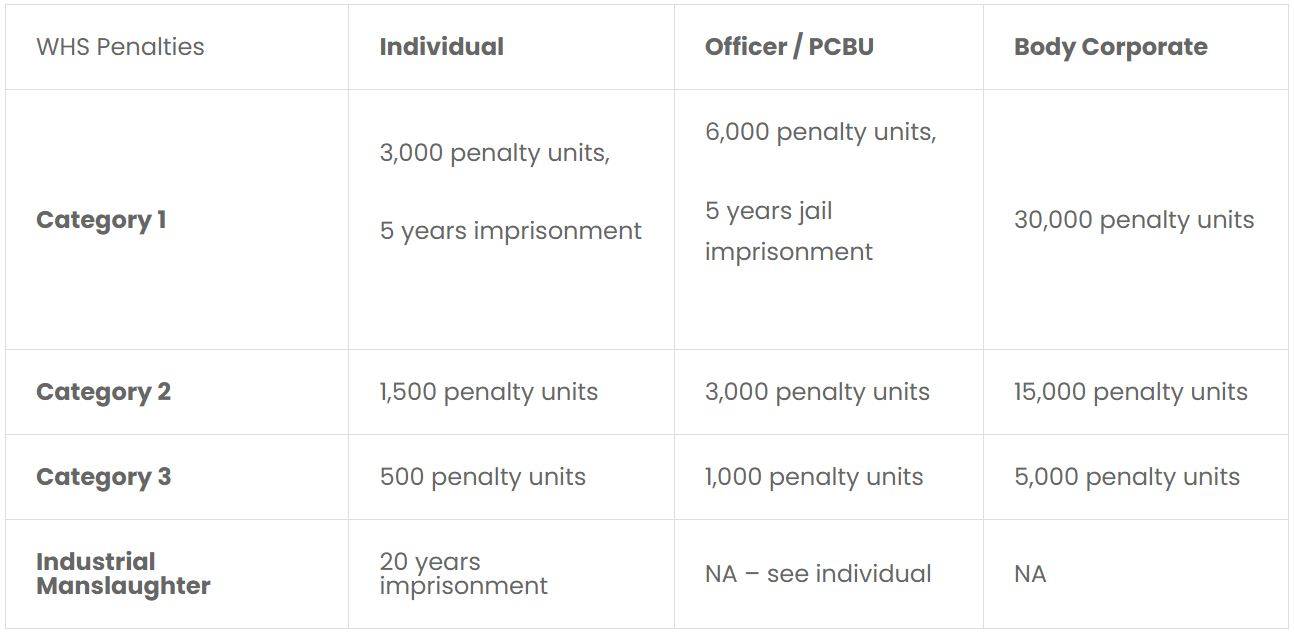
Offences and Penalties
Offences and penalties are outlined for different parties. We have a detailed guide on offences and penalties. The below table is state-specific and an example only. Please check your local legislation for accurate penalties.
Work Health and Safety Regulations 2011
The Work Health and Safety Regulations 2011 (the Regulations) are made under the Act and provide more detailed information about how the Act is to be implemented in the workplace. The Regulations set out specific requirements for various aspects of work health and safety, such as:
Confined spaces
Plant
Hazardous chemicals
Who is protected by WHS Act?
The Work Health and Safety (WHS) Act 2011 protects the health, safety, and welfare of all workers and other persons at the workplace. This includes employees, self-employed persons, contractors, volunteers, and any other person who is at the workplace or is affected by the work carried out at the workplace.
The Act applies to all workplaces in Australia, including those that are self-employed, casual, part-time, or volunteer.
Conclusion
The Work Health and Safety Act 2011 is a comprehensive legislation that sets out the rights and obligations of all parties in the workplace concerning work health and safety.
The Act applies to all workplaces in Australia, including those in NSW and QLD, and is administered by SafeWork NSW and Workplace Health and Safety Queensland, respectively.
The Act is supported by the Work Health and Safety Regulations 2011, which provide more detailed information about how the Act is to be implemented in the workplace.
All parties in the workplace must comply with the Act and the Regulations to ensure the health and safety of everyone at the workplace.
FAQ
What is the WHS Act 2011?
The Work Health and Safety (WHS) Act 2011 is legislation enacted by the Australian government to ensure the health and safety of workers and workplaces by managing and mitigating risks.
Who does the WHS Act 2011 apply to?
The Act applies to all workplaces in Australia, including employers (Persons Conducting a Business or Undertaking – PCBUs), workers, and other individuals such as visitors who are present at the workplace.
What are the primary duties of a PCBU under the WHS Act 2011?
PCBUs have the primary duty to ensure, as far as reasonably practicable, the health and safety of their workers while at work. This includes providing a safe work environment, safe systems of work, information, training, supervision, and where appropriate, suitable facilities and protective equipment.
What rights do workers have under the WHS Act 2011?
Workers have the right to a safe work environment, the right to be trained and informed about workplace hazards, the right to participate in WHS decision-making processes, and the right to cease work if they believe it is unsafe.
How does the WHS Act 2011 encourage worker participation?
The Act encourages worker participation through Health and Safety Representatives (HSRs) and Health and Safety Committees (HSCs), which allow workers to have a say in the health and safety practices of their workplace.
What are the penalties for non-compliance with the WHS Act 2011?
Penalties vary depending on the nature and severity of the breach but can include heavy fines and, for the most serious breaches, imprisonment for individuals responsible.
How are WHS complaints and incidents handled under the WHS Act 2011?
Complaints and incidents are handled by state and territory WHS regulators. Employers must report certain types of incidents, known as 'notifiable incidents', to these regulatory bodies.
Further Reading
What are the WHS Penalties for Non-Compliance? (Spire Safety)
Who we are and what we do (Safe Work Australia)
WHS Definitions (Spire Safety)
Share this resource
Need Help?
Our WHS consultants can help you implement this in your business. Book a free consultation today.
Book a Consultationor call 1300 891 503