
Industry-Specific WHS Playbooks in Australia (2026 Guide)
Australian businesses face diverse risks that general safety templates often fail to address adequately. Industry-specific WHS playbooks ensure your safety management system aligns with unique sector

Australian businesses face diverse risks that general safety templates often fail to address adequately.
Implementing industry-specific WHS playbooks in Australia ensures your safety management system aligns with the unique physical and psychosocial hazards of your sector.
TLDR
Generic safety manuals often miss high-risk hazards specific to niche Australian industries.
Recent 2026 legal updates require businesses to manage digital work systems and AI-related stress.
Industry-specific playbooks simplify compliance with mandatory Codes of Practice starting July 2026.
Tailored frameworks improve worker engagement by providing relevant, practical safety instructions.
The Shift Toward Sector-Specific WHS Plans
A one-size-fits-all approach to safety often leads to compliance fatigue, in which workers ignore irrelevant rules.
By using sector-specific WHS plans, organisations can focus on the high-risk activities that actually occur on their sites.
A warehouse in Western Sydney requires different controls than a software firm in Melbourne.
The warehouse needs traffic management and racking inspections, while the office must focus on ergonomic hazards and digital work systems.
Recent updates for 2026 show that regulators now expect businesses to address modern hazards like AI-driven work pressure.
These industry safety handbooks help managers identify where new technologies create specific mental health risks for their staff.
Managing Psychosocial Hazards by Industry
New Australian laws in 2026 put significant pressure on small businesses to protect staff from high-tech hazards.
This includes managing workplace stress caused by monitoring software or automated workflows.
A healthcare facility in Adelaide will face different psychosocial stressors compared to a construction firm in Perth.
Healthcare workers may deal with vicarious trauma, while construction workers face isolation or high-pressure deadlines.
Developing a robust psychosocial hazards at work strategy allows you to address these nuances.
Without a tailored approach, you risk breaching your duty of care under the updated WHS Regulation 2011 (supported by Model WHS Regulations amended in April 2023) (Source: www.peopleplaybook.one).
Legislative Changes and Mandatory Benchmarks
From 1 July 2026, NSW WHS reforms make Approved Codes of Practice mandatory benchmarks for businesses.
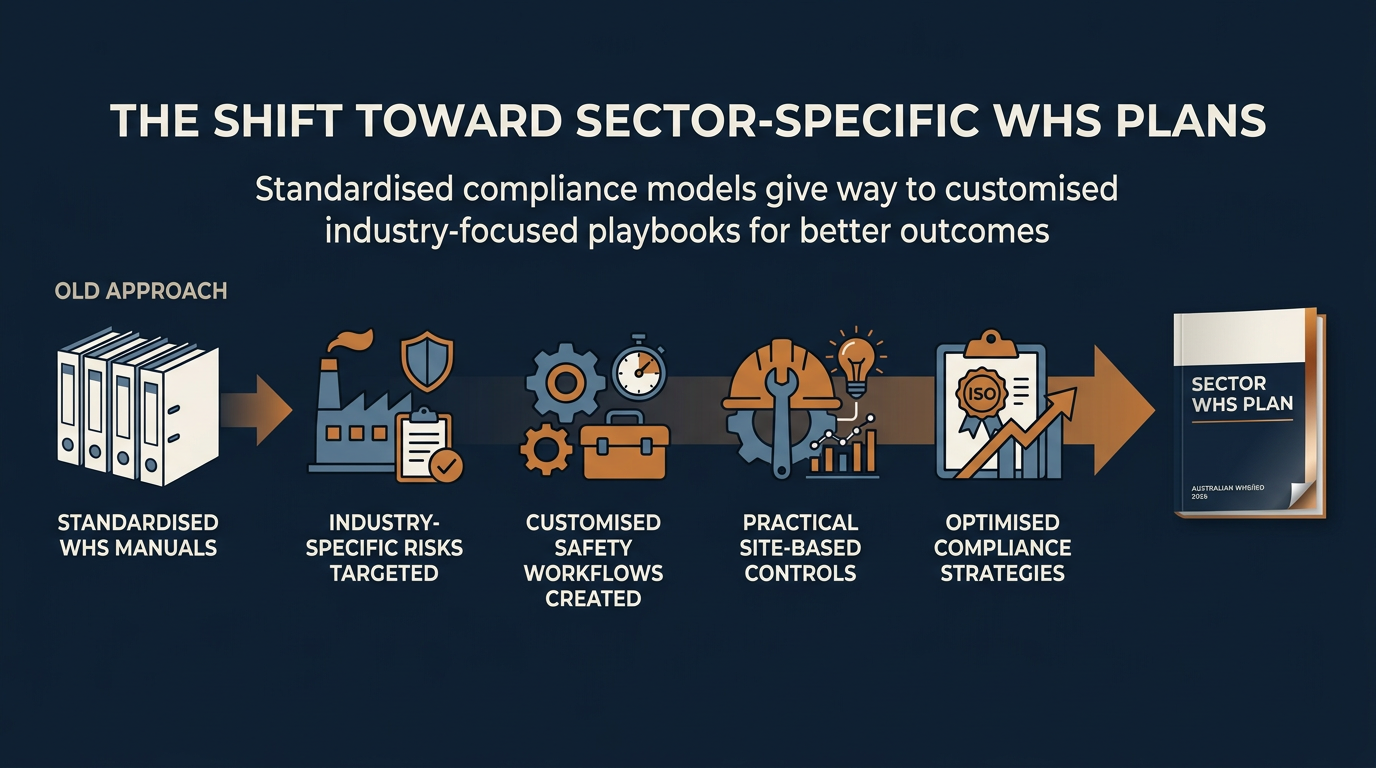
Tailored WHS plans are becoming essential for Australian workplaces.
You must either comply with these codes or prove you have implemented an equal or better safety standard.
Using industry-specific WHS playbooks in Australia ensures you meet these benchmarks without guesswork.
These playbooks translate complex legal jargon into actionable steps for your specific operational environment.
If you are building a safety culture, these documents provide the foundation for leadership to demonstrate commitment.
They show that management understands the real-world dangers employees face every day.
Customised WHS Frameworks for High-Risk Sectors
High-risk industries like mining, agriculture, and manufacturing cannot rely on basic safety checklists.
They require customised WHS frameworks that integrate technical safety standards with daily operational procedures.
For example, a manufacturing plant in Brisbane needs specific lockout-tagout procedures and hazardous chemical registers.
An agriculture business in regional Victoria must address quad bike safety and zoonotic disease risks.
When a fire strategy is needed, a chemical plant requires far more complex suppression systems than a retail shop.
Tailored playbooks ensure these critical differences are documented and funded.
The Role of Digital Work Systems
The Digital Work Systems in Act of 2026 introduces new requirements for how employers monitor performance.
If your industry uses GPS tracking or automated dispatch, your playbook must reflect these digital hazards.
Regulators are increasingly looking at how these systems impact fatigue and mental health.
A WHS safety guide by industry helps you audit these systems to ensure they do not inadvertently increase injury risks.
How to Develop Your Industry Playbook
Creating tailored workplace safety manuals involves more than just downloading a template from the internet.

Tailored WHS playbooks for managing psychosocial hazards across various Australian industries.
It requires a deep dive into your specific work processes and consultation with your workforce.
Start by reviewing Safe Work Australia guidance and sector data to identify common injury trends.
Use these statistics to prioritise the most dangerous tasks in your operational procedures.
If you are an internal safety lead, focus on mapping every workflow.
This mapping allows you to identify where generic controls fail to protect your team in real-world scenarios.
Consultation and Engagement
A playbook is only effective if the workers who use it actually believe in its relevance.
Consult with HSRs and frontline staff to identify work-as-done versus work-as-imagined.
Involving staff in the creation of industry-specific WHS playbooks in Australia increases their sense of ownership.
When workers see their specific challenges addressed, they are more likely to follow the established safety protocols.
Integrating ISO Standards into Industry Playbooks
For businesses seeking ISO 45001 certification, industry playbooks serve as the bridge between international standards and local operations.
The playbook acts as the how-to guide for meeting the high-level requirements of the ISO standard.
Whether you are in civil construction or aged care, your management system must be functional.
An industry-specific approach ensures that your documentation during an audit is actually relevant to your risk profile.
Auditors in Australia look for evidence that your system is tailored to your specific context.
A generic manual is often a red flag that the organisation is not truly managing its unique risks.
Auditing and Updating Your Playbook
The WHS environment in Australia changes rapidly, as evidenced by the major reforms scheduled for 2026.
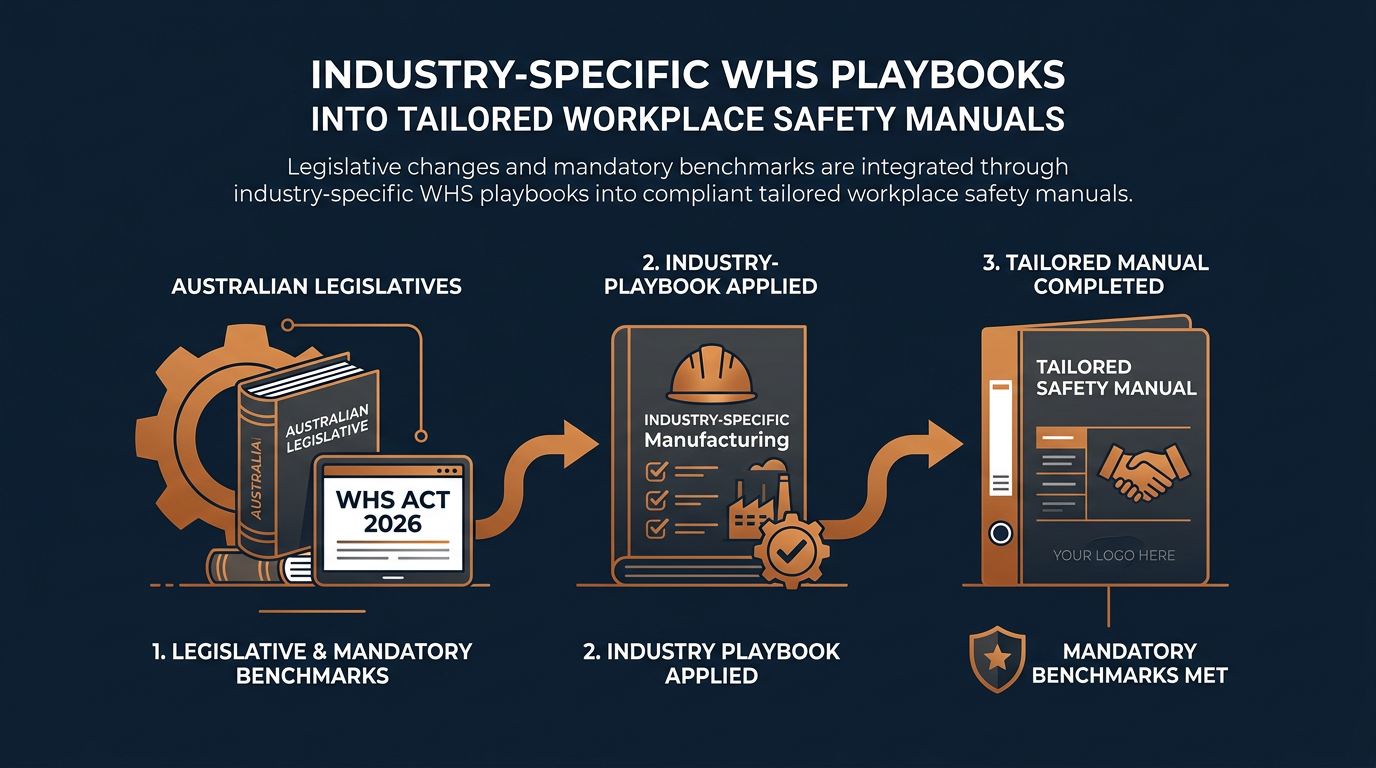
Understanding legislative changes and mandatory benchmarks for tailored Australian WHS safety guides.
Your playbook must be a living document that undergoes regular review and adjustment.
Schedule annual reviews to incorporate new Codes of Practice or changes in industrial technology.
If your business adopts new machinery or software, update the risk assessments in your playbook immediately.
Having a dedicated WHS safety professional can help manage these updates.
They ensure that your documentation remains compliant with both state and federal requirements as they evolve.
Training and Implementation Strategies
Once your industry safety handbooks are developed, they must be effectively communicated to the entire team.
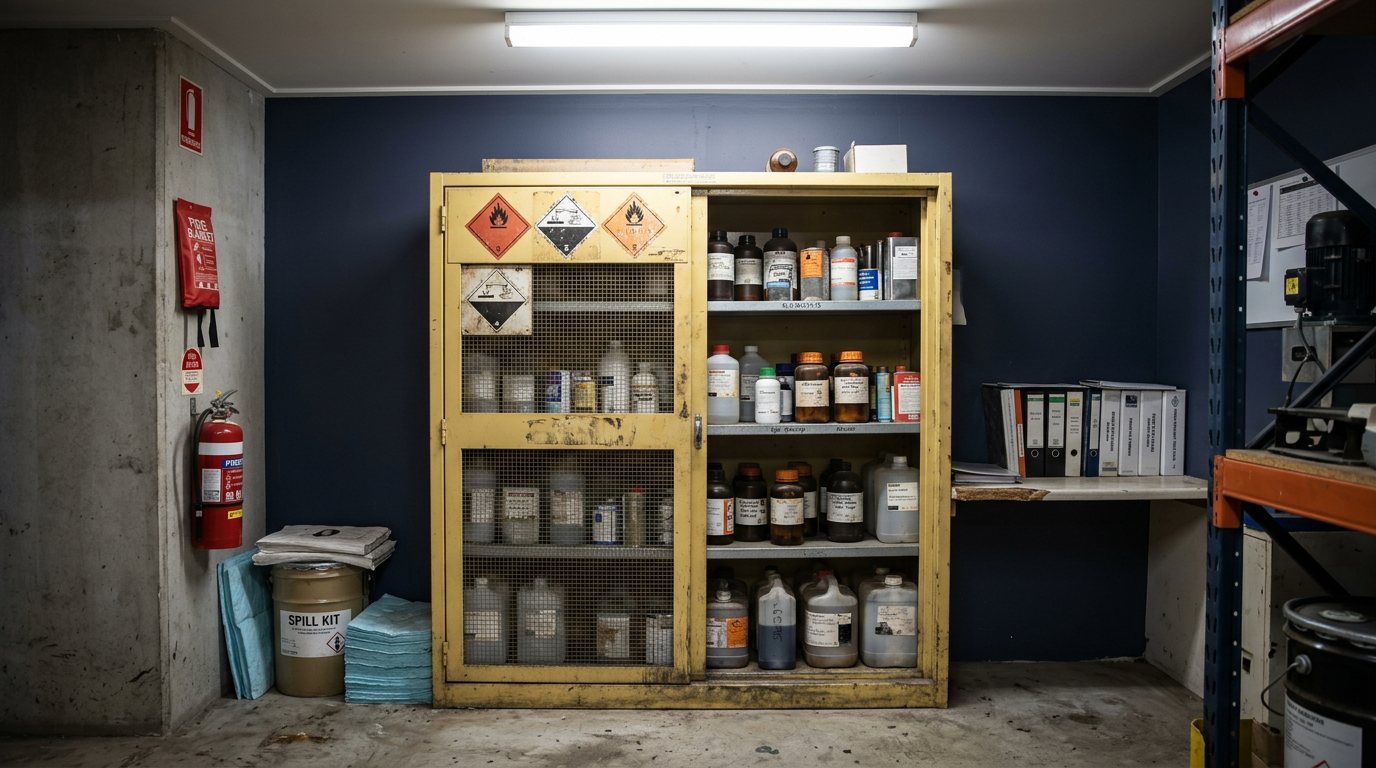
Tailored WHS plans for high-risk Australian industries, ensuring safety compliance.
This is not just about a one-off induction but ongoing reinforcement through practical application.
Use the playbook to guide your toolbox talks and safety meetings.
Focus on one specific section each week to keep the information digestible and relevant to current tasks.
For workers returning to work after a period of absence, the playbook provides a clear refresher.
It ensures they are quickly brought up to speed on the latest sector-specific safety protocols.
Common Questions (PAA)
What is an industry-specific WHS playbook in Australia?
It is a tailored safety manual that reflects the hazards, controls and legal benchmarks for a particular sector in Australia.
Who needs an industry playbook?
Any PCBU whose operations include sector-specific risks or who must demonstrate compliance with Approved Codes of Practice should have one.
How often should a playbook be updated?
Review annually and after significant operational changes such as new machinery, software or organisational structure.
Actionable Next Steps
Map your high-risk tasks and list the controls currently in place.
Compare those controls against Safe Work Australia guidance and relevant Approved Codes of Practice.
Engage frontline staff and HSRs to validate your work-as-done assumptions.
Document a prioritised risk control action plan with clear timelines, as required for psychosocial risk management (Source: www.peopleplaybook.one).
Track changes and evidence your decisions so you can demonstrate due diligence if regulators arrive.
Maintaining clear documentation will also help if you need to reference the average costs or impacts of psychological injury claims in NSW and elsewhere (Source: employmenthero.com).
FAQ
Frequently asked questions
01How do industry-specific WHS playbooks differ from generic WHS management systems?
02Can these playbooks help address compliance for international operations, or are they strictly Australian-focused?
03What is the typical timeframe and resource commitment required to implement an industry-specific WHS playbook?
04How often should an industry-specific WHS playbook be reviewed and updated to remain effective and compliant?
05Are there specific government grants or incentives available in Australia for businesses implementing enhanced WHS systems like these?
Share this article
Get Expert Advice
Speak with a certified WHS consultant about your workplace.
Contact Usor call 1300 891 503