
Integrating ISO 9001, 14001, and 45001 Into One Management System
Australian businesses often find that managing three separate compliance frameworks creates unnecessary administrative burden. By mapping the shared requirements of quality, environmental, and safety

Australian businesses often find that managing three separate compliance frameworks creates unnecessary administrative burden.
By mapping the shared requirements of quality, environmental, and safety standards, organisations can build a single, lean framework that drives performance across the board.
TLDR
- The Annex SL high-level structure allows businesses to map identical requirements across the three ISO standards.
- A single integrated management system can materially reduce documentation compared with siloed systems.
- Integrated audits typically save time and cost for firms across Australia.
- Focusing on common clauses eliminates conflicting procedures and operational friction.
The Power of a Unified Framework
Combining ISO 9001, 14001, and 45001 into one system is known as an Integrated Management System (IMS).
This approach uses the common High-Level Structure to align processes and reduce duplication.
Most organisations in Australia previously managed these as separate pillars, leading to duplicate forms and confusing workflows.
An IMS treats quality, safety, and environment as a single business objective.
A integrated management system allows leadership teams to view risk holistically.
You no longer need three separate meetings to discuss business performance.
Mapping the Common Clauses of ISO Standards
Since 2015, ISO has used a consistent layout for major management system standards called Annex SL.
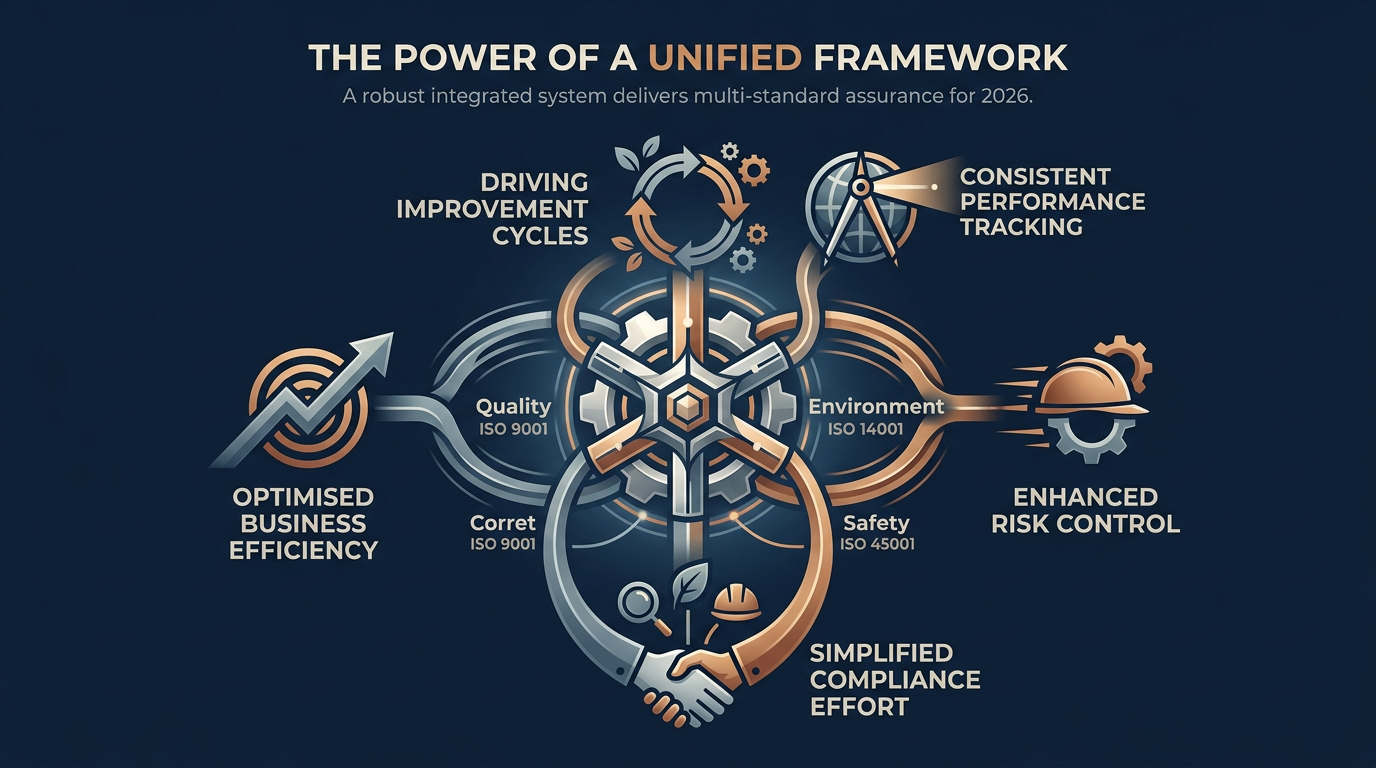
Clause 4 through Clause 10 follow the same themes across ISO 9001, ISO 14001 and ISO 45001.
For example, "Context of the Organisation" is Clause 4 in each standard.
You can satisfy this requirement with one document that lists quality influences, environmental impacts, and safety risks.
Leadership and Planning Overlaps
Clause 5 requires leadership commitment and a functional policy.
Instead of three policies, you can write one Integrated Policy that addresses quality, environment, and safety objectives.
Clause 6 covers risk and opportunity management for all three standards.
An integrated risk register can track quality failures alongside safety hazards and environmental aspects.
Establishing objectives also benefits from mapping specific requirements in one place.
You can align production targets with waste reduction goals and injury prevention KPIs in a single objectives register.
Strategic Benefits of Triple Certification
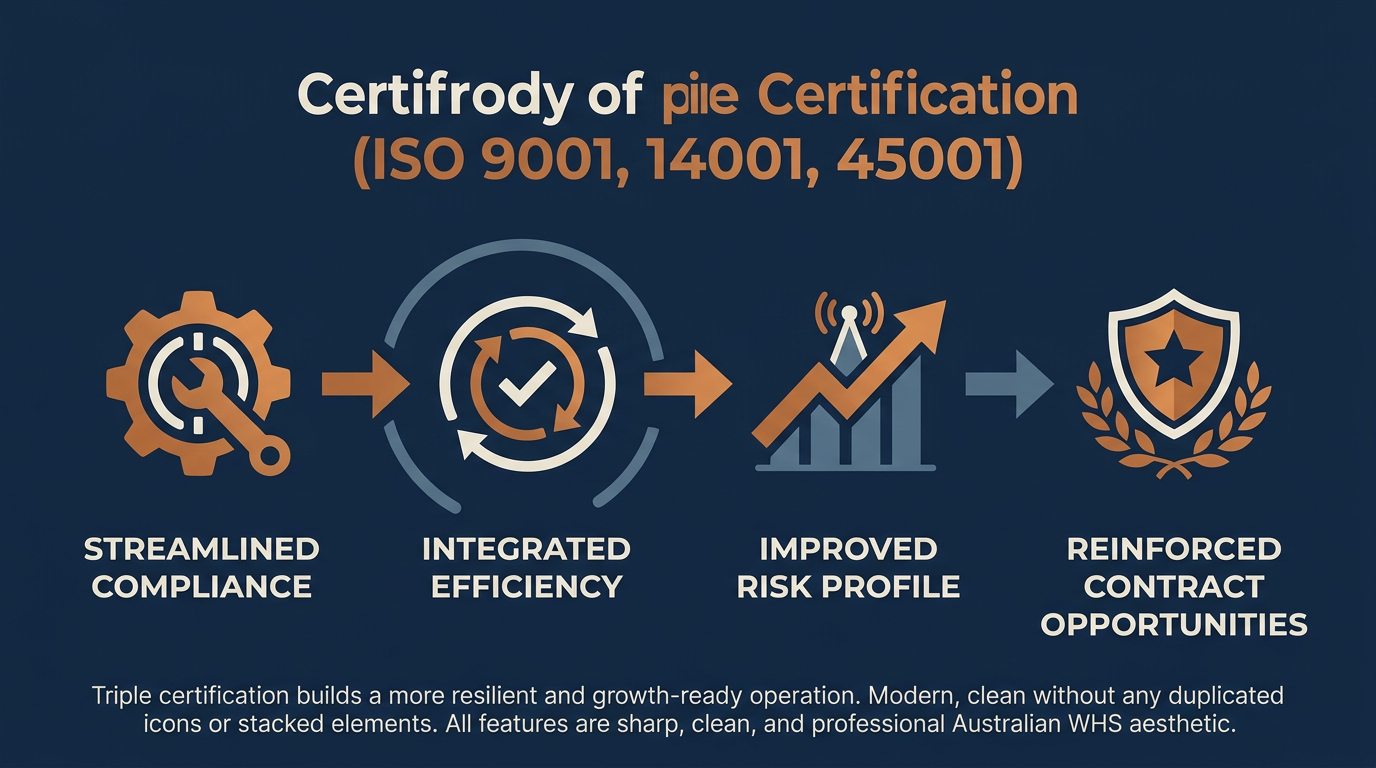
Pursuing ISO 9001 certification in Australia alongside ISO 14001 and ISO 45001 supports tender readiness and stakeholder confidence.

Many procurement processes value demonstrable management maturity across quality, environment and safety.
Achieving triple certification shows the business manages quality, health and safety, and environmental impacts together.
It demonstrates systems thinking across people, planet and product delivery.
Reduced Audit Fatigue
Separate systems commonly cause multiple audits and repeated site interruptions.
An IMS lets auditors assess requirements for all three standards in one programme, which reduces audit days overall.
Document Control and Resource Management
Clause 7 and Clause 8 cover support and operation requirements across the standards.

Most businesses need only one document control process and one competence framework to satisfy all three standards.
If you are a contractor in Australia, you likely use a single induction process for staff and visitors.
That induction can cover safety rules, environmental spills and quality requirements at the same time.
Unified Internal Audits
Clause 9 requires internal auditing to ensure the system works.
Perform internal audits for all three standards simultaneously using a single audit checklist.
Use integrated checklists that link clauses to evidence items, such as maintenance records, chemical storage arrangements and PPE checks.
This approach gives a complete snapshot of site compliance in one audit report.
Managing Continuous Improvement
Clause 10 focuses on non-conformance and corrective actions across ISO 9001, 14001 and 45001.
Use a single Corrective Action Report (CAR) to capture customer complaints, near-misses and environmental incidents.
Centralising corrective actions ensures management sees all issues in one database.
That data helps prioritise systemic improvements across quality, environment and safety.
Steps to Map Your Documents
Start by creating a Cross-Reference Matrix that lists each clause from the three standards side by side.
Map each clause to the document or record that provides evidence of compliance.
Identify where you have three different procedures for the same task, such as document control or management review.
Merge redundant files into one clear version that uses consistent terminology for all standards.
Ensure new documents explicitly reference the clause numbers and the evidence required for each standard.
This evidence-led phrasing helps auditors and the certification body trace compliance quickly.
Always consult your team during the mapping process to keep the IMS practical for daily work across Australia.
Their feedback ensures the system is usable and aligned with operational realities.
Common Questions (PAA)
How do I prove one document meets Clauses 4–10 for all three standards?
Answer: Use a Cross-Reference Matrix that maps each clause to your single document and to objective evidence.
Can audits be combined for ISO 9001, 14001 and 45001?
Answer: Yes. Auditors can review integrated processes and evidence in one audit programme when an IMS is in place.
How do you keep clause-specific technical requirements visible in a merged document?
Answer: Include clause annotations and an annex that lists clause-specific expectations and the evidence location.
Want a quick checklist to start mapping common clauses?
Answer: Begin with clauses 4 to 10, list current documents, and mark where duplication occurs.
Need a hand?
Spire Safety works as ISO certification consultants for Australian businesses, from gap analysis to certification and surveillance audits. Get in touch to talk it through.
FAQ
Frequently asked questions
01What is the High-Level Structure (HLS) in ISO standards?
02How long does it typically take to achieve integrated ISO 9001, 14001, and 45001 certification in Australia?
03What are the common challenges when implementing an Integrated Management System (IMS)?
04Can ISO 27001 (Information Security) also be integrated with ISO 9001, 14001, and 45001?
05What kind of documentation reduction can an Australian company expect with an IMS?
Share this article
Get Expert Advice
Speak with a certified WHS consultant about your workplace.
Contact Usor call 1300 891 503