
ISO Certification Readiness & Maintenance in Australia (2026 Guide)
Achieving ISO certification is a major milestone for any business in Australia, demonstrating commitment to global standards. This guide covers readiness, maintenance, and audit preparation.

Achieving ISO certification is a major milestone for any business in Australia.
It demonstrates a commitment to global standards and builds significant trust with clients and stakeholders.
TLDR
- Preparation starts with a gap analysis to identify missing compliance elements.
- Staff engagement is critical for the long-term success of any management system.
- Internal audits are required regularly to ensure the system remains effective.
- Ongoing maintenance prevents non-conformances during official surveillance audits.
Understanding ISO Certification Readiness in Australia
Getting ready for an initial audit requires a structured approach to your current business processes.
Most organisations begin by selecting the relevant standard, such as ISO 9001 for quality or ISO 45001 for safety.
Verification of your current standing is the first practical step.
This process helps you understand where your existing documented procedures meet the standard and where they fall short.
Using a professional WHS consultant cost in Australia as a benchmark helps you budget for expert guidance during this phase.
Consultants typically charge day rates in the range reported for the market and bring experienced audit capability to your gap analysis.
Prepare your team by ensuring they understand their specific roles within the new system.
Readiness is not just about paperwork; it is about how your people follow processes every day.
Building an Effective ISO Management System
A robust system must be tailored to the specific operational needs of your business.
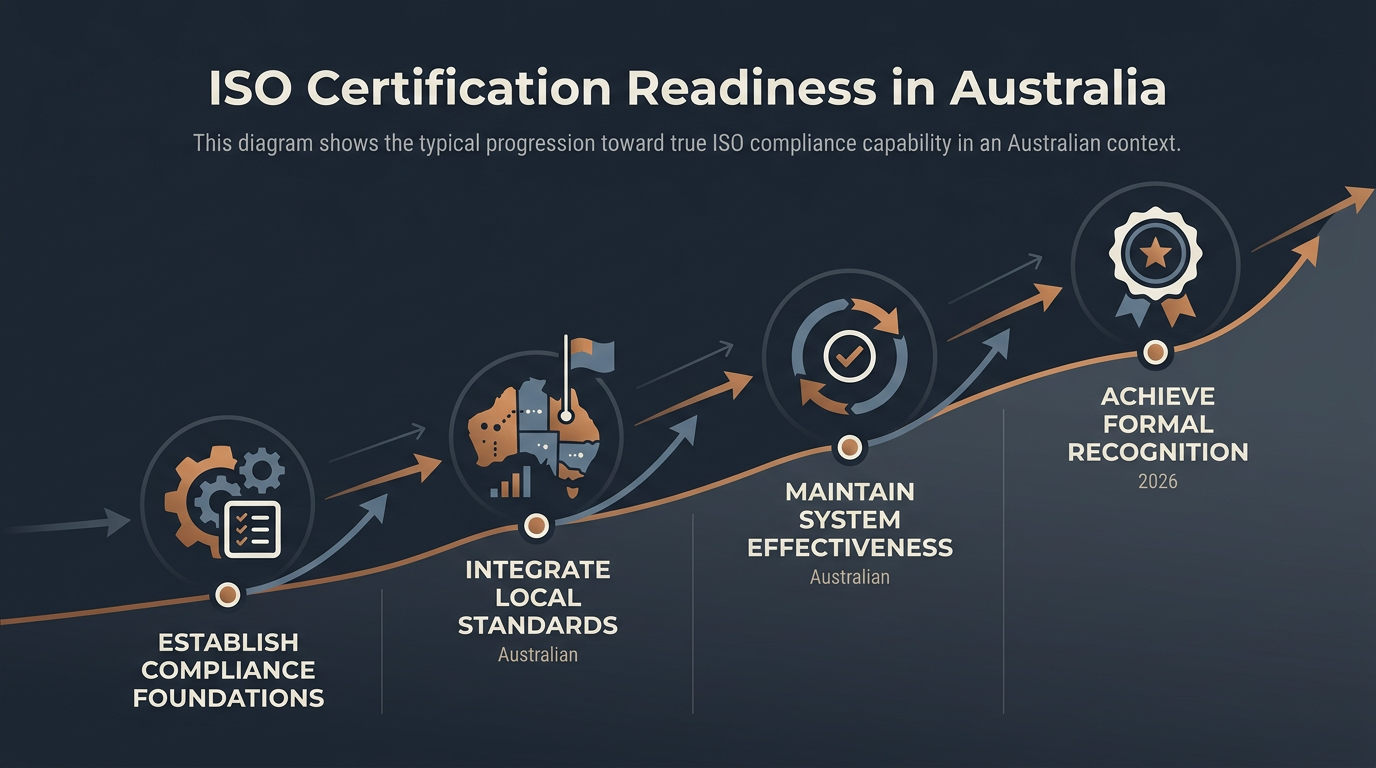
Standardised templates can help, but they must reflect how your work is actually performed on-site.
For businesses managing multiple standards, an Integrated Management System can streamline documentation significantly.
This approach reduces duplication by combining common elements like document control and management reviews.
Your system should include clear policies and procedures that address the requirements of your chosen ISO standard.
It should also establish measurable objectives to track performance throughout the year.
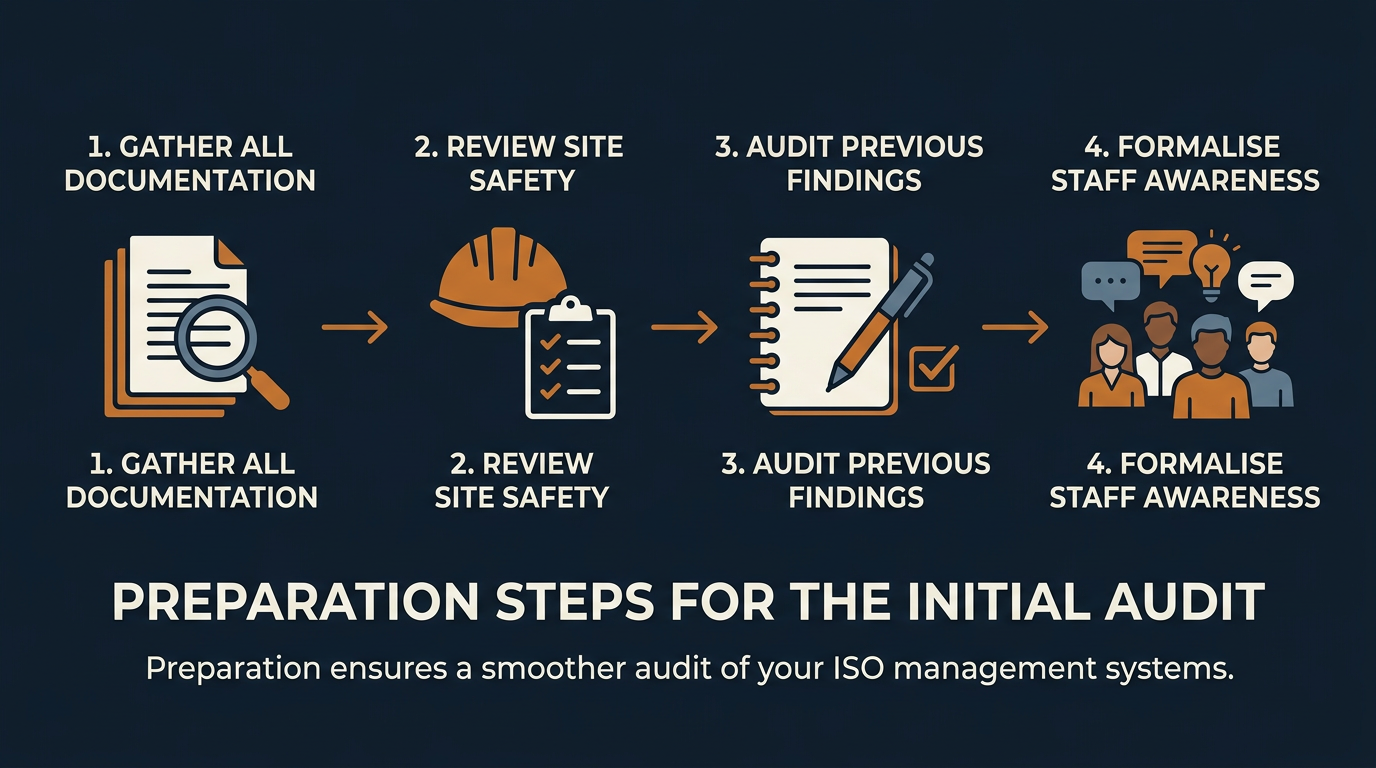
Preparation Steps for the Initial Audit
The certification process generally involves a two-stage audit by a third-party body.

Stage one is a document review to ensure your system is designed correctly.
Stage two is an on-site assessment where the auditor looks for evidence that you are following your own procedures.
You will need to show records of training, risk assessments, and incident reports.
Maintaining high standards in PPE Compliance in Australia is a common area of focus during safety audits.
Auditors will check if employees are correctly using safety gear as mandated by your system.
If the auditor finds any gaps, they will issue a non-conformance report.
You must address these issues within a set timeframe to secure your certification.
The Role of Internal Auditing
You cannot rely solely on the external auditor to find problems.
Internal audits are a mandatory requirement of all ISO standards in 2026.
These audits must be conducted by someone independent of the specific area being checked.
They provide an objective view of how well your management system is functioning before the "real" audit occurs.
If you lack internal resources, you can engage WHS consultants to conduct these reviews for you.
They bring a fresh perspective and professional auditing experience to the process.
Maintaining Your ISO Certification Across Australia
Certification is not a one-time event but a three-year cycle.

After the initial certification, you will undergo annual surveillance audits to ensure continued compliance.
The most common mistake businesses make is letting their system "gather dust" between audits.
This often leads to a stressful rush of activity just weeks before the auditor returns.
Regularly updating your risk registers is essential for Fire Safety Compliance and other critical risk areas.
Risks change as your business grows or as you move into new work environments.
Continuous Improvement and Management Reviews
ISO standards are built on the "Plan-Do-Check-Act" cycle.
This means your organisation must look for ways to improve its processes constantly.
Management review meetings are the primary venue for this high-level analysis.
Senior leadership must review audit results, customer feedback, and process performance at least once a year.
During these meetings, you should also review your WHS inductions in Australia to ensure new staff are getting current information.
Updating your induction material ensures that the latest safety protocols are effectively communicated.
Document the minutes of these meetings carefully.
They serve as vital evidence for auditors that your leadership team is actively involved in the system.
Handling Changes and Notifiable Incidents
Operational changes can impact your certification status if they are not managed correctly.
This includes moving into new premises or introducing new machinery.
You should always conduct a change management assessment before making significant adjustments to your operations.
This ensures that any new risks are identified and controlled within your ISO framework.
Your system must also have clear protocols for reporting incident notifications in Australia to the relevant state regulator.
Auditors will check your incident logs to see if you are following legal reporting requirements.
Failure to report serious incidents can lead to the immediate suspension of your ISO certification.
It also exposes the business to significant legal risks and fines.
The Value of External Support and Surveillance
Keeping up with evolving standards can be challenging for busy management teams.
Professional ISO audit preparation services help ensure you stay ahead of regulatory shifts in 2026.
Ongoing support can involve quarterly check-ins or assistance with complex data analysis.
This ensures your records remain audit-ready at all times without overwhelming your internal staff.
By treating the ISO system as a living part of your business, you turn compliance into a competitive advantage.
It ensures your operations remain efficient, safe, and consistently high-quality across every project.
FAQ — Common questions about ISO certification readiness in Australia
How long does ISO certification typically take?
Most organisations can expect 3 to 12 months, with ISO 9001 implementations commonly taking 6–12 months and some startups taking 12–18 months depending on maturity (Source: smartqms.com.au).
What are typical costs for ISO certification in Australia?
Indicative costs vary by standard and organisation size; small-business first-year certification commonly sits between AUD 5,000 and AUD 15,000, while ISO 9001 estimates are often AUD 4,000–$15,000 (Source: smartqms.com.au; iso-27001.com.au).
Who accredits certification bodies in Australia?
Accredited certification bodies operate under JAS-ANZ oversight for applicable standards (Source: smartqms.com.au).
How often will we be audited after certification?
Surveillance audits are typically annual in years one and two, with full recertification in year three (Source: www.cyberpulse.com.au).
Can ISO certification reduce incidents and costs?
ISO 45001 certification has been shown to reduce workplace incidents materially, with industry sources indicating reductions in the order of 30% for some programmes (Source: isocertificationgroup.com.au).
For further support, consider an audit readiness gap analysis and a documented internal audit programme to maintain continuous compliance.
Need a hand?
Getting certified or staying certified is easier with support. Spire Safety provides ISO consulting for Australian businesses. Get in touch to talk it through.
FAQ
Frequently asked questions
01What is the typical timeframe for achieving ISO certification in Australia?
02How much does ISO certification usually cost for Australian businesses?
03What are the benefits of integrating multiple ISO management systems?
04What types of records are typically required during an ISO certification audit?
Share this article
Get Expert Advice
Speak with a certified WHS consultant about your workplace.
Contact Usor call 1300 891 503