
FREE Hay Rake SOP (Safe Operating Procedure) Template
Download our free Hay Rake SOP (Safe Operating Procedure) Template in Word and PDF format. Outline safe systems of work for hay rake use, aligned with AS45001:2018.
Download FREE Hay Rake SOP (Safe Operating Procedure) Template
DOCX + PDF
Updated Oct 2026
No signup required
By downloading you agree to our Free Resources Licensing Agreement.
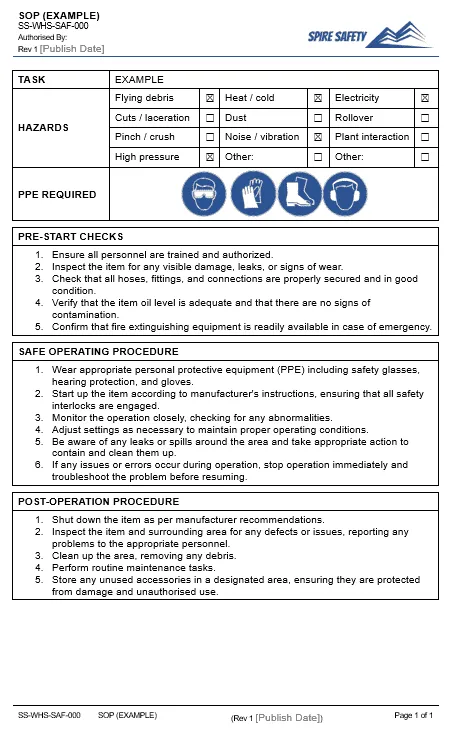
Download our free Hay Rake SOP Template:
*For internal use only. Not for resale or redistribution. By downloading, you agree to our Free Resources Licensing Agreement.
Purpose of a Hay Rake SOP
Hay rake SOPs outline a safe operating procedure for hay rake use. Hay rake SOPs can also be used as a training and induction document. The primary goal is to protect workers from injury or illness by outlining a safe system of work and providing adequate training and instruction. This form is broadly aligned with AS45001:2018.
How to Use
Hay rake SOPs should be communicated to workers before they complete the task. A hard copy can also be displayed in the workplace or provided at the workface. You can also use hay rake SOPs during the induction or onboarding process.
NOTE: This document is a template only and it must be customised for your business. Other aspects that need to be considered include, but are not limited to, ensuring that:
- Relevant legal requirements have been met,
- Workplace specific risks are identified and managed, and
- Workers are consulted with during the customisation / review process.
When to Use
Workers should read and agree to comply with hay rake SOPs prior to operation within your business. They can also be used for refresher training periodically.
Who Should Use
Hay rake SOPs should be developed by a competent person. The SOP is then read and followed by the worker completing the task. New workers should also read and understand the SOPs during the induction or onboarding process.
Legal Considerations
There is no specific legal requirement to have a documented Safe Operating Procedure (SOP). However, it is best practice, as having SOPs can assist in meeting general legal duties, including:
- s(19)(3)c WHS Act – Duty to Provide Safe Systems of Work
- s(19)(3)d WHS Act – Duty to Ensure Safe Use of Plant
- s(19)(3)f WHS Act – Duty to Provide Adequate Information, Training, Instruction and Supervision
- s(39) WHS Regulations – Duty to Provide Adequate Information, Training and Instruction
- s(203) WHS Regulations – Management of Risks to Health and Safety (PCBUs with management or control of plant)
The Code of Practice "Managing risks of plant in the workplace" states that employers (PCBUs) must provide workers with information, training, and instruction as necessary to protect them from risks arising from the use of the plant.
FAQ's
What is a hay rake?
A hay rake is a mechanical tool used in agriculture for collecting cut hay or straw into windrows for later collection and turning over the cut material to help with drying.
What is a hay rake used for?
Hay rakes are used to gather loose hay into rows, turn hay for drying, and fluff up the hay, which enhances the drying process and results in better preserved forage.
What hazards are involved in hay rake use?
Some hazards that are involved in hay rake use include:
- Entanglement
- Punctures
- Lacerations
- Overturns
- Collisions
What are some safety controls that can be utilised during hay rake use?
Some safety controls that can be utilised include:
- Installing guards and shields
- Operator training
- Signalling
- Regular maintenance
Did you know?
Early hay rakes were simple, hand-operated tools, but the mechanical versions that followed, such as the side-delivery rake, allowed for faster, more efficient operation. Today, innovative hay rakes are designed to be gentler on the crop to retain more leaves (nutritious parts) and are adjustable to fit different windrow sizes.
Article Sources and Further Reading
Legal references
Legal considerations
The following legal requirements may be relevant to this type of work.
- Work Health and Safety Act (Harmonised) — Provides the primary duties for protecting workers and other people from work health and safety risks.
- Work Health and Safety Regulations (Harmonised) — Sets out requirements supporting the management of workplace hazards and risks.
The following codes may be relevant to this type of work.
- Managing WHS Risks Code of Practice — Provides practical guidance on identifying hazards, assessing risks and applying effective controls.
- Work Health and Safety Consultation, Cooperation and Coordination Code of Practice — Provides practical guidance on consulting workers and coordinating with other duty holders.
- Managing the Work Environment and Facilities Code of Practice — Provides practical guidance on safe work environments, workplace facilities and related controls.
Share this resource
Browse Categories
How To Use It
- 1Download and open in Word or PDF.
- 2Replace the placeholders with your business details.
- 3Get it reviewed by a WHS specialist before rollout.
Need it customised?
Our WHS consultants can adapt this template to your site, run a gap analysis, or audit what you already have in place.
Book a Free Consultation WHS consulting servicesor call 1300 156 382
Related templates
- FREE Hay Tedder SOP (Safe Operating Procedure) Template
- FREE HDPE Butt Fusion SOP (Safe Operating Procedure) Template
- Free Heat Gun SOP (Safe Operating Procedure) Template
- FREE Heavy Combination Truck SOP (Safe Operating Procedure) Template
- FREE Hydraulic Press SOP (Safe Operating Procedure) Template
- FREE Injection Molding Machine SOP (Safe Operating Procedure) Template