
FREE Telehandler SOP (Safe Operating Procedure) Template
Download our free Telehandler SOP Template in Word and PDF format. Safe Operating Procedure for telehandler use, aligned with AS45001:2018.
Download FREE Telehandler SOP (Safe Operating Procedure) Template
DOCX + PDF
Updated Oct 2026
No signup required
By downloading you agree to our Free Resources Licensing Agreement.
Download our free Telehandler SOP Template:
*For internal use only. Not for resale or redistribution. By downloading, you agree to our Free Resources Licensing Agreement.
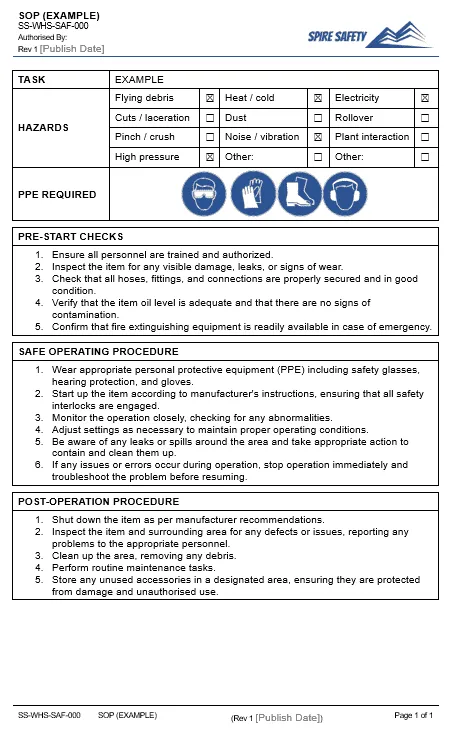
Preview of the Telehandler SOP template — covering purpose, scope, responsibilities, pre-operation checks, the safe operating procedure, post-operation tasks and key hazards for telehandler use.
Purpose of a Telehandler SOP
Telehandler SOPs outline a safe operating procedure for telehandler use. Telehandler SOPs can also be used as a training and induction document. The primary goal is to protect workers from injury or illness by outlining a safe system of work and providing adequate training and instruction. This form is broadly aligned with AS45001:2018.
How to Use
Telehandler SOPs should be communicated to workers before they complete the task. A hard copy can also be displayed in the workplace or provided at the workface. You can also use telehandler SOPs during the induction or onboarding process.
NOTE: This document is a template only and it must be customised for your business. Other aspects that need to be considered include, but are not limited to, ensuring that:
Relevant legal requirements have been met,
Workplace specific risks are identified and managed, and
Workers are consulted with during the customisation / review process.
When to Use
Workers should read and agree to comply with telehandler SOPs prior to operation within your business. They can also be used for refresher training periodically.
Who Should Use
Telehandler SOPs should be developed by a competent person. The SOP is then read and followed by the worker completing the task. New workers should also read and understand the SOPs during the induction or onboarding process.
Legal Considerations
There is no specific legal requirement to have a documented Safe Operating Procedure (SOP). However, it is best practice, as having SOPs can assist in meeting general legal duties, including:
s(19)(3)c WHS Act – Duty to Provide Safe Systems of Work
s(19)(3)d WHS Act – Duty to Ensure Safe Use of Plant
s(19)(3)f WHS Act – Duty to Provide Adequate Information, Training, Instruction and Supervision
s(39) WHS Regulations – Duty to Provide Adequate Information, Training and Instruction
s(203) WHS Regulations – Management of Risks to Health and Safety (PCBUs with management or control of plant)
The Code of Practice "Managing risks of plant in the workplace" states that employers (PCBUs) must provide workers with information, training, and instruction as necessary to protect them from risks arising from the use of the plant.
FAQ
What is a telehandler?
A telehandler is a versatile piece of machinery that combines the lifting capability of a forklift with the reach and height of a crane. They are equipped with a telescopic boom that can extend forwards and upwards.
What is a telehandler used for?
Telehandlers are used for material handling, lifting, and placing loads in applications ranging from construction to agriculture, and they are particularly useful for tasks that require reach in both vertical and horizontal directions.
What hazards are involved in telehandler use?
Some hazards that are involved in telehandler use include:
Overturning
Collisions
Load drops
Falls
Crush risk
What are some safety controls that can be utilised during telehandler use?
Some safety controls that can be utilised include:
Trained operators
Limit loads
Routine checks
Safe maneuvers
Correct attachments
Site assessments
Did you know?
Telehandlers are known for their incredible adaptability, with the ability to switch between different types of attachments like buckets, winches, or forks in just a few minutes. This allows one telehandler to do the work of multiple machines, saving time and resources on job sites. Some telehandlers are even equipped with sophisticated computer systems that provide readouts of load weight and boom position to ensure safe operation within the machine's operational parameters. What's more, these machines have an extensive range of reach, with some models capable of extending over 30 feet horizontally and upwards of 60 feet.
Article Sources and Further Reading
Legal references
Legal considerations
The following legal requirements may be relevant to this type of work.
- Work Health and Safety Act (Harmonised) — Provides the primary duties for protecting workers and other people from work health and safety risks.
- Work Health and Safety Regulations (Harmonised) — Sets out requirements supporting the management of workplace hazards and risks.
The following codes may be relevant to this type of work.
- Managing WHS Risks Code of Practice — Provides practical guidance on identifying hazards, assessing risks and applying effective controls.
- Work Health and Safety Consultation, Cooperation and Coordination Code of Practice — Provides practical guidance on consulting workers and coordinating with other duty holders.
- Managing the Work Environment and Facilities Code of Practice — Provides practical guidance on safe work environments, workplace facilities and related controls.
Share this resource
Browse Categories
How To Use It
- 1Download and open in Word or PDF.
- 2Replace the placeholders with your business details.
- 3Get it reviewed by a WHS specialist before rollout.
Need it customised?
Our WHS consultants can adapt this template to your site, run a gap analysis, or audit what you already have in place.
Book a Free Consultation WHS consulting servicesor call 1300 156 382
Related templates
- Free Thresher SOP (Safe Operating Procedure) Template
- Free Tractor SOP (Safe Operating Procedure) Template
- FREE Trencher SOP (Safe Operating Procedure) Template
- FREE Vacuum Truck SOP (Safe Operating Procedure) Template
- FREE Water Truck SOP (Safe Operating Procedure) Template
- FREE Waterjet Cutter SOP (Safe Operating Procedure) Template