
ISO 45001 Leadership Commitment Evidence: What Good Looks Like in 2026
For organisations aiming for ISO certification, providing objective evidence of top management involvement is crucial. Auditors look for documented processes, not just vague concepts, to ensure

Auditors often find that organisations treat safety leadership as a vague concept rather than a documented process.
For businesses in Australia aiming for ISO certification, providing objective artefacts of top management involvement separates minor non-conformances from audit success.
TLDR
ISO 45001 requires top management to demonstrate active accountability rather than just delegating safety tasks.
Concrete artefacts like signed meeting minutes and approved WHS budgets are essential for audit success.
Auditors look for evidence of two-way communication between executives and frontline workers.
Leadership commitment must be visible through the integration of WHS into broader business strategies.
The Core Requirements of Clause 5
Clause 5 of the ISO 45001 standard places the responsibility for the health and safety management system squarely on top management.
This means directors and senior executives must prove they are personally involved in the system's success.
In the past, many leaders believed that hiring a safety manager was sufficient to satisfy compliance needs.
Under the current standard, auditors require documented evidence that leadership understands risks and supports the system with resources.
Top management must ensure the WHS policy and objectives are established and compatible with the strategic direction of the organisation.
They must also promote a culture that supports the intended outcomes of the management system.
For those transitioning from AS/NZS 4801, the shift toward proactive leadership involvement is one of the most significant changes to document.
Essential Artefacts for Demonstrating Commitment
Evidence of leadership commitment must be objective and verifiable during an audit.
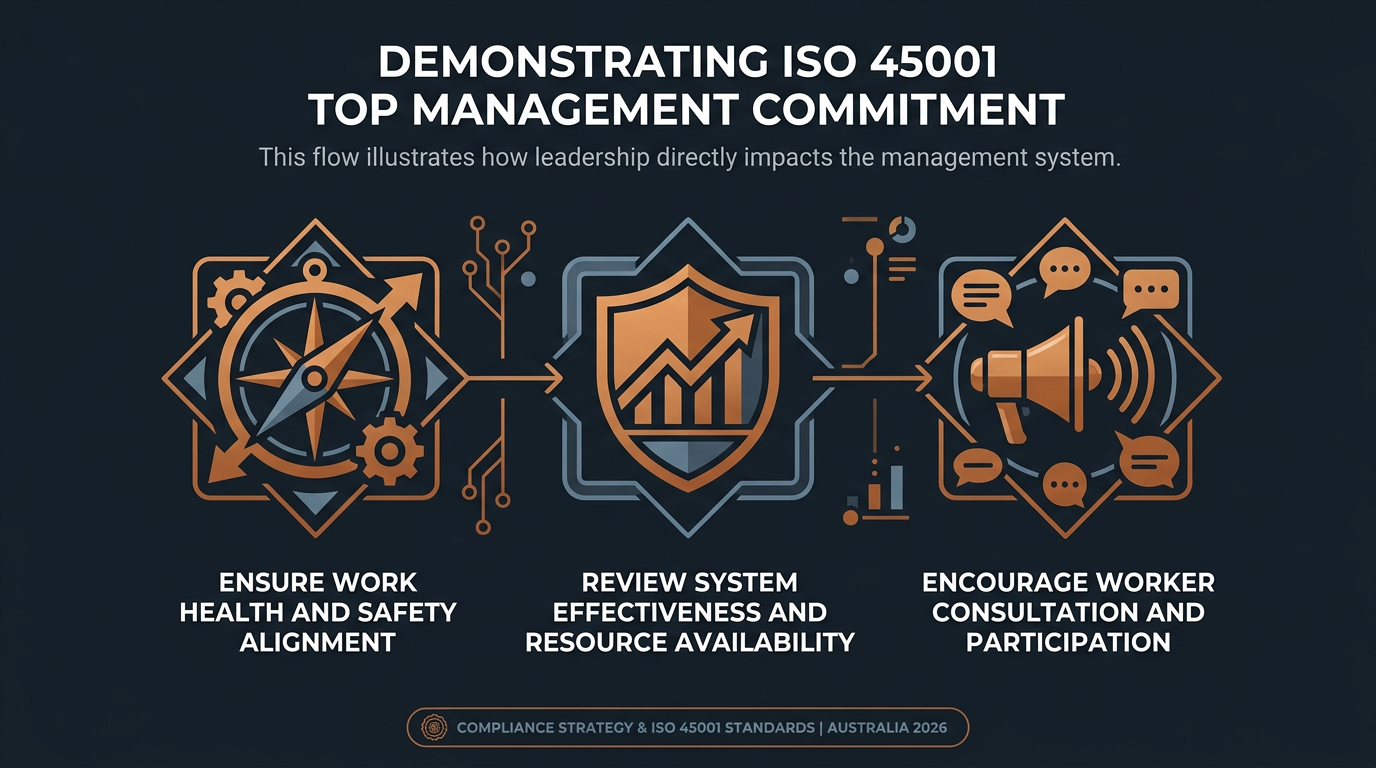
Visualising the core requirements of Clause 5 for ISO 45001 leadership commitment and worker participation.
Verbal assurances from a CEO are rarely enough to satisfy an auditor looking for ISO 45001 standards compliance across the business.
Signed Health and Safety Policies
A signed WHS policy is the most basic piece of evidence.
The policy should be reviewed annually and signed by the current most senior person in the organisation.
It should not be a generic template found online.
It must reflect the specific risks and nature of the work performed by the company.
WHS Budget Approvals
Financial commitment is a primary indicator of genuine leadership support.
Auditors may ask to see evidence of approved expenditure for safety equipment, professional consulting, or software.
Documented approval for a new ventilation system or high-quality personal protective equipment (PPE) serves as a strong artefact.
This shows that management prioritises worker safety over simple cost-cutting.
Meeting Minutes and Attendance Logs
Attendance records for WHS committee meetings are vital.
If the Managing Director is listed as an attendee in the minutes, it shows safety is a priority at the highest level.
These minutes should record actual contributions from management.
This includes decisions made on hazard controls or reviews of incident investigation reports.
Effective Communication and Worker Participation
Leadership commitment is not just about giving orders from an office.

Evidence of WHS leadership commitment via seamless integration into daily business processes.
It involves creating a two-way street where workers feel safe to report hazards without fear of reprisal.
Executives should be seen participating in site walks or "safety chats" on the floor.
Documenting these interactions through a simple log or digital entry provides excellent leadership commitment evidence for auditors.
Toolbox talks with documented attendance and topics discussed are a concrete artefact auditors expect to see.
Records should show who ran the toolbox talk and evidence of management attendance or follow-up actions.
When leaders engage in these activities, they gain a better understanding of the practical challenges workers face daily.
This helps in defining safety leadership as a collaborative effort rather than a top-down mandate.
Auditors may interview workers to verify if management is approachable.
If workers report that they never see the directors on-site, the written documentation may be viewed with scepticism.
Integration into Business Processes
A common failure in management systems is treating safety as a standalone department.

Key artefacts showcasing demonstrable ISO 45001 leadership commitment and WHS top management involvement.
ISO 45001 requires that WHS is integrated into all business functions, from procurement to project planning.
Evidence of this integration can be found in high-level business plans.
If WHS performance indicators are included in the same reports as financial targets, it demonstrates true alignment.
When integrating ISO 9001 + 14001 and 45001, leaders can streamline their reporting.
This ensures that quality, environment, and safety are managed through a unified corporate strategy.
Evidence of Resource Allocation
Top management must ensure the availability of resources necessary to establish, implement, and maintain the management system.
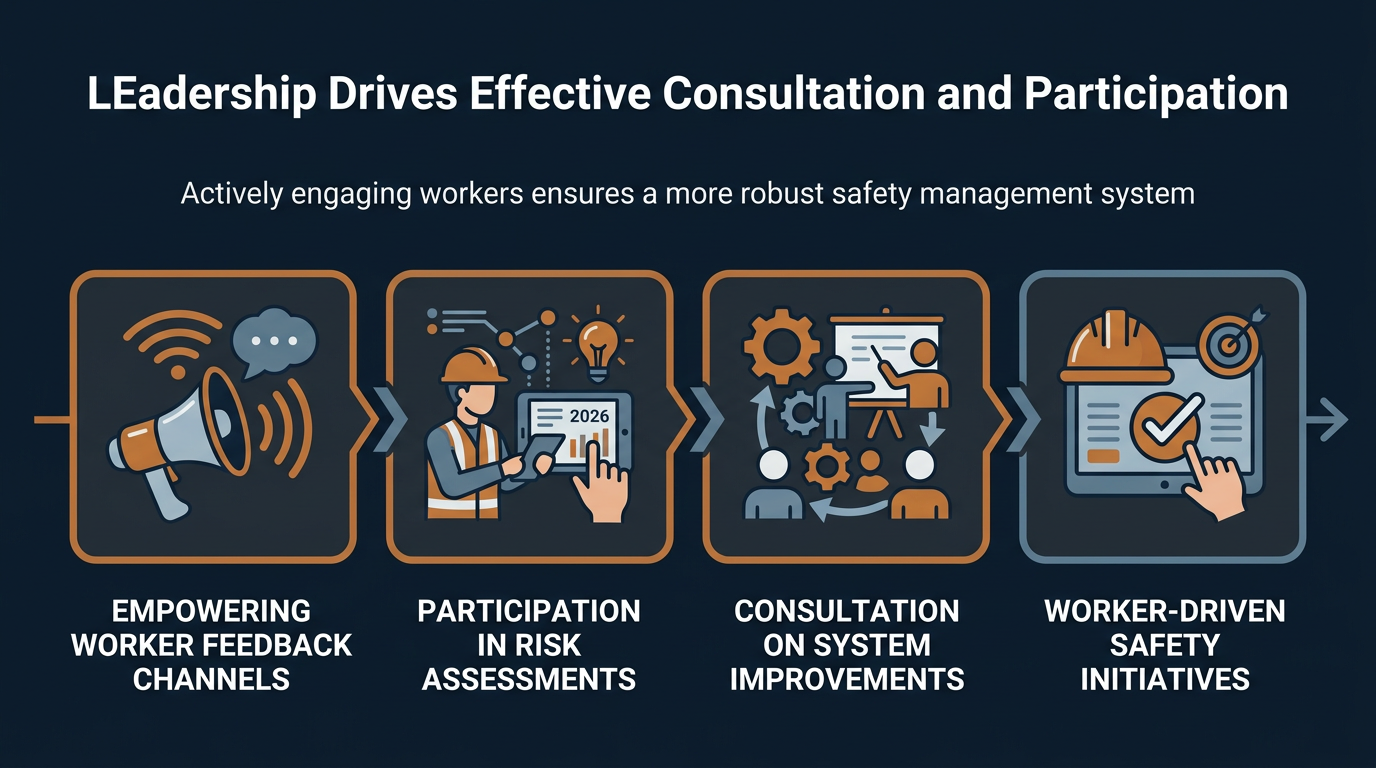
Effective communication is key to demonstrating ISO 45001 leadership and fostering worker participation.
Resources include human resources, specialised skills, technology, and financial backing.
Evidence of this can include the organisational chart.
This should clearly show dedicated roles for WHS or the appointment of external consultants across Australia to provide technical advice.
Training records for managers also serve as evidence.
If senior staff attend workshops on WHS obligations under the WHS Act 2011, it proves they are taking their legal duties seriously.
Reviewing System Performance
The Management Review meeting is the pinnacle of clause 5 evidence.
This is a formal session where top management reviews the entire system to ensure its ongoing suitability and effectiveness.
The output of this meeting must be documented.
The records should show that leaders have analysed incident trends, audit results, and feedback from workers.
Strategic decisions made during these reviews, such as investing in new technology to mitigate a recurring risk, are powerful artefacts.
These decisions prove that management is using the data to drive continuous improvement.
For leaders looking for safety leadership strategies for management, focusing on these review outputs is the best way to ensure the system remains relevant.
Checklist for Audit Readiness
To ensure your organisation is ready for an audit in 2026, verify the following artefacts are current and accessible.
Current WHS Policy signed by the CEO or Managing Director.
Approved budget items specifically allocated for safety improvements.
Minutes from board meetings where safety performance was an agenda item.
Reports from site inspections conducted or led by senior managers.
Documented responses to worker suggestions for safety improvements.
Signed Management Review minutes with clear action items and deadlines.
Having these documents organised and readily available demonstrates a level of professional rigour that auditors appreciate.
It moves the conversation from "what we intend to do" to "what we are actually doing."
FAQ
Frequently asked questions
01What are the common pitfalls organisations face when trying to demonstrate ISO 45001 leadership commitment?
02How can small to medium enterprises (SMEs) effectively demonstrate leadership commitment without extensive resources?
03Beyond signed policies and budget approvals, what other 'soft' evidence might an auditor look for regarding leadership involvement?
04What is the role of worker participation in demonstrating top management's commitment to ISO 45001?
Share this article
Get Expert Advice
Speak with a certified WHS consultant about your workplace.
Contact Usor call 1300 891 503