
Management Review Meetings That Actually Satisfy ISO Clause 9.3
Management review meetings are often viewed as a bureaucratic hurdle rather than a strategic tool. When structured correctly, these sessions ensure your leadership team remains accountable for the

Management review meetings are often viewed as a bureaucratic hurdle rather than a strategic tool.
When structured correctly, these sessions ensure your leadership team remains accountable for the performance and direction of your management systems.
For businesses in Australia, satisfying the strict requirements of Clause 9.3 is essential for maintaining ISO certification and driving operational improvement.
A robust review process proves to your certification body that your system is suitable, adequate, and effective.
TLDR
Management reviews must be conducted at planned intervals to meet ISO 9.3 compliance.
The agenda must cover specific inputs including audit results, customer feedback, and process performance.
Outputs must include actionable decisions regarding resources, system changes, and improvement opportunities.
Detailed minutes serve as the primary evidence during external certification audits.
Understanding ISO 9.3 Compliance for Leadership
Clause 9.3 requires top management to review the organisation's management system at regular intervals.
This is not a simple "catch-up" meeting but a formal evaluation of the system's health.
Leadership must determine if the current system supports the strategic direction of the company.
In 2026, auditors look for genuine engagement from senior managers rather than a "box-ticking" exercise led solely by a compliance officer.
Successful firms across Australia use these meetings to align safety, quality, and environmental goals with commercial objectives.
This ensures the management system remains a functional part of the business rather than a separate administrative burden.
Effective safety leadership strategies start with management taking full ownership of these periodic reviews.
Without this high-level oversight, systems often stagnate and fail to address emerging operational risks.
Standard ISO Management Review Agenda
To satisfy a certification auditor, your agenda must mirror the requirements outlined in the standards.
Using a structured ISO management review agenda ensures you do not miss mandatory discussion points.
A compliant agenda should follow this sequence:
Review of actions from previous management reviews.
Changes in external and internal issues relevant to the management system.
Information on performance and effectiveness, including trends in non-conformities.
Feedback from interested parties and customer satisfaction levels.
Extent to which objectives and targets have been met.
Process performance and conformity of products or services.
Adequacy of resources required for maintaining the system.
Effectiveness of actions taken to address risks and opportunities.
Organisations often find that a safety management system overhaul is necessary if their current agenda fails to cover these points.
If you cannot prove these topics were discussed, the auditor may issue a non-conformance.
Mandatory Management Review Inputs
The "inputs" are the data points and reports that management must analyse during the meeting.

A comprehensive ISO Management Review Agenda covering key inputs and outputs for WHS and environmental compliance.
You cannot have a compliant review without reviewing specific evidence from the preceding period.
WHS management review inputs should include incident statistics, workers' compensation data, and results from site inspections.
For quality systems, include supplier performance data and product defect rates.
Auditors expect to see an analysis of trends rather than just raw data.
For example, knowing you had ten incidents is less valuable than knowing those incidents all relate to a specific site in Sydney.
Include highlights from internal audit checklists, customer escalations, supplier non-conformances, and context issues like new legislation or market changes.
These inputs show the certification body you considered internal and external context during the review. (Source: qualityassure.com.au)
Reviewing your workplace health and safety data allows management to allocate budget where it is most needed.
This data-driven approach is a core requirement of the ISO 45001 and ISO 9001 standards.
Generating Compliant Outputs
The outputs of your review are the decisions and actions resulting from the discussion.
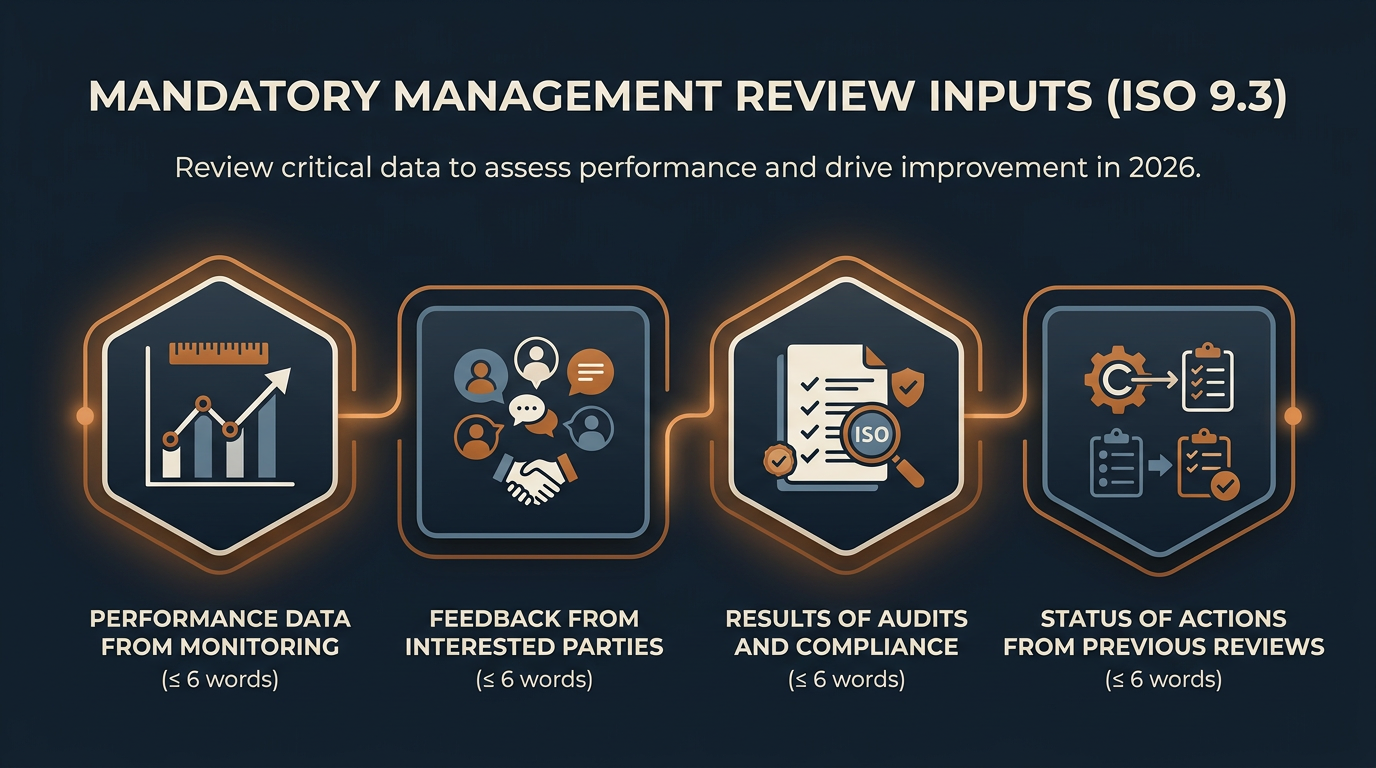
Key inputs required for an effective ISO management review meeting, ensuring compliance.
These must be documented clearly to demonstrate ISO 9.3 compliance during your next audit.
Outputs must specifically address opportunities for improvement and any need for changes to the management system.
If a process is underperforming, the minutes must record the decision made to rectify it.
Every output must have an action owner, a deadline, and a verification step to demonstrate follow-through.
Certification bodies expect this level of clarity. (Source: www.9001simplified.com)
Management must also address resource needs, such as new equipment, additional personnel, or specialised software.
A review that results in "no actions required" is often viewed with suspicion by experienced auditors.
For companies using an integrated management system, these outputs should cover quality, safety, and environmental concerns simultaneously.
This streamlined approach prevents duplication of effort and ensures all risks are managed under one framework.
Documenting the Meeting Minutes
Evidence is everything in the world of ISO certification.

Ensuring your management review outputs meet ISO 9.3 compliance and WHS requirements.
Your minutes must serve as a stand-alone record that proves every agenda item was discussed and evaluated.
Avoid brief notes like "discussed audit results."
Instead, write decision-ready summaries such as "reviewed three minor non-conformities from the October internal audit; corrective actions verified closed by 15 Nov; owner: Safety Manager." (Source: qualityassure.com.au)
The minutes should clearly state who attended the meeting to prove that top management was present.
If the Managing Director or CEO is absent, the review may not meet the standard's definition of leadership involvement. (Source: www.9001simplified.com)
Referencing WHS management systems auditing protocols can help you understand exactly what level of detail an auditor expects.
Proper documentation protects the business by demonstrating a commitment to continuous improvement.
Timing and Frequency of Reviews
The standards do not specify a fixed timeframe, but they do require planned intervals.
Most Australian businesses conduct a full environmental management review or quality review at least annually.
High-risk industries or rapidly growing companies may benefit from quarterly reviews.
This allows leadership to respond more quickly to changes in the market or new regulatory requirements.
If your business undergoes significant structural changes, you should trigger an unscheduled management review.
This ensures the management system remains suitable for the new organisational structure.
Consistency is more important than frequency.
If your internal policy states reviews happen every six months, you must stick to that schedule to remain compliant.
Linking Review Outcomes to Continuous Improvement
The ultimate goal of Clause 9.3 is to drive the Plan-Do-Check-Act cycle.
The management review represents the "Check" and "Act" phases of this loop.
When management identifies a gap during the review, it must lead to a formal improvement project.
This might involve updating a principal mining hazard management plan or investing in new staff training.
Auditors look for a clear link between the review minutes and the subsequent improvement register.
If the management review identifies a lack of resources, the auditor will check if those resources were actually provided.
This closed-loop system ensures that the management review is a catalyst for growth.
It moves the management system from a static set of documents to a living, breathing part of the business operations.
Practical checklist for certifiers: inputs and outputs they want to see
Inputs: internal audit highlights, incident trends, customer feedback, supplier issues, legal changes, KPIs tied to objectives, and risk-register updates.
Outputs: updated objectives and targets, approved budget changes, assigned owners, deadlines, verification steps, and an action register with status updates.
Frequently asked (quick answers)
What is the minimum frequency for management reviews?
There is no minimum. Use planned intervals.
Many organisations opt for quarterly or semi-annual reviews. (Source: www.9001simplified.com)
What evidence will a certification body check?
They will check meeting minutes, action logs, attendance lists showing top management, and evidence that outputs were implemented and verified. (Source: www.9001simplified.com)
How many KPIs should I bring to the review?
Aim for 6–10 KPIs tied to objectives and decision-making. Decision-ready summaries beat raw data. (Source: qualityassure.com.au)
How do I avoid common nonconformities?
Ensure minutes are descriptive, include owners and deadlines, and cover all required inputs. Avoid vague statements and data dumps. (Source: www.9001simplified.com)
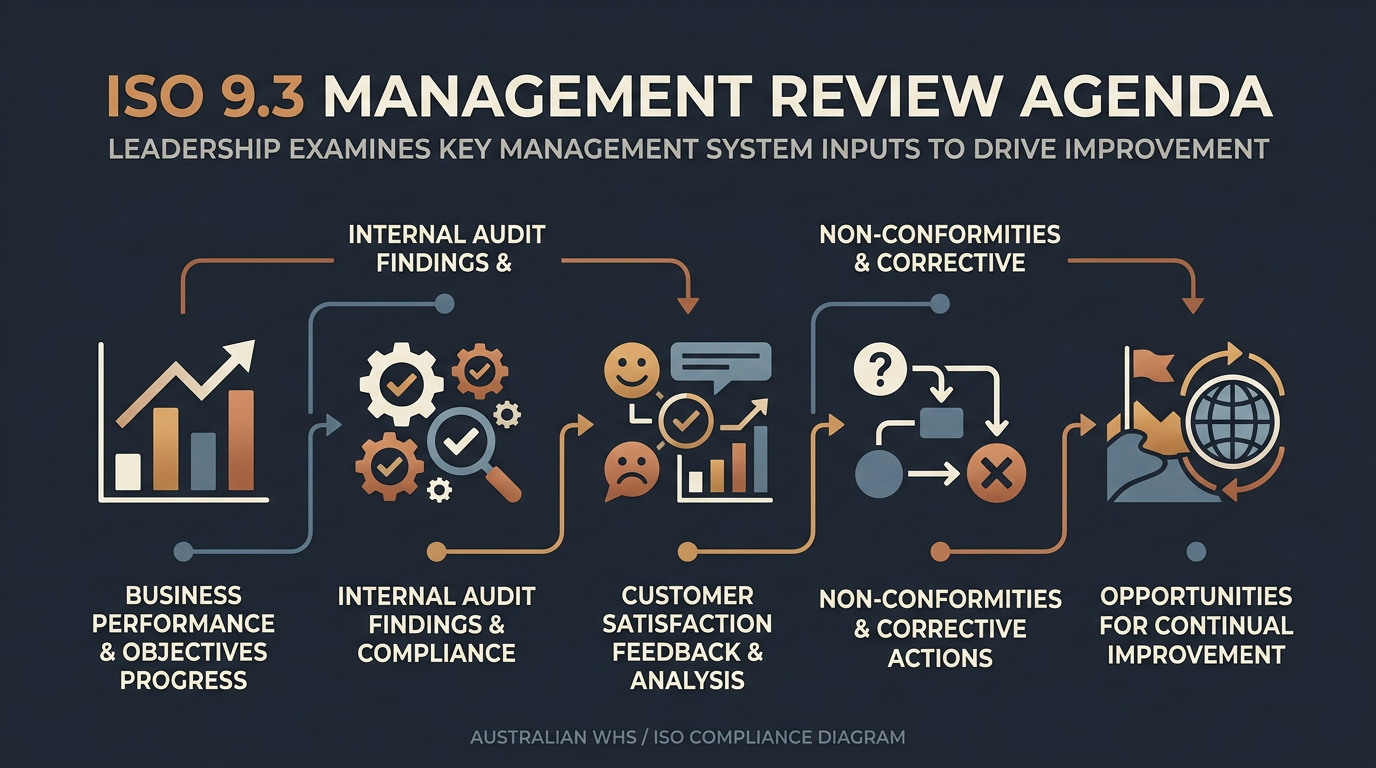
Key elements of ISO 9.3 compliance, covering leadership's role in management review meetings and system effectiveness.
FAQ
Frequently asked questions
01How often should ISO management review meetings be held to ensure compliance?
02Can virtual meetings be used for ISO management reviews, and what are the documentation requirements?
03What are the common pitfalls Australian businesses face when conducting ISO management reviews?
04Beyond compliance, what are the strategic benefits of a well-executed management review?
05What is the expected output from an ISO management review meeting?
Share this article
Get Expert Advice
Speak with a certified WHS consultant about your workplace.
Contact Usor call 1300 891 503