
Project-based vs Retainer WHS Consulting: Which Suits Your Business's Cashflow
Choosing between project-based and retainer WHS consulting significantly impacts your business's cashflow and risk management. This guide explores which model provides the best financial and safety

Managing workplace health and safety (WHS) involves balancing legal risk with the practical constraints of your monthly cash flow.
Choosing the wrong engagement model can create unexpected lump-sum expenses or leave you paying for a subscription you do not fully use.
TLDR
Project-based WHS consulting offers fixed costs for specific outcomes like system builds or audits.
Retainer models provide predictable monthly cash flow and ongoing legal risk coverage.
High-risk industries benefit from the consistent oversight of a retained safety advisor.
Businesses with stable systems may prefer project-based engagements for periodic compliance checks.
The Financial Logic of Project-Based Engagements
Project-based consulting works best when you have a clearly defined beginning and end to a safety objective.
This model lets businesses treat WHS improvements as a capital expenditure rather than an ongoing operational cost.
You pay for a specific deliverable such as the creation of a Safety Management System or a comprehensive site audit.
This suits businesses that have internal capacity to maintain systems once they are built.
Many companies choose this route when they begin their compliance journey because it clarifies the initial cost exposure.
Project fees for diagnostic reviews commonly range from $5,000 to $15,000, which helps with budgeting for a single scope of work (Source: sbaas.com.au).
Project fees are often fixed and protect your business from scope creep and hourly billing surprises.
However, the downside is safety decay when systems become outdated after the consultant leaves the site.
Retainers: Predictable Cashflow and Risk Mitigation
A WHS retainer turns safety from a sporadic project into a steady operational heartbeat.
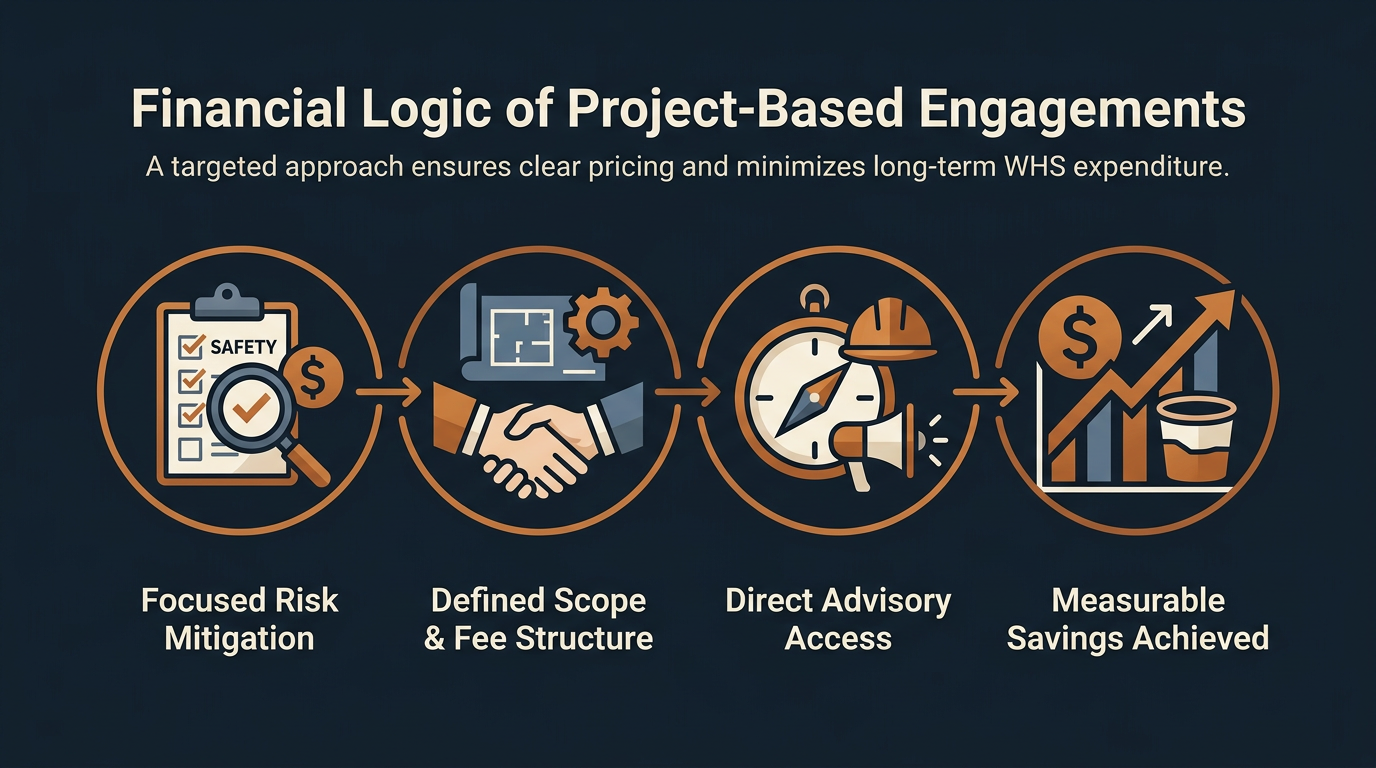
Understanding the financial benefits of project-based WHS consulting for Australian businesses.
You pay a set monthly fee for a guaranteed number of hours or specific recurring services.
This model appeals to businesses in high-risk sectors in Australia where safety requirements change frequently.
A retainer acts as a safety insurance policy by ensuring a qualified professional is available for urgent queries and incident response.
From a cash flow perspective, retainers smooth the peak-and-trough impact of compliance costs.
Instead of a single $15,000 bill for a new system, you might pay a smaller monthly amount for ongoing development and support.
Indicative retainer ranges in the market start around $2,000 to $4,000 per month for limited advisory access and $5,000 to $10,000+ per month for integrated support (Source: sbaas.com.au).
Retained advisors become familiar with your site culture and operational hazards.
This familiarity enables more nuanced advice than a one-off consultant can typically provide.
Choosing Based on Your Risk Profile
Low-risk environments such as professional services in a city often function well with project-based support and intermittent reviews.
They may only need a consultant once every two years to update documentation or perform a fire risk assessment.
By contrast, construction or manufacturing businesses across New South Wales face constant physical hazards and regulatory scrutiny.
For these firms, a project approach can create dangerous gaps in oversight between engagements.
If your industry has high staff turnover, a retainer ensures new employees have access to expert safety guidance.
Continuity is vital for maintaining a consistent safety culture and meeting due diligence obligations under Australian law.
Managing these ongoing risks through a WHS management system requires regular monitoring that project work cannot always provide.
A retained advisor can perform monthly inspections and attend safety committee meetings as part of a fixed fee.
Comparing the Total Cost of Ownership
When evaluating WHS advisor pricing, look beyond the immediate invoice to total cost over 12 months.

Secure predictable cash flow & mitigate risks with expert WHS consulting retainer services in Australia.
A project-based engagement might seem cheaper upfront but become expensive if you need follow-up support or emergency advice.
Retainer agreements often include value-add services such as emergency incident response or liaison with regulators.
If an incident occurs, having a consultant already on retainer can save thousands in emergency hourly rates.
Some businesses use a hybrid approach to manage their WHS support budget more effectively.
They engage a consultant for a large initial project and then transition to a low-tier retainer for maintenance.
Feature | Project-Based Model | Retainer Model |
|---|---|---|
Cashflow Impact | Large lump sums | Predictable monthly fees |
Risk Coverage | Point-in-time only | Continuous oversight |
Admin Burden | High (new contracts) | Low (ongoing) |
Flexibility | High for single tasks | High for urgent advice |
Meeting Compliance Deadlines across Australia
Project work is excellent for meeting hard deadlines such as an upcoming tender or a certification audit.
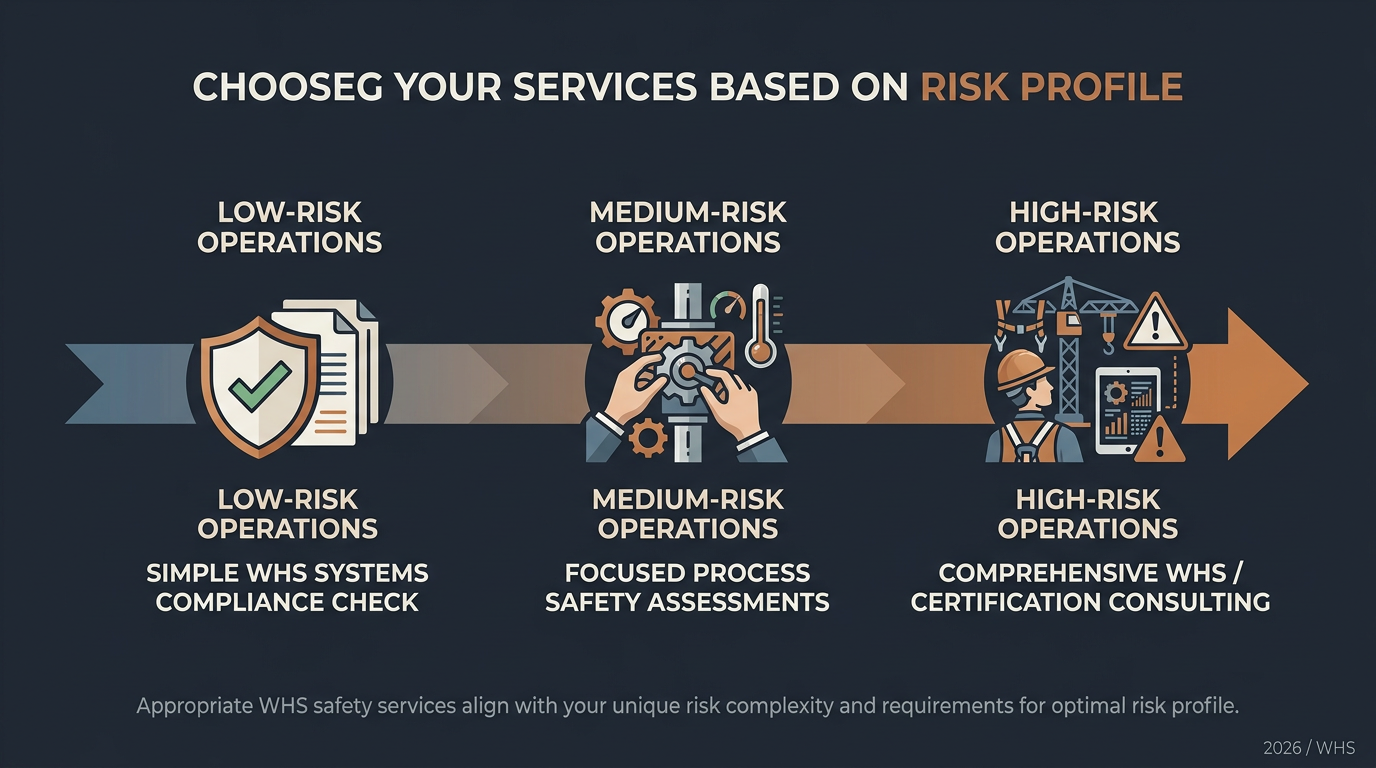
Tailoring WHS consulting costs in Australia to your specific business risk profile and budget.
If you need to achieve ISO 45001 certification by a certain date, a project manager can drive that specific outcome.
Many Australian businesses find the work does not end once the certificate is on the wall.
Maintaining international standards requires ongoing internal audits and management reviews.
A retainer ensures those tasks are scheduled and completed throughout the year.
This avoids the stressful compliance rush often seen before surveillance audits.
For businesses with multiple locations in Victoria, a retained consultant can provide consistent standards across all sites.
This prevents branches from developing their own potentially non-compliant ways of managing safety.
Leveraging Expertise for Specialised Tasks
Sometimes a business needs highly specific technical knowledge for a short duration.

Understand the true Total Cost of Ownership when budgeting for WHS consulting in Australia.
Project rates let you buy that expertise without longer-term commitment.
Typical experienced consultant hourly rates in the market commonly sit between $250 and $450 per hour, and small business consulting rates range from $100 to $500 per hour (Source: sbaas.com.au).
Daily consulting rates for experienced advisors commonly range from $2,000 to $4,000 per day (Source: sbaas.com.au).
You might engage a specialist to conduct noise monitoring or develop a Safe Work Method statement for a unique high-risk activity.
Once the technical report is delivered, the project is complete, and the financial commitment ends.
Many organisations find targeted specialists combined with a generalist retainer provides the best balance of cost and compliance.
This ensures technical bases are covered while maintaining a baseline level of safety across the business.
Decision Matrix for Your Safety Strategy
To decide which model suits your business, evaluate internal resources and operational complexity.
If you have no internal safety staff, a retainer is often the safer financial and legal choice.
If you have a dedicated WHS coordinator who lacks time for system development, a project-based consultant is a force multiplier.
They can do the heavy lifting while your staff manage daily implementation.
Consider outsourced safety services cost as a strategic investment in business continuity.
A single major fine or workplace injury can cost significantly more than years of professional consulting support.
Finally, review contract terms to ensure flexibility to scale up or down as your business grows.
Most reputable firms in Australia tailor retainer fees based on organisation size and risk profile (Source: safedesignaustralia.com.au).
Quick PAA-style Guidance
How to budget for WHS consulting in Australia?
Estimate initial project costs for system builds and then model a monthly retainer for routine oversight; use market ranges for sanity checks (Source: sbaas.com.au).
When is a retainer more cost-effective than project work?
When your risk exposure or incident probability creates recurring advisory needs or when you want predictable monthly cash flow for compliance coverage.
Checklist: choose a project if you need a one-off deliverable by a fixed date and you can maintain it internally.
Choose a retainer if you need continuous risk coverage, regulatory liaison, or predictable monthly WHS costs.
Spire Safety provides WHS consulting services across Australia for organisations seeking ongoing compliance support and auditing services.
Contact a provider to align scope with your cash flow and risk appetite before signing a long-term agreement.
FAQ
Frequently asked questions
01What is the typical hourly rate for a WHS consultant in Australia in 2026?
02How can a small business budget for WHS consulting efficiently?
03Are there tax benefits for choosing a WHS retainer over project work?
04What are the hidden costs of not engaging a WHS consultant?
05How do WHS consulting fees differ for regional vs. metropolitan businesses in Australia?
Share this article
Get Expert Advice
Speak with a certified WHS consultant about your workplace.
Contact Usor call 1300 891 503