Exemplar Certification for Asbestos & Demolition (ISO 45001)
A guide to exemplar certification (ISO 45001) for asbestos removal and demolition licensing in Australia, covering requirements by state, key features, implementation steps, and common mistakes.
Exemplar Certification (ISO 45001) for Asbestos & Demolition Licensing in Australia
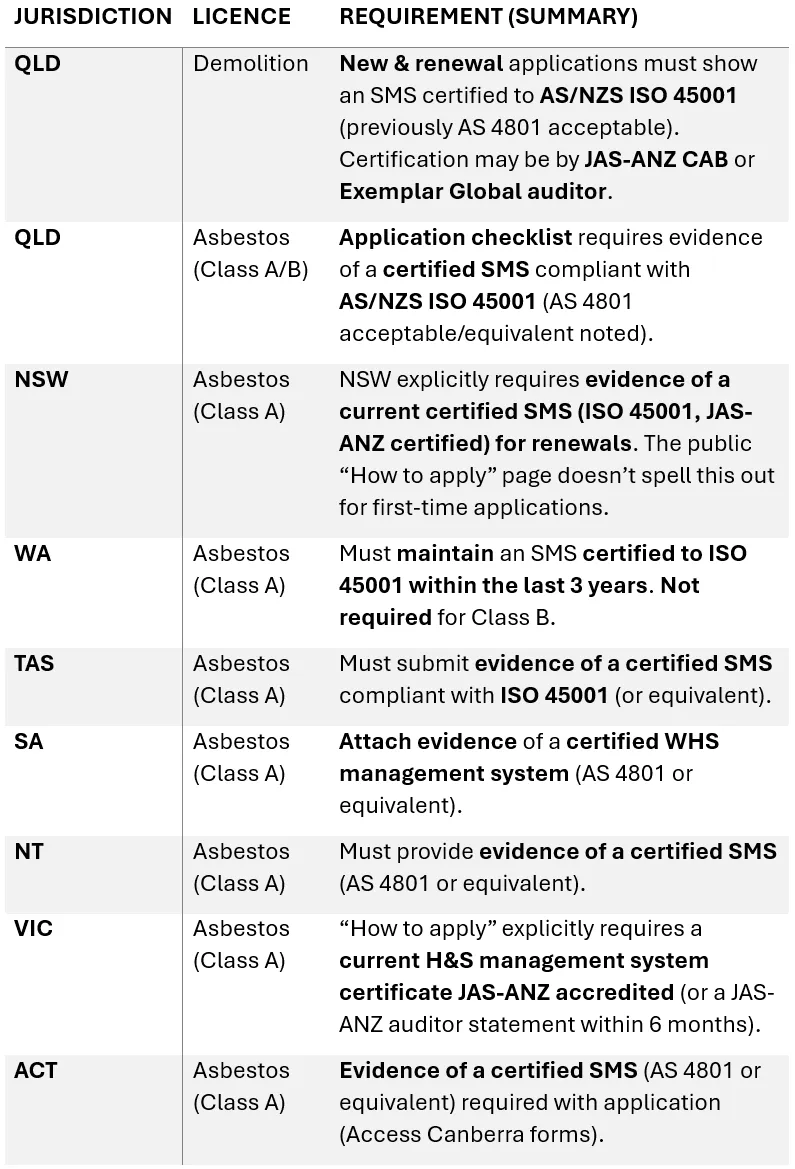
Many contractors search for “exemplar certification” when regulators actually expect a third‑party certified ISO 45001 safety management system (SMS) for the business. In several jurisdictions— including Queensland—a certified SMS is required for Class A asbestos removal, and Queensland also requires it for demolition licence applicants.
This guide explains what exemplar certification means in practice, how it supports asbestos and demolition licensing, and the steps to become certification‑ready. Spire Safety helps contractors prepare, implement, and evidence an ISO 45001 SMS— Queensland‑based, Australia‑wide—so you can meet licensing requirements and win work without rewriting your system every tender.
Contact us for help getting certified. We also provide free resources! Check them out:
Actionable Tips
Define scope clearly – Avoid audit delays and scope gaps.
Choose JAS‑ANZ or Exemplar certifier – Regulator‑recognised ISO 45001 certificate.
Map licence evidence – Meet asbestos and demolition licence application wording.
Align asbestos and demolition controls – Support demolition licence applications.
Audit before Stage 2 – Fix gaps and prove operation.
Maintain surveillance schedule – Keep certification current.
Summary of Licensing Requirements by State & Territory
What It Is and Why It Matters
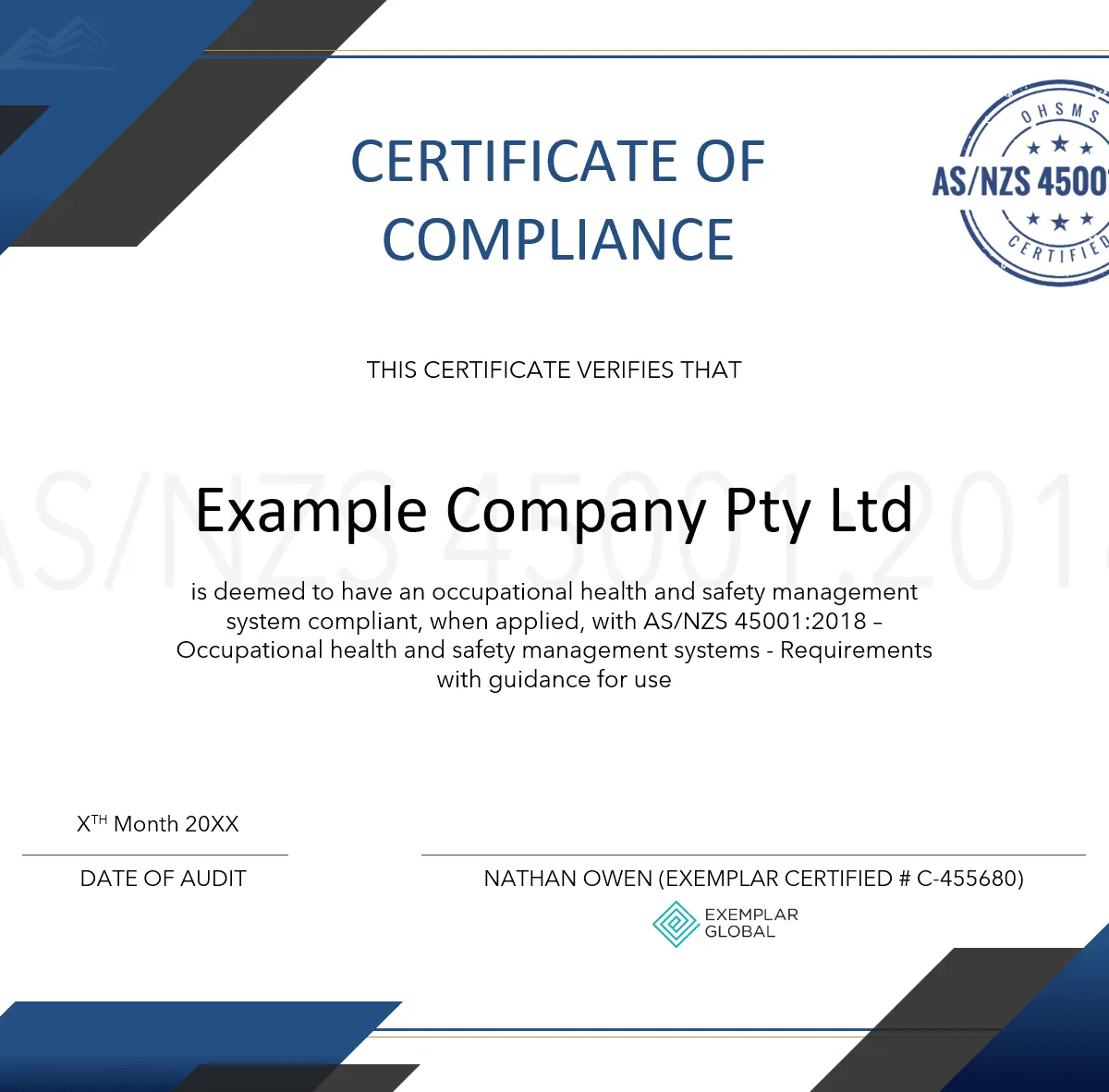
In plain terms, “exemplar certification” refers to your organisation holding an ISO 45001‑certified safety management system issued by an independent, Exemplar Certified Auditor. It is not a personal credential; it is third‑party assurance that your WHS Management System meets the ISO 45001 standard and is working in practice.
For an Integrated Management System, ISO 45001 shares the Annex SL structure with ISO 9001 and ISO 14001, so you can run one coherent set of processes—risk, consultation, training, document control, incident management, internal auditing, and management review—while meeting client and regulator expectations for asbestos and demolition projects.
Handy Links
Jurisdiction | Licence | Link |
|---|---|---|
QLD | Demolition | Form 76 – Form guide – Application for a licence to carry out demolition work |
QLD | Asbestos | Form 80 – Application for asbestos removal licence for Class A or Class B |
NSW | Asbestos | Renewal Application Class A or Class B Asbestos Removal Licence |
WA | Asbestos | Applicant Guide – Application for Asbestos Removal Licence CLASSES A and B |
SA | Asbestos | |
NT | Asbestos | |
VIC | Asbestos | |
ACT | Asbestos | |
Comcare | Asbestos |
Key Features and Elements
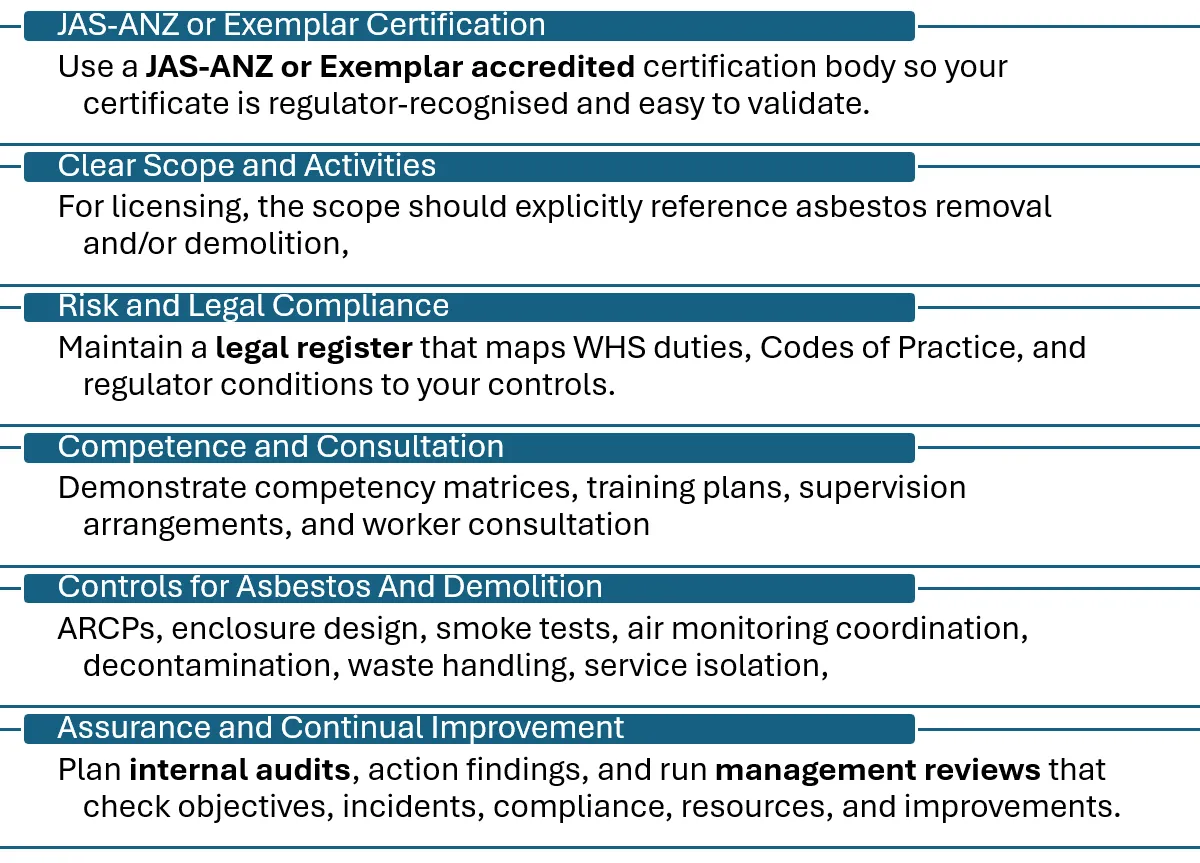
Accredited ISO 45001 Certification (JAS‑ANZ or Exemplar)
Use a JAS‑ANZ or Exemplar Certification Auditor so your certificate is regulator‑recognised and easy to validate. Keep scope wording precise (e.g., “asbestos removal—Class A/B” and/or “demolition contracting”) and ensure the legal entity name matches your licence applicant.
Clear Scope and Activities
State the services and locations covered, and list any exclusions. For licensing, the scope should explicitly reference asbestos removal and/or demolition, and the underlying procedures must match those activities (e.g., enclosures, negative pressure units, clearances, high‑risk construction work).
Risk and Legal Compliance
Maintain a legal register that maps WHS duties, Codes of Practice (e.g. codes for Demolition and Asbestos Removal), and regulator conditions to your controls. Couple this with a risk methodology (likelihood/consequence, hierarchy of controls) and keep records on real jobs to show the system operates.
Competence and Consultation
Demonstrate competency matrices, training plans, supervision arrangements, and worker consultation (toolboxes, pre‑starts, HSR interactions). Keep licences, refresher training, and fit‑testing evidence in one place for audits and tenders.
Operational Controls for Asbestos And Demolition
Show end‑to‑end control of critical tasks: ARCPs, enclosure design, smoke tests, air monitoring coordination, decontamination, waste handling, service isolation, sequential demolition, and emergency response. Use short, field‑ready procedures supported by checklists.
Assurance and Continual Improvement
Plan internal audits, action findings, and run management reviews that check objectives, incidents, compliance, resources, and improvements. Track corrective actions to closure and prepare for surveillance audits to keep your Exemplar Certification current.
How to Develop or Implement It
Plan
Define scope (asbestos/demolition), objectives, risk methodology, and legal obligations; map regulator evidence to ISO 45001 clauses.
Draft
Build policy, procedures, and practical forms (ARCP, SWMS, inspections, incidents) with clear roles and document control.
Approve
Gain leadership sign‑off and consult workers; record approvals and consultation outcomes.
Integrate
Train teams, run pilot projects, collect records (inductions, fit‑tests, inspections), and correct issues quickly.
Review
Conduct internal audits and a management review; then book Stage 1/2 with a JAS‑ANZ or Exemplar Certification Auditor.
Case Study: Fast‑Track ISO 45001 for Class A Applicant
A mid‑size contractor sought ISO 45001 to support a Class A asbestos licence and national tenders. Spire Safety completed a two‑week gap analysis, simplified procedures (enclosures, clearances, air monitoring), and trained supervisors on record‑keeping. Within 10 weeks, the client achieved certification.
Over the next quarter, internal audit findings dropped 62%, tender prequalification time fell 40%, and project admin time on clearance documentation reduced by 25% thanks to clearer roles and checklists.
Related Tools and Processes
ISO 45001 Gap Analysis Checklist
What it is:
A clause‑by‑clause review of your current SMS against ISO 45001.
How to do it:
Score maturity, record gaps, assign actions and due dates.
Legal Register (WHS & Environmental)
What it is:
A mapped list of applicable laws, regulations and codes with controls.
How to do it:
Identify obligations, link to procedures, review and update quarterly.
Internal Audit Plan
What it is:
A 12‑month schedule of audits covering high‑risk activities and clauses.
How to do it:
Prioritise asbestos/demolition controls and sample live project records.
Management Review Agenda
What it is:
A leadership meeting framework to evaluate SMS performance and resources.
How to do it:
Table objectives, incidents, audits, compliance, resources and improvements.
Common Mistakes to Avoid
Scope mismatch – Ensure the certificate scope names asbestos and/or demolition.
Unaccredited certifier – Use a JAS‑ANZ or Exemplar certification body only.
Documentation without evidence – Keep real project records to prove operation.
Ignoring licence wording – Mirror the application’s evidence requirements precisely.
FAQs
What does “exemplar certification” mean for a business?
It’s ISO 45001 certification of your company’s SMS by an independent Exemplar Auditor.
Do I need ISO 45001 for asbestos or demolition licensing?
Several jurisdictions require a certified SMS (especially for Class A asbestos); Queensland also requires it for demolition—check current regulator requirements.
Who can issue an acceptable certificate?
A JAS‑ANZ or Exemplar accredited certification body; certificates should show your legal entity and scope.
How long does certification take?
Small–medium contractors typically become certification‑ready in 6–12 weeks (sometimes less), depending on gaps and evidence.
We hold AS/NZS 4801—do we need ISO 45001?
ISO 45001 is the modern standard; many organisations have migrated to it and regulators increasingly reference it.
Articles and Further Reading
What is a WHSMS (Work Health and Safety Management System)? (Spire Safety)
Demolition Work Code of Practice (Safe Work Australia)
Asbestos Removal Code of Practice (Safe Work Australia)
A Short History of Silica and Asbestos (Spire Safety)
Clause 4.1 – Understanding the Context of the Organisation in ISO Certification (ISO Certification Group)
About the Author

Nathan has worked in HSEQ management for 15 years helping Australian businesses improve compliance, manage risk and gain ISO and Exemplar Certification. He has masters degrees in business management and WHS.
Share this resource
Filter
Categories
Most Popular
More Like This
- How to Prepare for an ISO Certification AuditISO & Certification
- ISO 45001 vs AS/NZS 4801: Key Differences ExplainedISO & Certification
- ISO Certification for Construction CompaniesISO & Certification
Recently Added
- WHS Gap Analysis: A Step-by-Step Guide
- ISO 45001 vs AS/NZS 4801: Key Differences Explained
- How to Prepare for an ISO Certification Audit
- What Is a Safety Management System?
Need Help?
Our WHS consultants can help you implement this in your business. Book a free consultation today.
Book a Consultationor call 1300 891 503