
What is ISO 45001 Certification and How Do I Get Certified?
ISO 45001:2018 (or AS/NZS 45001:2018) is the international standard for WHS Management Systems (WHSMS). Learn how to get ISO 45001 certified in 7 steps.

What is ISO 45001?
ISO 45001:2018 (or AS/NZS 45001:2018) is the international standard for WHS Management Systems (WHSMS). To learn about WHS Management Systems, check out our detailed guide. We help clients from Brisbane, Sydney and Melbourne get ISO certified.
If you'd rather not do it alone, our ISO 45001 certification consultants start with a gap analysis and get you ready for the certification audit.
We also provide free resources! Check them out:
*For internal use only. Not for resale or redistribution. By downloading, you agree to our Free Resources Licensing Agreement.
A WHSMS is a set of documents that outlines how workplace safety is managed in an organisation.
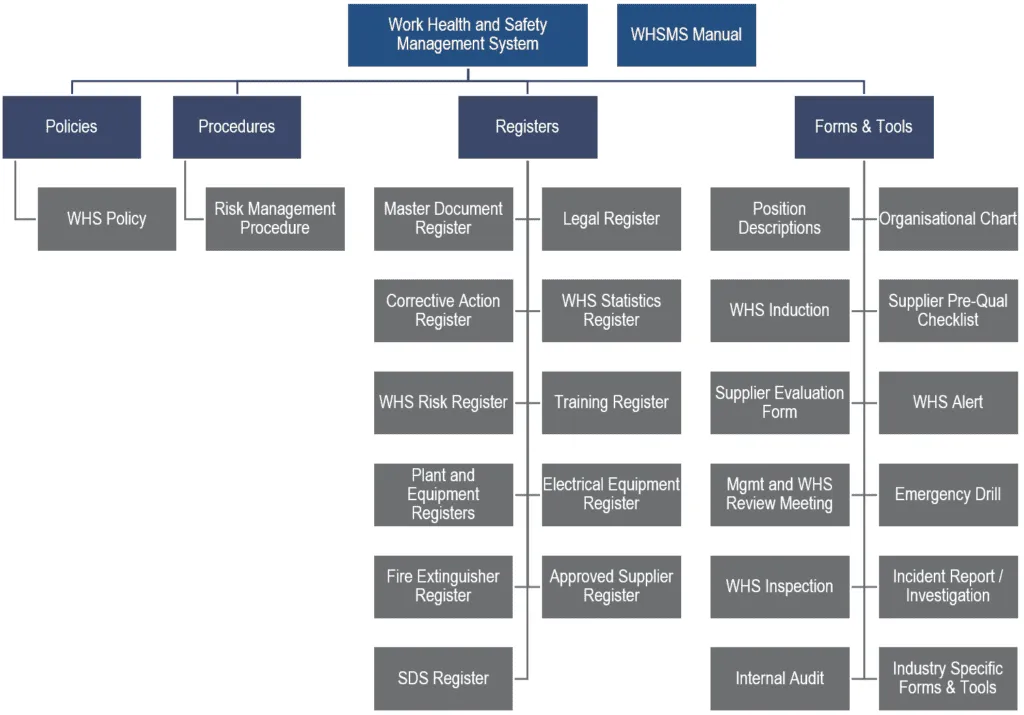
An ISO 45001 certified workplace audit — illustrating the occupational health and safety management system requirements organisations meet to achieve and maintain ISO 45001 certification.
The documents are developed to address the requirements of ISO 45001:2018, which are:
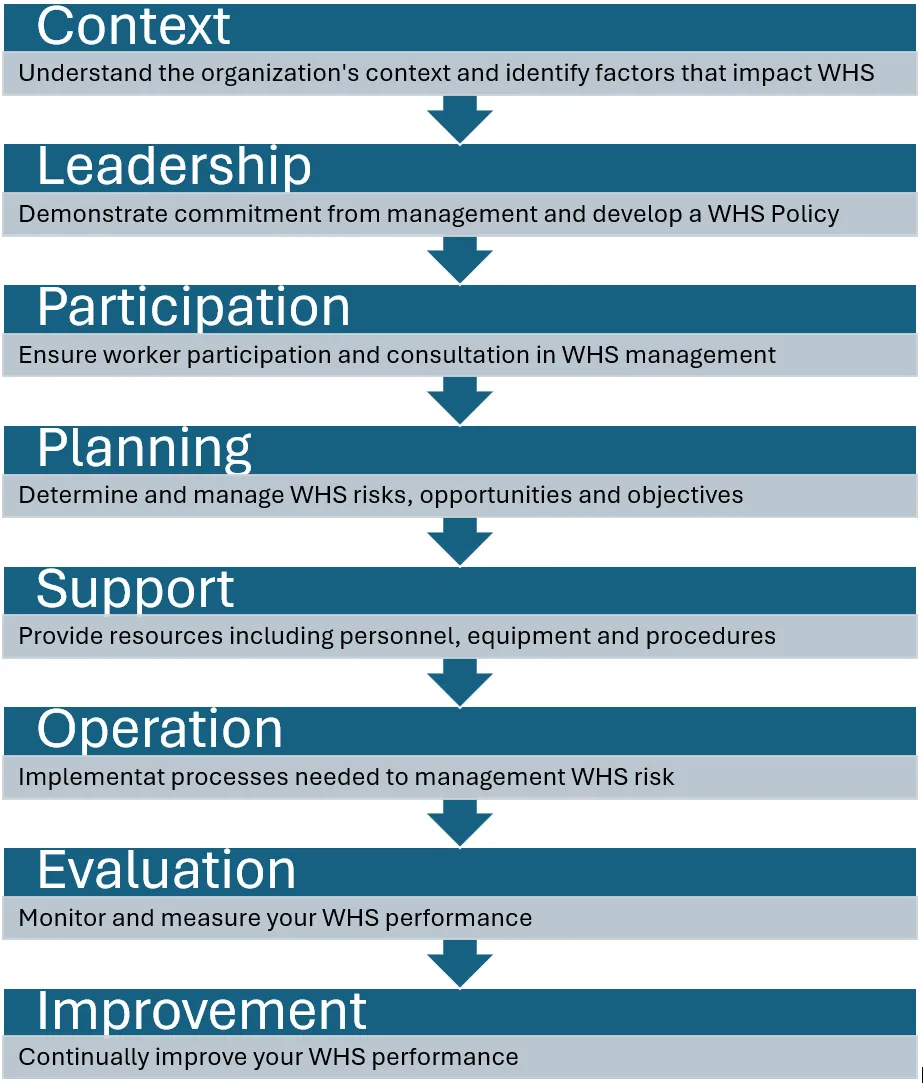
An ISO 45001 certified workplace audit — illustrating the occupational health and safety management system requirements organisations meet to achieve and maintain ISO 45001 certification.
How do I get ISO 45001 certification?
The easiest way to get certified is to call us now. We can typically get a company certified for ISO 45001 (as well as 9001 and 14001) for around $20,000 total cost(including certification audit).
The timeline for us to develop an ISO 45001 compliant WHS Management Systems (or a 45001, 9001 and 14001 integrated management system) is typically 6 weeks development + 1 week for the certification audit = about 7 weeks total.
Step 1: Gap Analysis (SKIP THIS?)
Many consultants will start with a gap analysis to identify gaps in your existing system, with the goal of filling these gaps to achieve certification. In our experience, many clients do not need a gap analysis, and their journey starts at Step 2 below.
Even if the company has existing WHS documentation or systems, it is usually simplest and easiest to begin with a new WHS Management System and simply "add-in" any existing documents or procedures that will add value to the new system (quite often, a lot of the old documentation is retired or archived).
Step 2: Getting a WHSMS
Option 1 – Purchase "Off-The-Shelf" WHSMS
Purchasing an off-the-shelf system is fastest and cheapest. This WHSMS will be generic in nature, but workplace-specific documentation can be added to the system.
It's similar to how you would make a homemade pizza – you are likely to buy the pizza base (or even a plain cheese pizza) from the supermarket, and then add your own choice of toppings. Then, bam! You have your own customised and workplace-specific WHS Management System (or pizza! or both!).
Option 2 – Write the WHSMS From Scratch
This option could be a lengthy process – and it will likely need to be written by someone with experience (or a consultant). For example, the WHSMS Manual is typically 20 – 50 pages (or longer). The entire system could take months to create – why reinvent the wheel?
Step 3: Overview of Operations
The next steps assume you have purchased an off-the-shelf system and engaged a consultant (hopefully us!) to assist.
The real work begins! We need to learn about your company's:
Operations
Staff
Work Sites / Locations
Step 4: Develop Company-Specific Documentation
Company-specific documents may include SWMS, Permit Systems or Inductions. In addition to the front-end documents, the back-end documents, including Policies, Procedures and Registers (or spreadsheets), are developed. To learn about WHS Policies and Procedures, read our detailed guide.
Step 5: Implement the WHSMS
Now, use the system! This can include inducting staff (with the new induction tool) and implementing Safe Work Procedures (SWPs or SWMS). You also need to conduct the following:
Safety Inspection
Safety Meeting (and distribute a Safety Alert)
Emergency Drill
Management Review Meeting
Internal Audit (we help with this step)
You will also need to ensure your workplace is safe and well-managed. For example, ensuring first aid kits and fire extinguishers are available.
Step 6: Third-Party Audit (The Easy Step)
Now you can sit back and let the auditor admire your WHS Management System. A third-party auditor will review your documentation and workplace. There will be corrective actions (i.e. stuff that needs fixing). However, we have a 100% success rate and have never failed an audit.
Step 7: Get Your ISO 45001 Certificates
You will be issued with certificate/s, which you can display on your website and submit for tenders.
Step 8: Keep Your Certificates
You will be required to undergo "surveillance audits" yearly and "re-certification audits" every 3 years to maintain your certification.
Did You Know?
Did you know that the International Organisation for Standardisation (ISO) owes its origin to a perplexing dinner party incident? Back in 1946, a group of engineers, scientists, and industry leaders gathered for a dinner party at a swanky restaurant. It just so happened that each guest had a different understanding of what constituted a "standard" when it came to measurements.
As the evening progressed, things got heated. Arguments broke out over the length of a meter, the weight of a kilogram, and even the definition of time itself! Frustrated by the confusion, one guest named Henry, an eccentric inventor, jumped up from the table, waving a napkin in his hand.
Henry announced, "We need one standardised way of measuring things! Let's create an organisation dedicated to establishing global standards!" The idea resonated with the rest of the diners, and thus, the seeds of ISO were planted that very night.
In the following years, Henry's napkin sketch was transformed into a fully-fledged international organisation, which aimed to bring uniformity and consistency to measurements, practices, and processes across the world. And so, the ISO was born, forever resolving the dinner party dispute and setting the stage for universal standards we rely on today.
FAQ
Frequently asked questions
01What is ISO 45001?
02Why was ISO 45001 developed?
03Who can use ISO 45001?
04How does ISO 45001 benefit organisations?
05Is ISO 45001 a legal requirement?
06Can ISO 45001 be integrated with other management systems?
Share this resource
Need Help?
Our WHS consultants can help you implement this in your business. Book a free consultation today.
Book a Consultationor call 1300 156 382