
AS/NZS 4801 to ISO 45001: Key Differences and 2026 Transition Plan
Australian businesses still relying on legacy AS/NZS 4801 safety systems must address the growing compliance gap in 2026. Transitioning to the international ISO 45001 standard is a necessity for

This guide compares ISO 45001 and AS/NZS 4801 side by side and explains why AS/NZS 4801 holders need to move to ISO 45001. It then sets out a step-by-step action plan for Australian businesses making the transition in 2026.
If you'd like help mapping your existing system to ISO 45001, see our ISO 45001 consultants.
Australian businesses and PCBUs still relying on legacy safety systems must address the growing compliance gap in 2026.
AS/NZS 4801 is a legacy standard in 2026 and ISO 45001:2018 (AS/NZS ISO 45001) is the certifiable benchmark.
TLDR
AS/NZS 4801 is technically obsolete and lacks the modern risk-based focus of ISO 45001.
Major government and private tenders now almost exclusively require ISO 45001 certification.
The transition involves moving from a prescriptive procedures-based model to a proactive leadership-driven system.
Integrated management systems are easier to maintain when following the Annex SL structure.
The Current Landscape for AS/NZS 4801 Holders
Many organisations across Australia have held AS/NZS 4801 certification for decades.
While this standard served the industry well, it was developed in 2001 and does not reflect modern work environments.
The global shift toward ISO 45001 was designed to create a universal language for occupational health and safety.
Most Australian certification bodies have already phased out support for the old standard.
Operating under an outdated system creates significant risks for your business reputation.
You may find that your ISO 45001 Standards Compliance is questioned during high-level contract negotiations.
For many years, AS/NZS 4801 was the main occupational health and safety management system standard used by Australian and New Zealand organisations seeking third-party certification. In March 2018, the International Organization for Standardization published ISO 45001, the first truly international OH&S standard, and Australian certification bodies subsequently withdrew support for AS/NZS 4801 certification.
Key Differences Between the Standards
The most significant change is the move toward the "High-Level Structure" known as Annex SL.
This format is shared by ISO 9001 and ISO 14001, making system integration much simpler.
AS/NZS 4801 focused heavily on documented procedures and following specific steps.
In contrast, ISO 45001 prioritises the "Context of the Organisation" and the needs of interested parties.
This means you must consider external factors like supply chain volatility and internal factors like company culture.
The new standard also places a much heavier burden on top management rather than just safety officers.
Leadership must demonstrate active involvement in the safety system.
This shift ensures that safety is a core business strategy rather than a peripheral administrative task.
ISO 45001 vs AS/NZS 4801 at a glance
| AS/NZS 4801 | ISO 45001:2018 | |
|---|---|---|
| Published | 2001 | March 2018 |
| Structure | Unique structure that did not align with other ISO standards | High Level Structure (Annex SL), shared with ISO 9001 and ISO 14001 |
| Focus | Documented procedures and following specific steps | Context of the organisation and the needs of interested parties (Clause 4) |
| Leadership | Safety largely managed by safety officers | Top management must demonstrate active commitment and accountability |
| Worker participation | Weaker requirements | Workers actively involved in hazard identification and system improvement |
| Risk | Physical workplace hazards | Risks and opportunities for the OH&S management system itself (Clause 6) |
| Certification | Support withdrawn by Australian certification bodies | The certifiable benchmark (AS/NZS ISO 45001) |
Scope and context
ISO 45001 requires organisations to understand their external and internal context (Clause 4) and the needs and expectations of interested parties. AS/NZS 4801 had no equivalent requirement, so ISO 45001 certification requires a more strategic view of how external factors such as legislative changes, supply chain expectations and community concerns affect your OH&S system.
Leadership and worker participation
Leaders must demonstrate active commitment, not simply endorse a policy document. Worker participation requirements are also stronger, with workers expected to be actively involved in hazard identification and system improvement.
Why You Must Upgrade in 2026
Wait times for certification audits are increasing as the final wave of legacy holders seeks to upgrade.
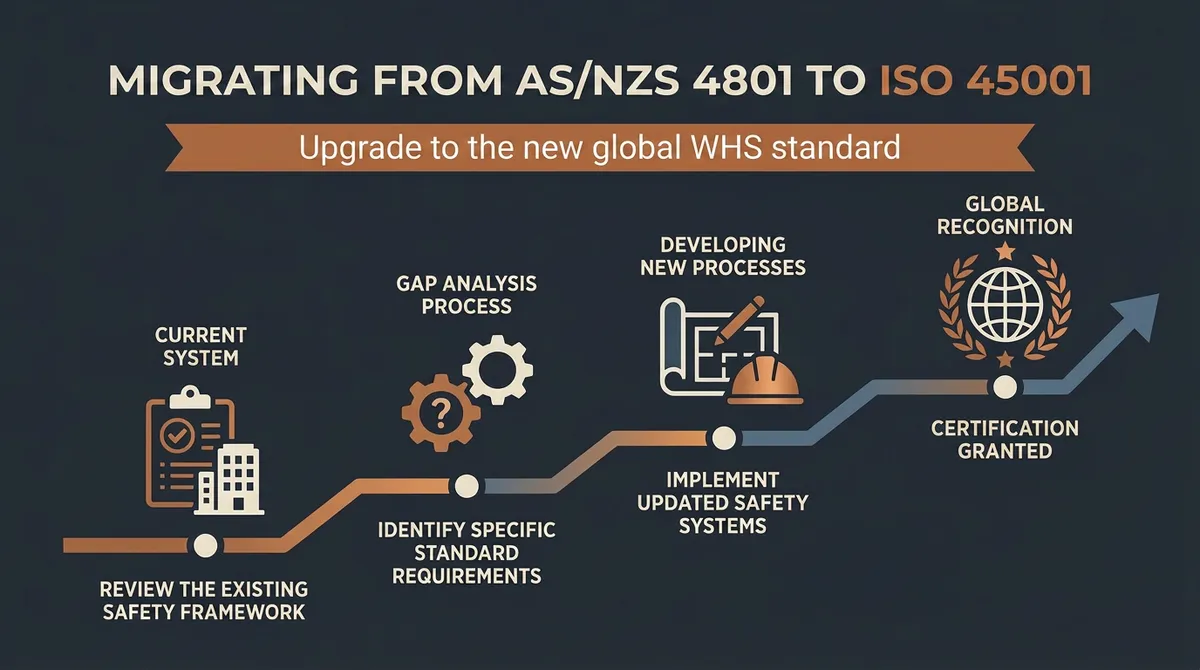
Understanding the current landscape for AS/NZS 4801 certification holders and their ISO 45001 migration.
If you delay your ISO Certification Readiness & maintenance, you risk a gap in your certified status.
Many tier-one contractors in Australia now view AS/NZS 4801 as a "legacy" document only.
It may not satisfy the pre-qualification requirements for major infrastructure projects or government works.
The 2026 regulatory environment in Australia places a high premium on psychosocial hazard management.
ISO 45001 provides a better framework for managing these complex risks than the old 4801 standard.
Upgrading your system allows you to streamline your documentation.
You can often reduce the total number of forms and manuals by integrating ISO 9001 + other standards into a single platform.
The Action Plan for Migration
A successful transition requires a structured approach to avoid operational disruption.
You should begin with a thorough gap analysis to see where your current system falls short.
Step 1: Gap Analysis and Context
Identify where your existing 4801 processes meet the new requirements and where they fail.
Define your internal and external issues, such as legislative changes or workforce demographics.
Step 2: Engaging Leadership
You cannot achieve ISO 45001 certification without documented evidence of leadership commitment.
This includes resource allocation, policy setting, and regular management reviews.
Step 3: Consultation and Participation
The new standard requires deeper worker involvement in the decision-making process.
You must show that non-managerial workers are consulted on hazard identification and system improvements.
Step 4: Updating Documentation
Replace your old manuals with a streamlined safety management system that follows the 10-clause ISO structure.
Ensure your risk management processes cover both physical and mental health risks.
Managing the Transition Costs
Budgeting for a transition involves both internal resource time and external audit fees.

Visual comparison of key differences between AS/NZS 4801 and ISO 45001 for Australian WHS management systems.
Understanding a consultant's charge can help you plan your project accurately.
Costs vary depending on the size of your workforce and the complexity of your operations.
However, the long-term savings from a more efficient system often outweigh the initial investment.
An integrated system reduces the number of audit days required by certification bodies.
This leads to lower ongoing maintenance costs for businesses across Australia.
Internal Audit and Pre-Assessment
Before booking your formal transition audit, conduct a full internal audit against the ISO 45001:2018 requirements.
This identifies any remaining "blind spots" in your implementation.
Pay close attention to Clause 6 (Planning) and Clause 8 (Operation).
These sections are where many legacy systems fail to meet the proactive requirements of the international standard.
If your business handles high-risk activities, ensure your operational controls are robust.
For example, firms needing Exemplar Certification for Asbestos must prove their controls meet the highest international benchmarks.
The Role of Risk-Based Thinking
ISO 45001 replaces the old "preventative action" concept with "risk-based thinking."
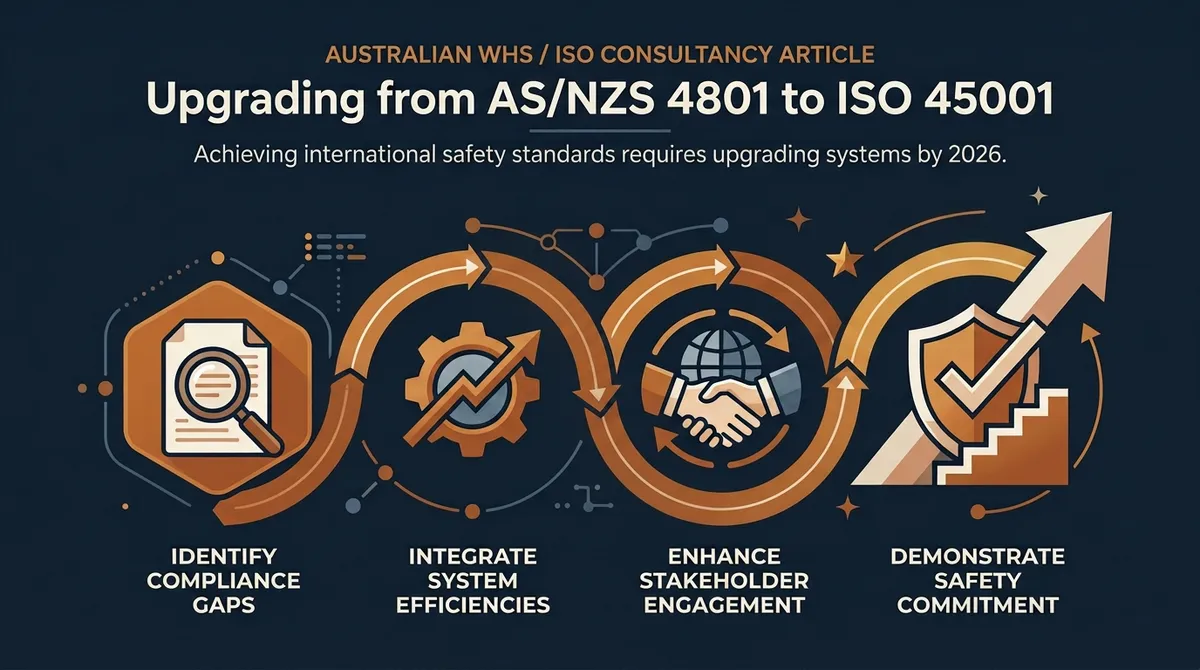
Understand the mandatory 2026 deadline for upgrading your AS/NZS 4801 WHS system to ISO 45001.
This means you evaluate risks and opportunities before they manifest as incidents or non-conformances.
In 2026, this includes digital risks, such as how your safety data is stored and protected.
It also includes looking at the resilience of your safety culture during periods of organisational change.
By treating safety as a dynamic risk rather than a static checklist, you create a more resilient business.
This approach is highly valued by insurers and stakeholders throughout the Australian market.
Selecting a Certification Body
Ensure your chosen auditor is accredited by JAS-ANZ to issue ISO 45001 certificates.

Your step-by-step action plan for a smooth AS/NZS 4801 to ISO 45001 transition in Australia.
Non-accredited certificates hold little value in the Australian commercial landscape.
Ask your auditor about their transition process and how they handle existing 4801 documentation.
Most will allow you to use your old records as historical evidence during the first ISO audit.
Coordinate your audit dates to align with your existing 4801 expiry if possible.
This prevents paying for two separate certification cycles in the same calendar year.
Common Pitfalls to Avoid
Many businesses try to simply "map" their old manual to the new clauses.
This often results in a clunky system that fails to embrace the spirit of the new standard.
Do not ignore the "Opportunity" aspect of the risk register.
ISO 45001 asks you to find ways to improve safety, not just prevent injuries.
Avoid over-complicating the system with excessive paperwork.
The goal of the 2026 transition is to make safety more accessible and integrated into daily work life.
Transitioning a former AS/NZS 4801 certification requires a gap analysis, system updates and a transition audit with your certification body. To keep costs down, use an internal gap analysis, prioritise high-risk controls and align your audit timing with your 4801 expiry to reduce duplicate audit days. For tailored advice, verify dates and obligations against Standards Australia and your chosen JAS-ANZ accredited certification body.
Spire Safety App: keep your forms, registers and documents in one place your team can use anywhere, even offline. See the Spire Safety App in action.
FAQ
Frequently asked questions
01What are the main differences between ISO 45001 and AS/NZS 4801?
02Can an organisation still obtain AS/NZS 4801 certification?
03How long does an AS/NZS 4801 to ISO 45001 migration take?
04Can I keep using old AS/NZS 4801 records during the ISO 45001 audit?
05What is involved in transitioning from AS/NZS 4801 to ISO 45001?
Share this article
Get Expert Advice
Speak with a certified WHS consultant about your workplace.
Contact Usor call 1300 156 382