
How to Effectively Brief a WHS Gap Analysis Consultant & Save Costs
Engaging a consultant for a WHS review is a significant investment. Preparing a comprehensive brief ensures they spend time analysing risks, not searching for missing paperwork, ultimately saving you

Engaging a consultant for a review of your safety systems is a significant investment for any business.
Preparing a comprehensive WHS gap analysis brief consultant package ensures they spend time analysing your risks rather than searching for missing paperwork.
TLDR
Gathering core safety documents upfront reduces consultant billable hours.
Defining the specific scope prevents scope creep and unnecessary costs.
Providing data on past incidents helps the consultant prioritise high-risk areas.
Assigning an internal point of contact ensures the onsite review runs smoothly.
The Value of Pre-Engagement Preparation
Consultants often charge by the hour or by the project complexity.
If a consultant spends their first day chasing policies, your budget is being wasted on administrative tasks.
Proper WHS gap analysis preparation allows the expert to arrive with a preliminary understanding of your operational risks.
This shift moves the engagement from data collection to expert evaluation and strategy.
A well-prepared brief ensures the final report is tailored to your specific industry challenges.
It also helps show how your system aligns with recognised frameworks such as ISO 45001 and the Model Code of Practice: How to manage work health and safety risks.
Defining the Scope and Objectives
Before contacting an expert, decide which parts of the business need reviewing.
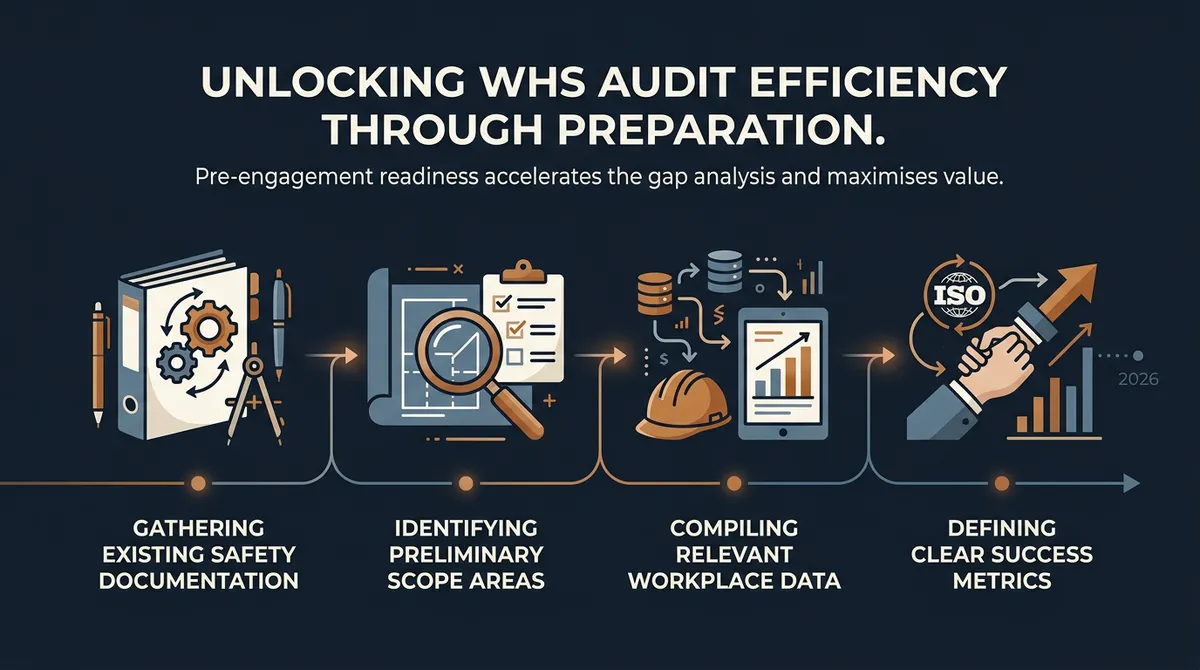
Thorough pre-engagement preparation key to optimising WHS review costs and effectiveness.
You might require a full organisational audit or a targeted review of a single high-risk site.
Clearly stating your goals helps the consultant provide an accurate quote.
For example, specify if you are aiming for ISO 45001 alignment or strictly legislative compliance under the Work Health and Safety Act 2011 in 2026.
Using a clear framework can assist in deciding whether you need an In-house Safety Manager vs an external provider.
Defining these boundaries early prevents expensive scope creep during the project.
Essential Documentation to Provide in Advance
Compiling a digital folder of your current safety system is the fastest way to lower your costs.

Briefing your safety consultant ensures efficient WHS gap analysis and optimal review costs.
At a minimum, send your primary health and safety policy and your most recent risk register.
Operational and Risk Information
Provide a list of your most common high-risk activities, such as working at heights or operating heavy machinery.
This allows the consultant to prepare specific checklists before they arrive at your facility.
If you work in specialised sectors, provide industry-specific data and licences for regulated activities.
This is particularly important when engaging a Mining Safety Consultant Services provider who must navigate state-based mining regulations.
Incident and Cultural Data
Share your incident log and near-miss reports from the last 24 months.
This data reveals patterns that a simple document review might miss.
Include corrective actions and the status of previous recommendations.
Showing where injuries occur helps the consultant focus on the gap between your written procedures and actual worker behaviour.
Attach any recent employee safety survey results or toolbox talk notes if available.
This helps the consultant assess safety culture without spending engagement hours collecting basic information.
Facilitating the Onsite Safety Audit
A safety audit pre-engagement plan should include a schedule for site walk-throughs and staff interviews.

Clearly defining WHS scope and objectives is crucial for a successful gap analysis.
Identify which supervisors and workers will be available for discussion during the visit.
Brief your team on why the consultant is visiting to ensure they provide honest, helpful feedback.
Without staff cooperation, the gap analysis will only reflect what is on paper, not what happens on the shop floor.
The consultant will need access to all areas, including restricted zones or satellite offices.
Providing site maps, site induction requirements, and any personal protective equipment rules in advance saves valuable time on the day of the audit.
Understanding the Financial Impact of Briefing
Your level of preparation directly influences the final cost a consultant will charge for the project.
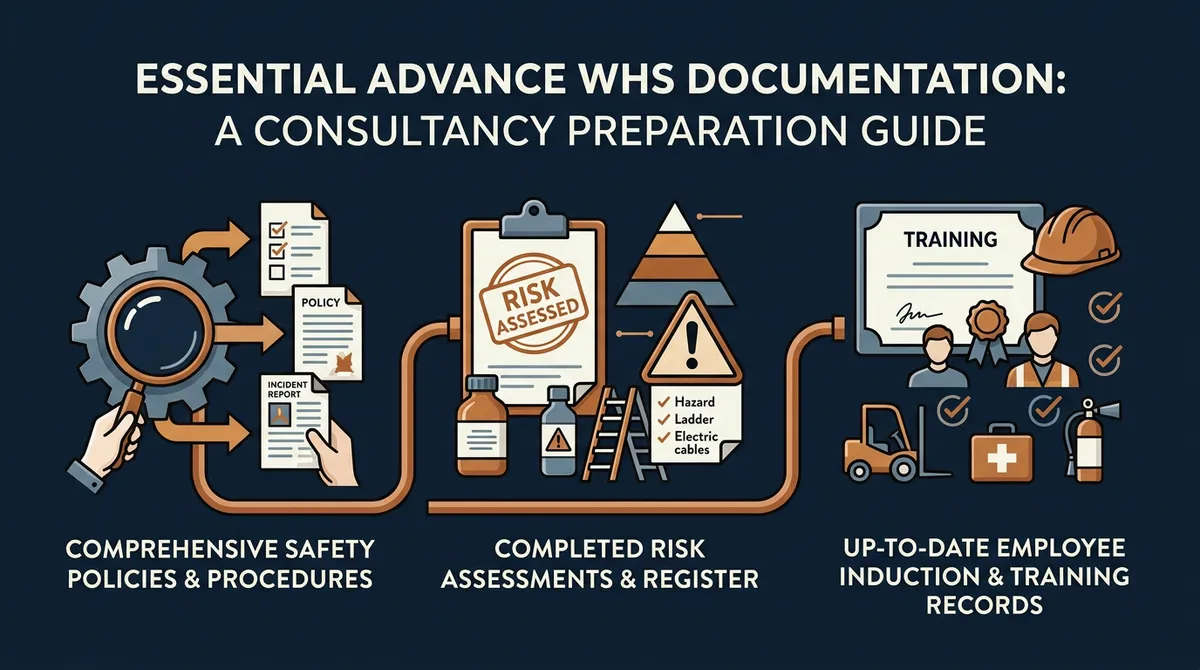
Supply these crucial documents for an efficient WHS gap analysis and cost-effective safety review.
A consultant who receives a messy pile of unsorted files must charge for the time spent organising them.
When briefing safety consultant professionals, ask for a fixed-fee proposal based on the documents you have already provided.
This keeps the project within budget and forces both parties to stick to the agreed scope.
Provide clear acceptance criteria for deliverables so time is not spent resolving scope ambiguity after the engagement starts.
Businesses that provide clean, digital records often see a measurable reduction in total project duration and associated fees.
Analysing the Results and Next Steps
The goal of the gap analysis is to produce a prioritised action plan.
Once the consultant delivers the report, you should have a list of non-conformances ranked by risk level.
You may find that specific operational documents need urgent rewriting after the review.
For instance, you might need to implement a new Safe Work Method Statement if the audit finds gaps in machinery safety.
Use the report to allocate your 2026 safety budget toward the highest-risk areas first.
This data-driven approach ensures your investment in consultancy leads to a measurable increase in workplace safety and better value for money.
Optimising Long-Term Compliance Costs
To optimise WHS review costs, treat the gap analysis as a recurring health check rather than a one-off event.
Regular internal reviews make the external consultant’s job easier and faster each year.
Maintain a compliance folder throughout the year that holds your latest training records and equipment maintenance logs.
This habit ensures your pre-consultation documentation WHS package is always ready to go at a moment's notice.
Consistent documentation also makes it much easier if you decide to change providers.
You will already have the foundational data required for any professional WHS consultants in Australia to begin their assessment.
Suggested pre-engagement checklist for the client:
Health and safety policy, up-to-date risk register, recent incident log, corrective action status.
Site maps, induction requirements, PPE rules and lists of high-risk tasks.
List of available staff for interviews and a single point of contact for the consultant.
Common reader questions (PAA) to consider before you brief a consultant:
What documents will reduce on-site time the most?
Can I get a fixed-fee if I provide all requested records in advance?
How far in advance should I send incident logs and risk registers?
Answering these questions and following the checklist will shorten the engagement and reduce consultancy costs in 2026.
If you are weighing up outside help, our WHS consulting services cover SWMS, risk assessments, SOPs and retained safety advisor support across Australia.
FAQ
Frequently asked questions
01What is the typical timeframe for a comprehensive WHS gap analysis, and how can I influence it?
02Beyond cost savings, what are the key benefits of providing a detailed brief for a WHS gap analysis?
03Should I share details of past WHS incidents or near misses in my pre-brief, and why?
04Are there any specific Australian legal requirements that necessitate pre-consultation documentation for WHS audits?
Share this article
Get Expert Advice
Speak with a certified WHS consultant about your workplace.
Contact Usor call 1300 156 382