
In-house Safety Manager vs Outsourced WHS Consultant: A 2026 Decision Framework
Choosing how to resource workplace health and safety is a critical decision for every Australian executive. This guide provides a decision framework to help you navigate the options.

Choosing how to resource workplace health and safety is a critical decision for every Australian executive. The right choice ensures legal compliance and protects your most valuable asset: your people.
TLDR
Small businesses with low risk should focus on scalable outsourced support.
High-risk industries often require a hybrid model to balance daily oversight with expert technical advice.
Headcount often dictates the financial tipping point for hiring a full-time professional.
Outsourced consultants provide specialised knowledge for ISO transitions and complex audits.
The Safety Resourcing Landscape in 2026
Australian businesses operate within a detailed WHS regulatory environment. The Model WHS Act and state variations influence obligations. The landscape in 2026 increasingly favours flexible, risk-based resourcing models. These models let organisations access senior expertise without paying a full-time salary.
Managing safety effectively requires a system, not just a person. A system adapts to legislative change and operational growth.
Determining Your Risk Profile
Your risk profile is the primary input to any WHS resourcing decision. High-risk sectors include construction, mining and manufacturing. These industries often demand immediate on-the-ground intervention for high-risk work. Low-risk sectors such as professional services and retail focus more on ergonomics and psychosocial hazards.
A low-risk business rarely needs a full-time safety manager. Targeted outsourced WHS consulting services can maintain compliance and reduce costs for these firms.
The Headcount Tipping Point
Headcount provides a practical trigger for resourcing changes. Organisations with fewer than 30 employees rarely have the workload to justify a dedicated safety manager. When businesses grow beyond 50 employees, administrative tasks multiply, and record-keeping becomes more time-consuming.
At that point, the choice between a safety manager vs WHS consultant in Australia becomes a financial and operational calculation. A full-time hire gives continuity but adds costs such as superannuation, insurance and professional development. An external advisor offers flexibility and access to specialised tools without those fixed costs.
Decision Matrix: Growth Stage and Capacity
Map your growth stage and capacity to a resourcing model. Use headcount bands, risk profile and upcoming projects as decision triggers.
The Startup and Small Business Stage
Start-ups and small firms usually benefit from outsourced support. External advisors set up foundations and provide templates. They deliver regulatory updates, Safe Work Method Statements and simple systems. This frees owners to focus on operations.
The Mid-Market and Scaling Stage
Mid-market firms commonly face a compliance gap where workload exceeds capacity. This is the ideal time to consider a hybrid model. A hybrid model pairs an internal person for day-to-day oversight with a consultant for specialist work. Use consultants for system design, complex audits and ISO 45001 alignment.
Enterprise and High-Volume Operations
Large organisations typically maintain a dedicated safety function. They still engage WHS consultants in Australia for independent audits and technical depth. Third-party consultants provide objective reviews and benchmark practices across industries. They help identify blind spots internal teams may miss.
Comparing In-house WHS vs External Safety Advisor
An internal manager knows your workplace culture and can build rapport through daily contact. This supports safety culture and continuous improvement. Internal staff are present for toolbox talks and site observations. They can influence behaviour through regular engagement.
An external consultant offers an objective perspective and specialised experience. They are often up to date on Safe Work Australia guidance and state regulator changes. Consultants also bring cross-sector learnings and can accelerate ISO 45001 certification projects. Use them when you need technical rigour for complex compliance tasks.
Technical Specialisation and ISO Standards
Some projects require specialist knowledge beyond a generalist manager. Certification to ISO 45001 usually requires detailed documentation and gap analysis. Consultants can perform WHS gap analyses and prepare documentation for certification. They reduce the trial-and-error burden on internal teams.
Financial Considerations and ROI
The total cost of employing a senior safety professional includes salary and on-costs. Recruitment and infrastructure add to this investment. Outsourcing can deliver higher ROI for project-based work or part-time needs. You pay for expertise when you need it, rather than a fixed salary.
Where an external advisor reduces incident frequency or lowers workers' compensation premiums, the service may pay for itself. Monitor incident metrics and premium changes when evaluating ROI.
Training and Competency Management
Effective safety management relies on workforce competency. Internal managers can oversee training records and competency frameworks. Consultants can design targeted training for tasks such as chemical handling or high-risk equipment. They often introduce fresh delivery methods to reduce safety fatigue.
Implementation Steps for your Business
Assess your headcount, risk profile and growth plans before choosing a resourcing model. Map tasks into categories: administrative, operational oversight and technical strategy. Start by reviewing critical documents such as Safe Work Method Statements and injury registers.
If documents are outdated, an external consultant can refresh them quickly. Decide if you have the internal capacity to maintain systems once they are established. If not, choose a long-term consulting partnership or plan for a permanent hire. Always verify credentials before engaging an advisor. Seek experience in your industry and a track record of successful audits and ISO projects.
Common questions (quick answers)
When should I hire a full-time safety manager?
Consider hiring when you exceed 50 employees, have sustained high-risk operations, or need daily oversight that consultants cannot provide cost-effectively.
What tasks should be outsourced?
Outsource gap analysis, ISO 45001 projects, complex incident investigations and independent audits. Keep daily engagement and culture-building in-house.
How do I measure whether outsourcing is working?
Track incident rates, corrective action closure times and workers' compensation premiums. Use these metrics to compare internal and external performance.
Which regulators and standards matter?
Safe Work Australia guidance, state WHS regulators and ISO 45001 are key references. Ensure your advisor is familiar with these frameworks.
Next steps
Use headcount bands, risk profile and planned projects as decision triggers. Then map responsibilities to in-house or outsourced resources accordingly.
For certification work or complex audits, engage a consultant early. For daily oversight and culture change, hire or develop internal capability.
Always document your decision and review it annually or when operations change significantly.
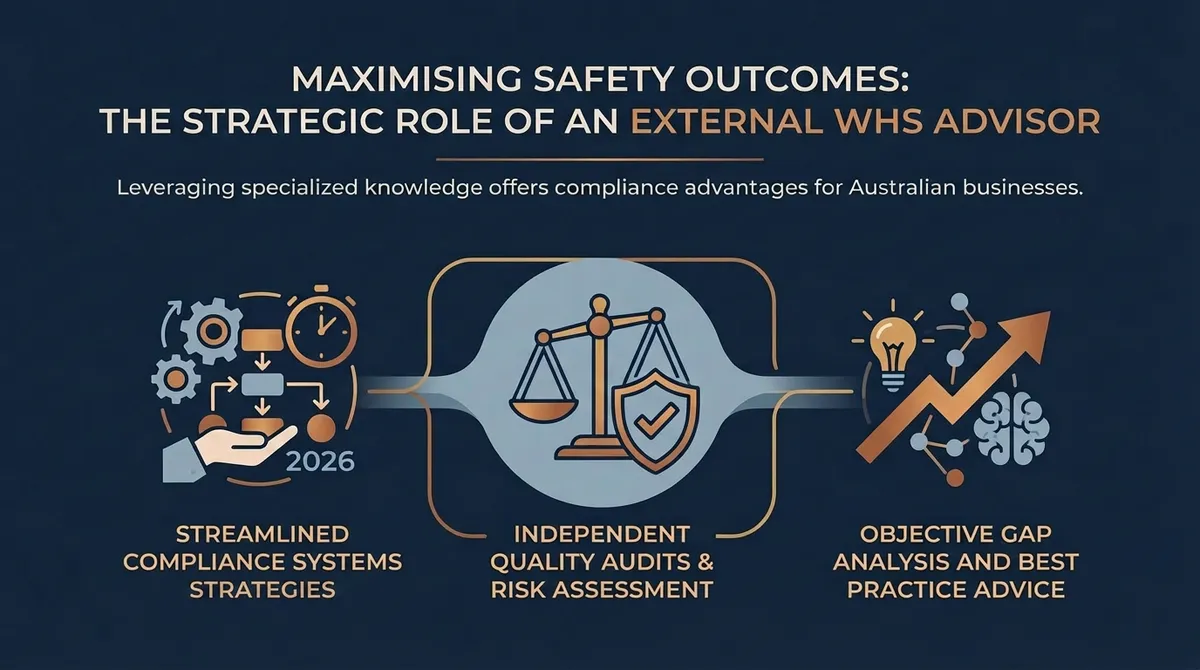
Evaluate cost-effectiveness and expertise when choosing between an in-house safety manager and an external WHS consultant.
FAQ
Frequently asked questions
01What legal responsibilities do Australian businesses have regarding WHS that dictate resourcing choices?
02How can a small business with limited budget effectively implement WHS without hiring a full-time safety manager?
03What are the hidden costs associated with hiring an in-house safety manager compared to an outsourced consultant?
04Can an outsourced WHS consultant provide the same level of on-site presence as an internal safety officer in high-risk industries?
Share this article
Get Expert Advice
Speak with a certified WHS consultant about your workplace.
Contact Usor call 1300 156 382