
Free Belt Sander SWMS (Safe Work Method Statement) Template
Download our free Belt Sander SWMS template. A Safe Work Method Statement that identifies hazards and controls associated with belt sander use.
Download Free Belt Sander SWMS (Safe Work Method Statement) Template
DOCX + PDF
Updated Oct 2026
No signup required
By downloading you agree to our Free Resources Licensing Agreement.
Download our free Belt Sander SWMS:
*For internal use only. Not for resale or redistribution. By downloading, you agree to our Free Resources Licensing Agreement
Read our Comprehensive Guide on Safe Work Method Statements.
 Purpose of a Belt Sander SWMS
A Belt Sander SWMS is a document that identifies hazards and controls associated with belt sander use. SWMS also list how the control measures will be implemented, monitored, and reviewed.
How to Use a Belt Sander SWMS
This Belt Sander SWMS is a template only and must be customised for your business by a competent person in consultation with workers.
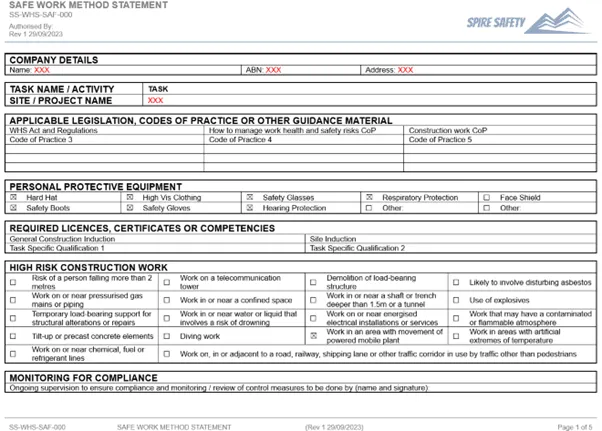
To complete the SWMS, fill in the details on the front page, including:
- Company details,
- Task, site and PPE details,
- Any relevant codes of practice, licences and high risk construction work, and
- Person responsible for monitoring and ensuring compliance.
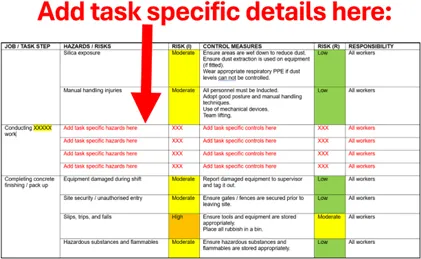
Ensure task-specific hazards and controls are added:
 Other factors that need to be considered include, but are not limited to, ensuring that:
- Relevant legal requirements have been met,
- Workplace specific risks are identified and managed, and
- Workers are consulted with during the customisation / review process.
When to Use
Workers should read and agree to comply with the Belt Sander SWMS prior to operation within your business. It can also be used for refresher training and during the induction / onboarding process.
Who Should Use
Belt Sander SWMS should be developed by a competent person, in consultation with workers. The SWMS is then read and followed by the workers. New workers should also read and understand all applicable site / company SWMS during the induction or onboarding process.
Legal Considerations
Legally, businesses (or PCBUs) need to ensure a Safe Work Method Statement is completed prior to high-risk construction work commencing. The requirement for SWMS is outlined in:
- s(299) WHS Regulations – Safe Work Method Statements,
- s(300) WHS Regulations – Compliance with Safe Work Method Statements,
- s(301) WHS Regulations – SWMS Collection by Principal Contractor,
- s(302) WHS Regulations – Review of SWMS, and
- s(303) WHS Regulations – SWMS Record Keeping.
A SWMS may also help to meet:
- s(19)(3)c WHS Act – Duty to Provide Safe Systems of Work.
Depending on the task being completed, the following legal requirements may apply:
- s(44 – 47) WHS Regulations – Personal Protective Equipment,
- s(49 – 50) WHS Regulations – Managing Risks from Airbourne Contaminants,
- s(51 – 52) WHS Regulations – Hazardous Atmospheres,
- s(54 – 55) WHS Regulations – Falling Objects,
- s(56 – 59) WHS Regulations – Noise,
- s(60 – 61) WHS Regulations – Hazardous Manual Tasks,
- s(62 – 77) WHS Regulations – Confined Spaces,
- s(78 – 80) WHS Regulations – Falls,
- s(81) WHS Regulations – High Risk Work (Licensing),
- Part 4.6 WHS Regulations – Demolition Work,
- Part 4.7 WHS Regulations – General Electrical Safety,
- Part 4.9 WHS Regulations – Crystalline Silica,
- Chapter 5 WHS Regulations – Plant and Structures,
- Chapter 6 WHS Regulations – Construction Work,
- Chapter 7 WHS Regulations – Hazardous Chemicals, and
- Chapter 8 WHS Regulations – Asbestos.
FAQ's
What is High Risk Construction Work?
High risk construction work is defined in WHS Regulations s(291). Some common types of high risk construction work are:
- Working at heights over 2m,
- Working in a trench or excavation over 1.5m,
- Work with mobile plant,
- Work on or adjacent to a roadway, and
- Work in confined spaces.
For a full list of high risk construction work, read our article 18 High Risk Construction Work Activities.
What is a Belt Sander?
A belt sander is a powerful handheld or stationary power tool used for smoothing and shaping wood, metal, and other materials. It features a continuous loop of sandpaper, or abrasive belt, that rotates rapidly to grind and sand surfaces.
What Hazards Are Involved in Belt Sander Use?
Some hazards that are involved in belt sander use include:
- Cuts, abrasions and lacerations,
- Dust,
- Noise,
- Electric shock (corded models),
- Musculoskeletal injuries, and
- Fire hazards.
How Often Does a Belt Sander SWMS Need to be Reviewed?
SWMS should be reviewed to ensure safety controls remain effective after:
- The task or environment changes,
- New processes or systems are incorporated into the task, and/or
- Following incidents or safety alerts.
If the task or environmental conditions do not change, SWMS should be reviewed informally by workers prior to each job with a "formal" (documented) review at least yearly.
Did You Know?
The belt sander was invented by Eugen Laegler in Germany in 1969, revolutionising the process of wood floor sanding by significantly reducing labour time and improving surface finish quality. Today, belt sanders are essential tools in woodworking, carpentry, and metalworking, renowned for their ability to quickly smooth large surfaces and remove material efficiently.
Article Sources and Further Reading
- A Comprehensive Guide to Safe Work Method Statements (Spire Safety)
- The Complete Guide to WHS Policies and Procedures in Australia (Spire Safety)
- Safe Work Method Statement for High Risk Construction Work (Safe Work Australia) https://www.safeworkaustralia.gov.au/system/files/documents/1703/information-sheet-safe-work-method-statement.pdf
Legal references
Legal considerations
The following legal requirements may be relevant to this type of work.
- Work Health and Safety Act (Harmonised) — Provides the primary duties for protecting workers and other people from work health and safety risks.
- Work Health and Safety Regulations (Harmonised) — Sets out requirements supporting the management of workplace hazards and risks.
The following codes may be relevant to this type of work.
- Managing WHS Risks Code of Practice — Provides practical guidance on identifying hazards, assessing risks and applying effective controls.
- Work Health and Safety Consultation, Cooperation and Coordination Code of Practice — Provides practical guidance on consulting workers and coordinating with other duty holders.
- Managing the Work Environment and Facilities Code of Practice — Provides practical guidance on safe work environments, workplace facilities and related controls.
Share this resource
Browse Categories
How To Use It
- 1Download and open in Word or PDF.
- 2Replace the placeholders with your business details.
- 3Get it reviewed by a WHS specialist before rollout.
Need it customised?
Our WHS consultants can adapt this template to your site, run a gap analysis, or audit what you already have in place.
Book a Free Consultation WHS consulting servicesor call 1300 156 382
Related templates
- Free Bricklaying SWMS (Safe Work Method Statement) Template
- Free Building SWMS (Safe Work Method Statement) Template
- Free Cabinet Making SWMS (Safe Work Method Statement) Template
- Free Carpentry SWMS (Safe Work Method Statement) Template
- Free Chainsaw SWMS (Safe Work Method Statement) Template
- Free Circular Saw SWMS (Safe Work Method Statement) Template