
Free WHS Self-Audit Tool & WHS Audit Checklist
Self-audit your own workplace against the model Work Health and Safety Act and Regulations. Work through 59 checklist questions across 34 regulation areas and get a printable, risk-ranked report. Want an independent auditor instead? See our WHS auditing services.
- Built by senior WHS auditors and consultants
- Based on the model WHS Act & Regulations
- Australian-owned — Spire Safety Pty Ltd
- Useful for most Australian businesses
Watch: how the WHS audit works
A short walkthrough of the WHS audit — how the questions are structured, how to answer them accurately, and what the report gives you at the end.
The WHS audit report you get at the end
When you finish the questions, the audit produces a branded, printable report — gaps identified up front, then a complete record of every response with the WHS Act or Regulation reference beside it. Print it or save it as a PDF for your records, your board, your insurer or a principal contractor.
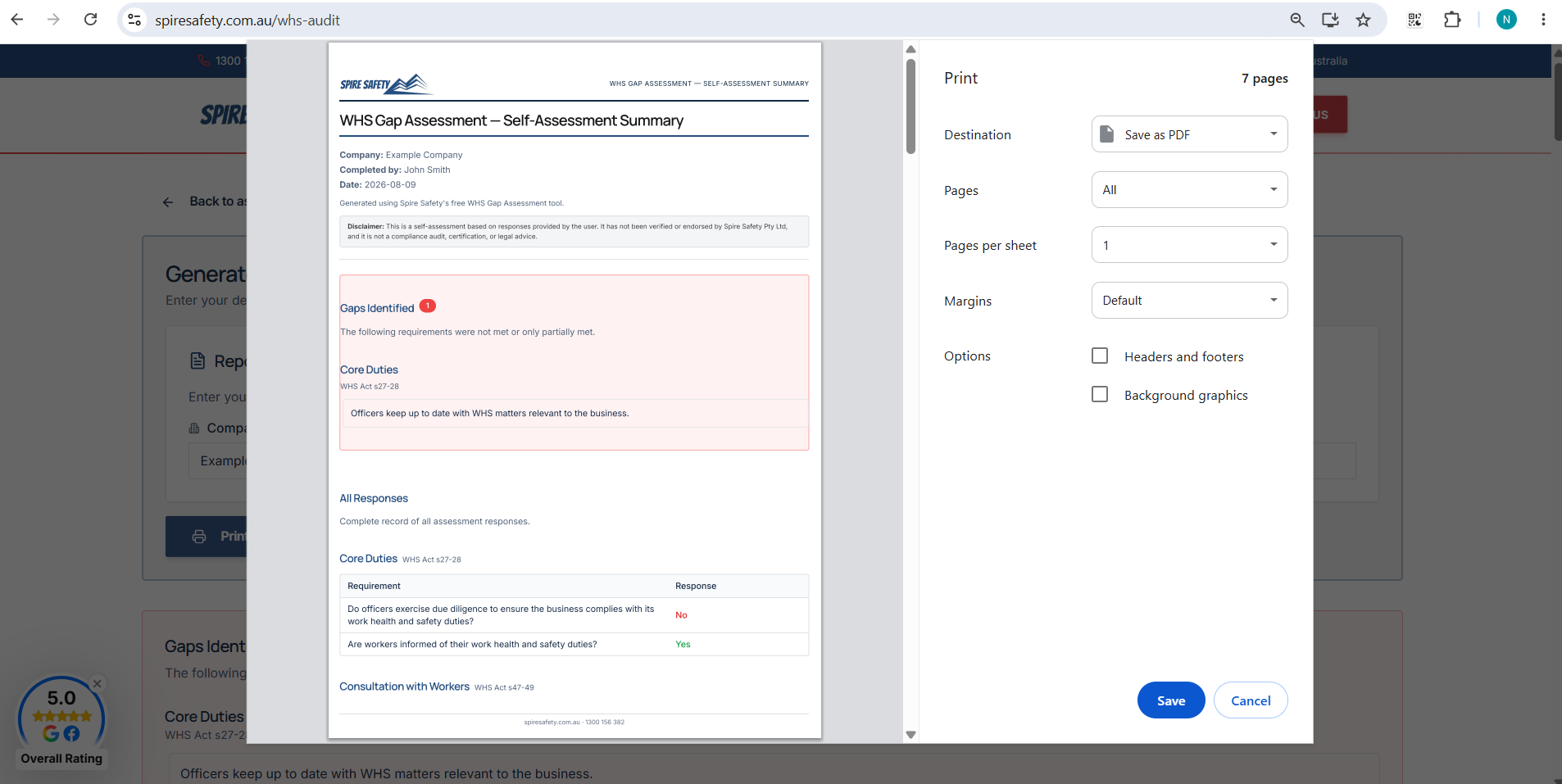
- Gaps identified first, with the requirement that was not met
- Every response recorded against its WHS Act or Regulation clause
- Company name, completed-by and date on the cover
- Print or save as a PDF — no account, no email required
The WHS audit methodology our auditors work from
This is the same WHS audit our consultants run when they walk onto a client site, structured so you can work through it yourself. Every question maps to a duty in the model WHS Act, the WHS Regulations as adopted in your jurisdiction, or a model Code of Practice — so the gaps it surfaces are the gaps a regulator, an insurer or a principal contractor would ask about.
It is deliberately a self-audit. You answer honestly about your own workplace and the report tells you where you stand. There is no external assessor, no certificate and no legal finding at the end of it — just a clear, evidence-based picture of what is in place, what is missing, and what to fix first.
What the WHS audit covers
The audit works through 34 areas of the WHS Regulations, grouped so you can skip anything that does not apply to your business. The main areas are:
- Duties of PCBUs, officers and workers
- Risk management and the hierarchy of controls
- Consultation, representation and issue resolution
- Incident notification and record keeping
- Emergency plans, first aid and facilities
- Psychosocial hazards and workplace behaviour
- Hazardous chemicals, SDS and the chemical register
- Plant, machinery and powered mobile plant
- Working at heights and falls prevention
- Confined spaces and hazardous atmospheres
- Noise, hazardous manual tasks and airborne contaminants
- High risk work licensing and competency
- Contractor and labour hire management
- Construction work and SWMS requirements
How to conduct a WHS audit
- 1
Gather your evidence first
Have your WHS policy, risk register, induction and training records, chemical register, plant register, incident records and consultation minutes to hand. The audit is only as good as the evidence behind your answers.
- 2
Work through the 34 regulation areas
Answer each question about what is actually happening on site, not what the folder says. Skip whole sections that do not apply — the report accounts for it.
- 3
Save your progress if you need to
A private save link lets you pause, gather evidence, involve a supervisor or HSR, and come back to finish later.
- 4
Generate and print your WHS audit report
You get a plain-English report listing each gap and a risk-ranked order of priority. Print it or save it as a PDF for your management review and safety records.
- 5
Close the gaps, then verify
Assign each finding an owner and a due date. Re-run the self-audit after the work is done, and bring in an independent auditor when you need verified assurance.
Self-audit or independent WHS audit — which do you need?
A self-audit is the right starting point when you want to understand your position, build an improvement plan, or prepare before someone else looks at your system. It costs nothing but your time, and you can repeat it as often as you like.
An independent WHS compliance audit is what you need when the finding has to hold up outside your business — for a board, an insurer, a principal contractor's prequalification, a certification body, or after a notifiable incident. Our auditors verify evidence on site, interview workers, and issue a formal report with a corrective action plan.
If this self-audit shows gaps at the system level rather than the task level, the fix is usually a documented system: WHS management systems or ISO 45001 certification support. For day-to-day help closing findings, see WHS consulting.
Our WHS auditors
The audit questions, scoring and report were written by the senior consultants who conduct WHS audits for our clients — across construction, mining, manufacturing, transport and professional services. If you would rather have an auditor do the work, or you want a second opinion on your findings, these are the people you will be speaking with.


Read more about the team on our people, or call 1300 156 382 to discuss an independent WHS audit of your workplace.
Related WHS audit guides
Reading before you start? These guides explain what an audit should cover and what happens once you have your findings.
- What to include in your WHS audit
The scope, evidence and records an audit should cover.
- Site safety audit & plan
How to plan and run an audit across a live worksite.
- WHS management systems & auditing guidelines
How auditing fits into a documented WHS management system.
- Preparing for an ISO certification audit
What changes when an external certification body audits you.
What a WHS audit looks like in practice
"Nathan was amazing to deal with — from getting a quote to receiving our audit report. He gave practical advice stemming from clear industry experience, and was professional, helpful and friendly in all his communications."
"He went above and beyond to help us improve our systems, and it's easy to see he genuinely cares about safety. An exceptional experience dealing with Spire."
The self-audit gives you the findings. If you want an independent auditor to verify them, close them out, or issue a formal report for a client, insurer or board, see our WHS compliance auditing service or read more client reviews.
How much does a WHS audit cost?
WHS audit costs depend on scope, site size, risk profile and how many locations are involved. As a guide, a single site inspection starts from around $1,000, and a large, multi-site or high-risk audit can run to $10,000 or more. Most independent WHS audits sit in the $2,000 to $4,000 range.
- From $1,000Site inspection
Single site, focused walkthrough and short report.
- $2,000 – $4,000Typical WHS audit
Documentation, site, interviews and full report.
- $10,000+Complex or multi-site
Multiple sites, high-risk work or ISO 45001 scope.
Running this self-audit first usually lowers the cost of an independent audit — you arrive with your documentation gaps already identified. Call 1300 156 382 for a fixed-price quote.
What an independent WHS audit includes
An independent WHS audit conducted by a Spire Safety consultant generally covers five stages:
- 1Review of documentation and systems
Policies, procedures, registers, records, training matrices and your WHS management system — checked against the duties that apply to your business.
- 2Review of the site and facilities
A physical walkthrough of the workplace, plant, amenities and high-risk areas to confirm controls are in place and working, not just documented.
- 3Discussion with key staff
Interviews with managers, supervisors, HSRs and workers to test whether consultation, training and reporting arrangements operate in practice.
- 4Audit report
A plain-English report with risk-ranked findings, supporting evidence and an executive summary suited to senior leadership or a board.
- 5Recommendations and closeout
A prioritised corrective action plan with owners and target dates, and an optional follow-up review to verify actions have been closed out.
See WHS compliance auditing for the full service, or WHS management systems if the audit uncovers system-level gaps.
WHS audits by state and territory
The audit questions are written against the model WHS Act and Regulations. Most states and territories have adopted the model laws with local variations; Victoria has not. Here is what applies where you operate.
WHS audit in Queensland
Queensland applies the Work Health and Safety Act 2011 (Qld) and WHS Regulation 2011, regulated by Workplace Health and Safety Queensland, with separate legislation for mining and resources. Psychosocial hazard duties and the managing the risk of psychosocial hazards code apply.
WHS consultants in BrisbaneWHS audit in New South Wales
NSW applies the Work Health and Safety Act 2011 (NSW) and WHS Regulation 2017, regulated by SafeWork NSW. Construction, plant and hazardous chemicals requirements closely follow the model laws.
WHS consultants in SydneyWHS audit in Victoria
Victoria has not adopted the model WHS laws. Victorian workplaces are governed by the Occupational Health and Safety Act 2004 and OHS Regulations 2017, regulated by WorkSafe Victoria. Most audit content still applies, but duty wording, incident notification and consultation requirements differ.
WHS consultants in MelbourneWHS audit in Western Australia
WA adopted the model laws through the Work Health and Safety Act 2020 (WA) and WHS (General) Regulations 2022, regulated by WorkSafe WA, with separate mines and petroleum regulations.
WHS consultants in PerthWHS audit in South Australia
SA applies the Work Health and Safety Act 2012 (SA) and WHS Regulations 2012, regulated by SafeWork SA.
WHS consultants in AdelaideWHS audit in Tasmania, the ACT and the Northern Territory
Tasmania (WHS Act 2012), the ACT (WHS Act 2011) and the Northern Territory (Work Health and Safety (National Uniform Legislation) Act 2011) all apply the model laws, regulated by WorkSafe Tasmania, WorkSafe ACT and NT WorkSafe respectively.
All service locationsWHS audit — frequently asked questions
Ready to see where you stand?
Start your WHS audit now, or talk to a senior WHS auditor about an independent audit of your workplace.