
Free Band Saw VOC (Verification of Competency) Template
Download our free Band Saw VOC (Verification of Competency) Template in Word and PDF format. Verify worker competence in band saw use, aligned with AS45001:2018.
Download Free Band Saw VOC (Verification of Competency) Template
DOCX + PDF
Updated Oct 2026
No signup required
By downloading you agree to our Free Resources Licensing Agreement.
Download our free Band Saw VOC Template:
*For internal use only. Not for resale or redistribution. By downloading, you agree to our Free Resources Licensing Agreement.
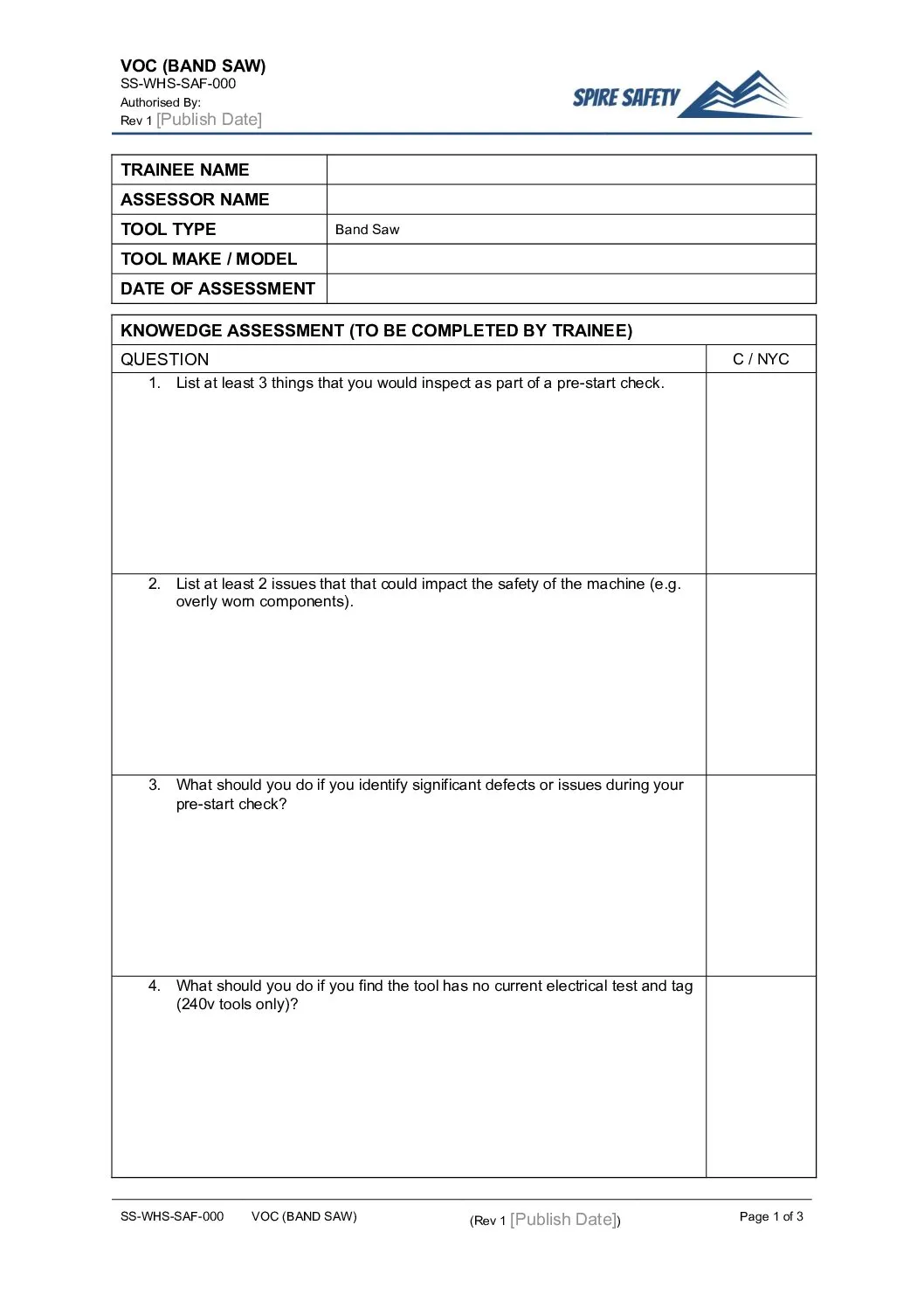
Preview of the Band Saw VOC template — covering operator competency criteria, pre-operation checks, safe operation steps, post-operation tasks and key hazards for band saw use.
Purpose of a Band Saw VOC Document
Band saw VOCs are used to verify a worker's competence in band saw use. The primary goal is to protect workers from injury or illness through effective training and competency procedures. This form is broadly aligned with AS45001:2018.
How to Use
This Band Saw VOC should be completed by a competent person in consultation with the trainee who will use the plant.
This document is a template only and it must be customised for your business. Other aspects that may need to be considered include, but are not limited to, ensuring that:
Relevant legal requirements have been met,
Workplace specific risks are identified and managed, and
Workers are consulted with during the customisation / review process.
When to Use
Band saw VOCs should be completed prior to the worker operating plant or equipment within your business.
Who Should Use
Band saw VOCs must be completed by someone who is familiar with operation of the piece of plant or equipment. This person should also be competent in training and assessment methods.
Legal Considerations
There is no specific legal requirement to complete a documented Verification of Competency (VOC). However, it is best practice. Completing a thorough Verification of Competency can help meet general legal duties, including:
s(19)(3)c WHS Act – Duty to Provide Safe Systems of Work
s(19)(3)d WHS Act – Duty to Ensure Safe Use of Plant
s(19)(3)f WHS Act – Duty to Provide Adequate Information, Training, Instruction and Supervision
s(203) WHS Regulations – Management of Risks to Health and Safety (PCBUs with management or control of plant)
The Code of Practice "Managing risks of plant in the workplace" states that employers (PCBUs) must ensure workers are trained and have the appropriate skills to carry out a particular task safely.
FAQ
What is a band saw?
A band saw is a power tool used primarily for cutting various materials such as wood, metal, plastic, and foam. It consists of a continuous looped blade with teeth that rotates on two wheels to make precise and curved cuts. Band saws are commonly used in woodworking, metalworking, and manufacturing for tasks such as cutting intricate shapes, resawing lumber, and ripping stock. They come in various sizes and configurations, including benchtop, floor-standing, and portable models, offering different levels of power and cutting capacity for various applications.
What is a band saw used for?
A band saw is primarily used for cutting irregular shapes, curves, and straight lines in wood, metal, plastic, and other materials. It consists of a continuous band of teethed metal stretched between two wheels that rotate, allowing the material to be cut as it passes through the blade. Band saws are commonly used in woodworking, metalworking, and fabrication shops for tasks such as ripping lumber, cutting veneers, resawing boards, and creating intricate shapes or patterns. They are versatile tools that offer precision, efficiency, and flexibility in cutting various materials.
What hazards are involved in band saw use?
Many hazards exist in band saw operation, for example:
Lacerations
Struck-By Accidents
Electrocution
Kickback
Noise Exposure
Eye Injuries
To mitigate these hazards, proper training, adherence to safety protocols, regular equipment maintenance, use of personal protective equipment (PPE), and thorough site inspections are essential.
Do you need training to operate a band saw?
In general, the level of training provided to workers must take into consideration "the nature of the work, the nature of the risks and the control measures required" – WHS regulations s(39). That is, for plant that poses no or minimal risks, there may be very little training required. As the risks of the plant increases, the requirement for training also increases.
To demonstrate competence in band saw operation, workers can complete the RTO unit https://training.gov.au/Training/Details/RIICRC319E.
Did You Know?
Did you know that the history of band saws dates back to the early 19th century? The concept of the band saw, a continuous blade with teeth running on two or more wheels, was developed and patented in the 1800s. Initially used for cutting wood, the band saw quickly gained popularity and found applications in metalworking, lumber mills, and industries requiring precise and intricate cuts. Today, band saws continue to be versatile and indispensable tools in various sectors, enabling efficient and accurate cutting of a wide range of materials.
Article Sources and Further Reading
Legal references
Legal considerations
The following legal requirements may be relevant to this type of work.
- Work Health and Safety Act (Harmonised) — Provides the primary duties for protecting workers and other people from work health and safety risks.
- Work Health and Safety Regulations (Harmonised) — Sets out requirements supporting the management of workplace hazards and risks.
The following codes may be relevant to this type of work.
- Managing WHS Risks Code of Practice — Provides practical guidance on identifying hazards, assessing risks and applying effective controls.
- Work Health and Safety Consultation, Cooperation and Coordination Code of Practice — Provides practical guidance on consulting workers and coordinating with other duty holders.
- Managing the Work Environment and Facilities Code of Practice — Provides practical guidance on safe work environments, workplace facilities and related controls.
Share this resource
Browse Categories
How To Use It
- 1Download and open in Word or PDF.
- 2Replace the placeholders with your business details.
- 3Get it reviewed by a WHS specialist before rollout.
Need it customised?
Our WHS consultants can adapt this template to your site, run a gap analysis, or audit what you already have in place.
Book a Free Consultation WHS consulting servicesor call 1300 156 382
Related templates
- Free Belt Sander VOC (Verification of Competency) Template
- Free Bench Grinder VOC (Verification of Competency) Template
- Free Body Truck VOC (Verification of Competency) Template
- Free Boom Pump VOC (Verification of Competency) Template
- Free Brush Cutter VOC (Verification of Competency) Template
- Free Chainsaw VOC (Verification of Competency) Template