
Safe Work Method Statement (Wheel Loader Operation) Template
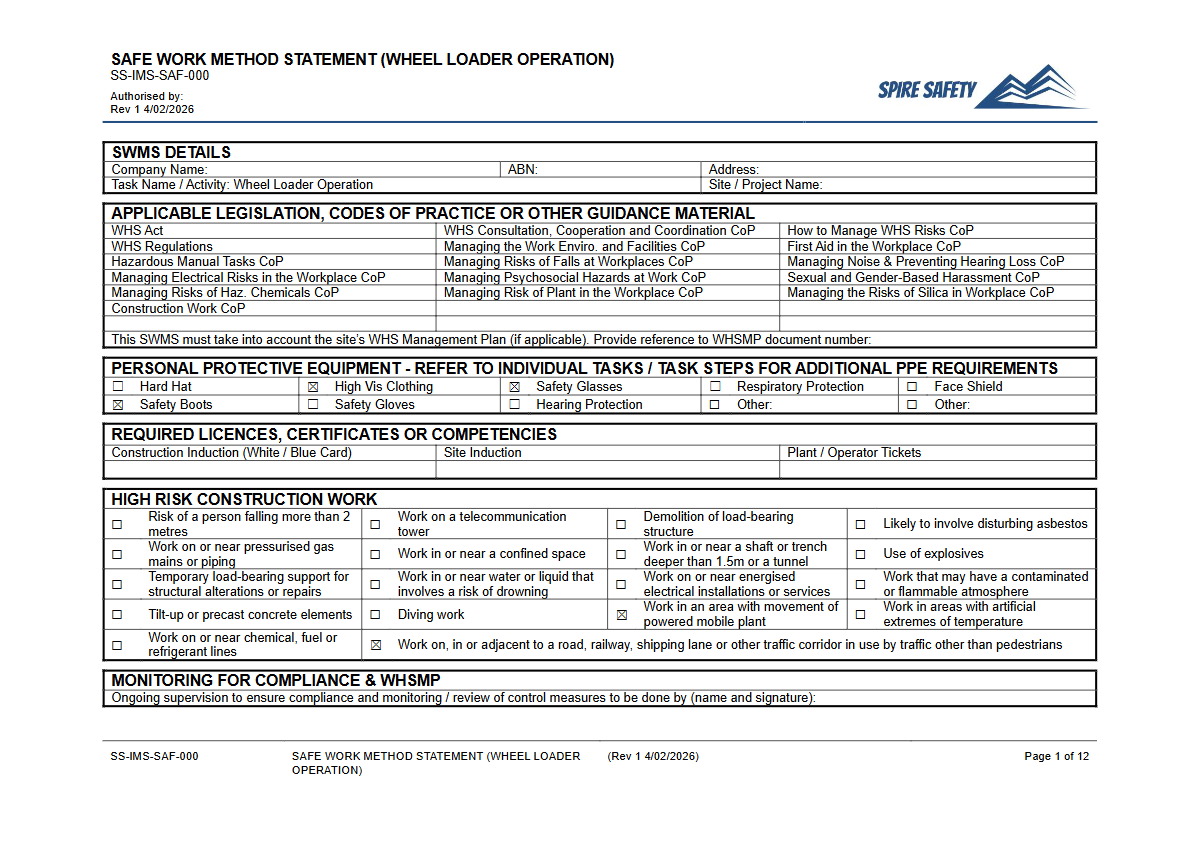
Download a free Safe Work Method Statement (SWMS) for Wheel Loader Operation. A structured starting point for your workplace safety documentation.
Safe Work Method Statement (Wheel Loader Operation) Template
DOCX • 161 KB + PDF
Updated Oct 2026
No signup required
Purpose of the Safe Work Method Statement (Wheel Loader Operation) Template
This free WHS resource provides a foundational Safe Work Method Statement (SWMS) template specifically designed for wheel loader operation in Australian workplaces. The document outlines a systematic approach to identifying hazards, assessing risks, and implementing control measures during the use of wheel loaders.
It serves as a critical safety document to ensure that all tasks involving wheel loaders are conducted safely, minimising risks to workers and others in the vicinity. By utilising a structured SWMS, organisations can clearly communicate the steps required to manage workplace health and safety effectively.
Video walkthrough
How to use the Safe Work Method Statement (Wheel Loader Operation) Template
This Safe Work Method Statement (Wheel Loader Operation) template is provided as a starting point for developing your workplace-specific documentation. To effectively use this resource, download the DOCX version and customise it to reflect the unique characteristics of your site, specific wheel loader models, operational procedures, and the competency of your operators.
You must ensure all identified hazards, assessed risks, and control measures are relevant and practicable for your work environment. This template is designed to align with Australian WHS practice, but compliance ultimately depends on how you adapt and implement it within your organisation.
Remember, a SWMS is a living document and should be reviewed and updated regularly.
When to use it
A SWMS for wheel loader operation should be developed and implemented before any work activity involving a wheel loader commences. This is particularly crucial for 'high-risk construction work' as defined in WHS Regulations.
It should also be reviewed and updated whenever there are changes to the work environment, equipment, personnel, or if an incident or near-miss occurs related to wheel loader operation. Regular reviews ensure the SWMS remains effective and relevant to current work practices.
Who should use it
This template is ideal for Persons Conducting a Business or Undertaking (PCBUs), WHS managers, site supervisors, and project managers responsible for overseeing operations that involve wheel loaders. It is also a valuable tool for safety officers and WHS consultants who assist organisations in developing robust WHS management systems. Workers involved in wheel loader operation should be consulted during its development and implementation, and trained on its contents.
Key components of a Wheel Loader SWMS
A comprehensive SWMS for wheel loader operation should typically include:
- Details of the work activity being undertaken.
- Identification of specific hazards associated with wheel loader use (e.g., rollovers, collisions, falls, noise, dust, crushing injuries).
- Assessment of the risks arising from these hazards.
- Detailed control measures to eliminate or minimise the identified risks, following the hierarchy of controls.
- Procedures for monitoring and reviewing the effectiveness of control measures.
- Responsibilities of personnel involved in the task.
- Required plant and equipment, including pre-operational checks.
- Emergency procedures relevant to wheel loader operation.
Maintaining your SWMS validity
To ensure your SWMS remains valid and effective, it's essential to conduct regular reviews and updates. This includes post-incident reviews, scheduled periodic reviews, and updates following any changes to equipment, processes, or workplace conditions.
Comprehensive WHS compliance auditing can help verify the ongoing effectiveness of your SWMS and overall safety documentation.
Training and competency
All workers involved in wheel loader operation must receive appropriate training and demonstrate competency. This includes not only operating the machinery safely but also understanding and adhering to the SWMS.
Training should cover operational procedures, hazard identification, emergency responses, and the correct use of personal protective equipment (PPE).
Common mistakes
Common mistakes to avoid
- Using generic SWMS without customising them to specific site conditions and equipment.
- Failing to adequately consult with workers who perform the wheel loader operation.
- Not reviewing or updating the SWMS after incidents, near misses, or changes in work practices.
- Inadequate communication of the SWMS content to all relevant workers.
Legal references
Legal considerations
The following legal requirements may be relevant to this type of work.
- Work Health and Safety Act (Harmonised) — Provides the primary duties for protecting workers and other people from work health and safety risks.
- Work Health and Safety Regulations (Harmonised) — Sets out requirements supporting the management of workplace hazards and risks.
The following codes may be relevant to this type of work.
- Managing WHS Risks Code of Practice — Provides practical guidance on identifying hazards, assessing risks and applying effective controls.
- Work Health and Safety Consultation, Cooperation and Coordination Code of Practice — Provides practical guidance on consulting workers and coordinating with other duty holders.
- Managing the Work Environment and Facilities Code of Practice — Provides practical guidance on safe work environments, workplace facilities and related controls.
Did you know
Wheel Loader Rollovers
Rollovers account for a significant percentage of serious injuries and fatalities involving wheel loaders, often due to operating on uneven ground or at excessive speeds.
Blind Spots
Wheel loaders typically have large blind spots, especially to the rear. Effective control measures include spotters, mirrors, cameras, and exclusion zones.
FAQ
Frequently asked questions
01What is a Safe Work Method Statement (SWMS) for a wheel loader?
02Is a SWMS legally required for operating a wheel loader?
03How often should a Wheel Loader SWMS be reviewed?
04Who is responsible for preparing a SWMS for wheel loader operations?
Share this resource
Safe Work Method Statement (Wheel Loader Operation) Template
Browse Categories
How To Use It
- 1Download and open in Word or PDF.
- 2Replace the placeholders with your business details.
- 3Get it reviewed by a WHS specialist before rollout.
Need it customised?
Our WHS consultants can adapt this template to your site, run a gap analysis, or audit what you already have in place.
Book a Free Consultation WHS consulting servicesor call 1300 156 382
Related templates
- Free Angle Grinder SWMS (Safe Work Method Statement) Template
- Free Belt Sander SWMS (Safe Work Method Statement) Template
- Free Bricklaying SWMS (Safe Work Method Statement) Template
- Free Building SWMS (Safe Work Method Statement) Template
- Free Cabinet Making SWMS (Safe Work Method Statement) Template
- Free Carpentry SWMS (Safe Work Method Statement) Template