
Verification of Competency (Boom Lift or Knuckle Boom) Template
Download our free Verification of Competency (Boom Lift or Knuckle Boom) Template. Ensure your boom and knuckle boom operators are competent.
Verification of Competency (Boom Lift or Knuckle Boom) Template
DOCX • 138 KB + PDF
Updated Oct 2026
No signup required
Purpose of the Verification of Competency (Boom Lift or Knuckle Boom) Template
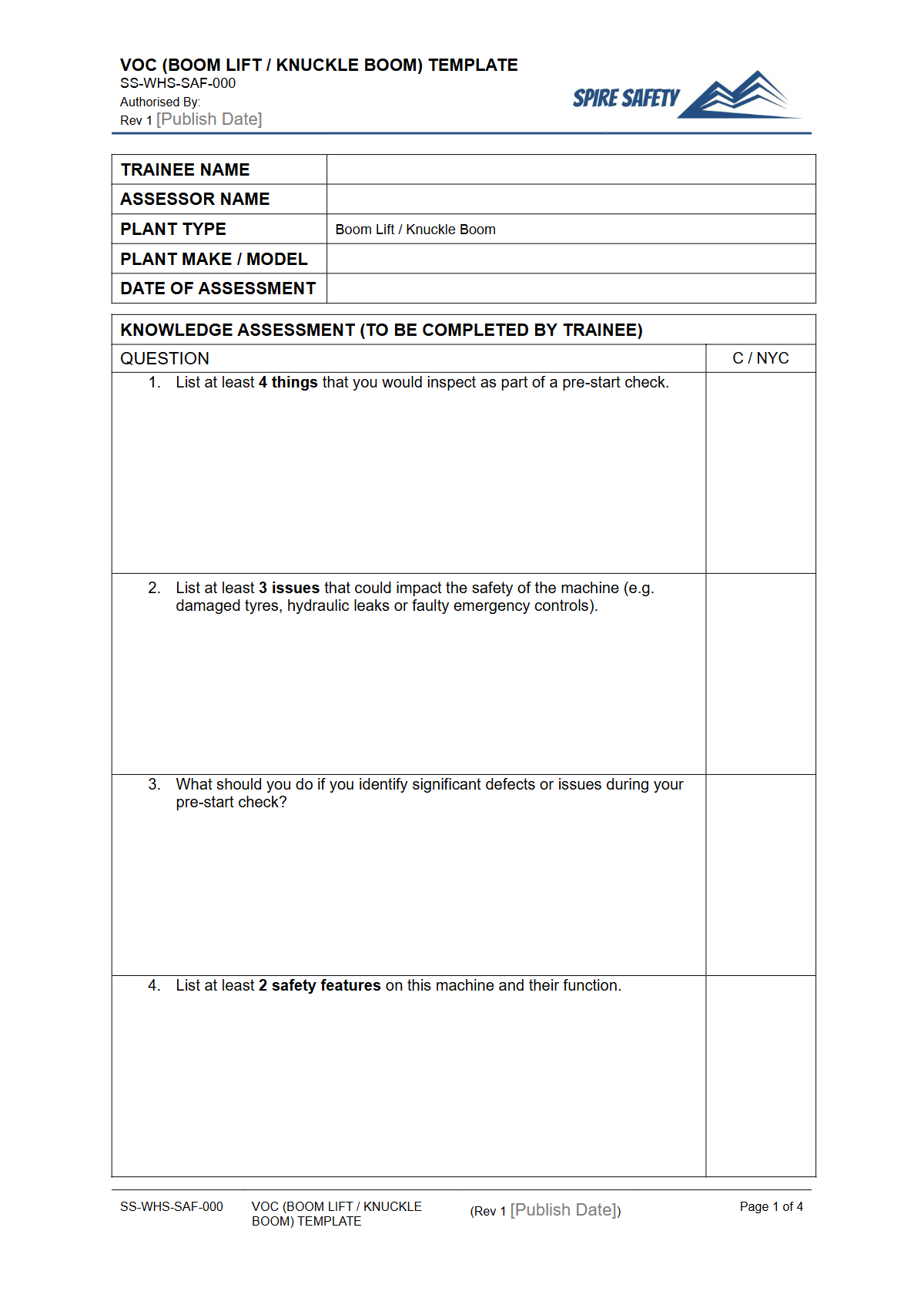
Our free Verification of Competency (Boom Lift or Knuckle Boom) Template is designed to help Australian workplaces formally assess and verify the current skills and knowledge of operators for boom lifts (also known as elevated work platforms or EWP) and knuckle booms. This template provides a structured approach to confirm that an operator can safely and effectively perform tasks involving these high-risk plant items.
Utilising a robust VOC process is essential for demonstrating due diligence and ensuring that health and safety risks associated with operating complex machinery are appropriately managed. It supports employers in meeting their responsibility to provide a safe working environment and competent workers.
Boom lifts and knuckle booms are critical pieces of equipment in many industries, including construction, maintenance, and logistics. Ensuring operators possess the necessary competencies and remain current in their skills is vital for preventing incidents.
This template is aligned with Australian WHS practice, offering a practical tool for assessing these specific competencies on an ongoing basis, significantly contributing to the overall safety culture within your organisation.
Video walkthrough
How to use the Verification of Competency (Boom Lift or Knuckle Boom) Template
This Verification of Competency (Boom Lift or Knuckle Boom) Template offers a systematic framework for evaluating operator competence. To use it effectively, download the DOCX or PDF version and customise it to reflect your specific operational procedures, site conditions, and the exact models of boom lifts or knuckle booms used in your workplace.
It includes sections for assessing theoretical knowledge, practical skills, and hazard identification related to these plant items. An assessor, who must be a competent person with relevant experience, will use this template to observe and question the operator.
We recommend you integrate this VOC process into your broader WHS management systems. Regularly reviewing operator performance and updating their competency records is crucial. Remember, this template is a starting point, and it must be customised to your workplace's specific requirements, plant, and operational context to be effective and relevant. It's also vital to ensure that any training or assessment is conducted in accordance with Australian standards and industry best practices.
For specific equipment like a skid-steer loader or a vac truck, similar VOC processes would be applied using the relevant templates.
When to use it
A Verification of Competency for boom lift or knuckle boom operators should be used in several key situations to maintain high safety standards:
- Upon initial employment: Even if an operator presents a licence, a VOC confirms their current competence with your specific equipment and site procedures.
- Introduction of new plant: When new models or types of boom lifts or knuckle booms are introduced, operators require a VOC tailored to the new equipment.
- Changes in work procedures: If there are significant changes to how boom lifts or knuckle booms are used or maintained, a VOC can ensure operators understand the new requirements.
- Following an incident: After any incident involving a boom lift or knuckle boom, a VOC can help determine if competency was a contributing factor and identify areas for retraining.
- After a period of inactivity: If an operator has not used a boom lift or knuckle boom for an extended period, a VOC can refresh their skills and ensure they are still proficient.
- As part of a regular review cycle: Periodic VOCs – often every 2-3 years, or as determined by your risk assessment – are good practice to ensure ongoing competency. This is similar to the review cycles for mitre saw operators or those using a roller.
Who should use it
This Verification of Competency template is intended for Australian businesses and organisations that operate boom lifts or knuckle booms and are responsible for ensuring the safety and competence of their workers. This includes:
- Employers and PCBUs (Persons Conducting a Business or Undertaking): To fulfil their primary duty of care in providing a safe workplace and competent workers.
- WHS Managers and Safety Officers: For implementing and managing the VOC process as part of their overall WHS responsibilities.
- Supervisors and Team Leaders: To assist in the on-site assessment of operators under their direction.
- HR Departments: For maintaining comprehensive competency records for all plant operators.
- Competent Assessors: Individuals appointed to conduct the VOC, who possess the necessary experience, training, and qualifications related to boom lift and knuckle boom operation.
- Internal and External Auditors: As a tool for WHS compliance auditing to verify that competency management processes are in place and effective.
Common mistakes
Common mistakes to avoid
- Failing to customise the VOC to specific plant models and site conditions.
- Not using a competent and experienced assessor to conduct the VOC.
- Solely relying on a VOC without linking it to broader training and risk management strategies.
- Neglecting to schedule periodic VOCs or conducting them reactively after an incident.
Legal references
Legal considerations
The following legal requirements may be relevant to this type of work.
- Work Health and Safety Act (Harmonised) — Provides the primary duties for protecting workers and other people from work health and safety risks.
- Work Health and Safety Regulations (Harmonised) — Sets out requirements supporting the management of workplace hazards and risks.
The following codes may be relevant to this type of work.
- Managing WHS Risks Code of Practice — Provides practical guidance on identifying hazards, assessing risks and applying effective controls.
- Work Health and Safety Consultation, Cooperation and Coordination Code of Practice — Provides practical guidance on consulting workers and coordinating with other duty holders.
- Managing the Work Environment and Facilities Code of Practice — Provides practical guidance on safe work environments, workplace facilities and related controls.
Did you know
Boom lift categories
Boom lifts are generally categorised into '1b' (self-propelled, manually propelled, or trailer mounted extending booms) and '3b' (self-propelled boom elevating work platforms) under Australian HRWL classifications, requiring different licences.
Knuckle booms vs. telescopic booms
While both are boom lifts, knuckle booms have multiple sections that 'knuckle' or bend, offering greater versatility in navigating obstacles, whereas telescopic boom lifts extend in a straight line for maximum reach.
FAQ
Frequently asked questions
01Does a VOC replace a High Risk Work Licence for boom lifts?
02How often should a boom lift or knuckle boom VOC be conducted?
03What qualifications should a vocational assessor have?
04Can this template be used for all types of EWPs?
Share this resource
Verification of Competency (Boom Lift or Knuckle Boom) Template
Browse Categories
How To Use It
- 1Download and open in Word or PDF.
- 2Replace the placeholders with your business details.
- 3Get it reviewed by a WHS specialist before rollout.
Need it customised?
Our WHS consultants can adapt this template to your site, run a gap analysis, or audit what you already have in place.
Book a Free Consultation WHS consulting servicesor call 1300 156 382
Related templates
- Verification of Competency (Bulldozer) Template
- Verification of Competency (Cement Mixer) Template
- Verification of Competency (Cherry Picker (Truck-Mounted)) Template
- Verification of Competency (Cold Cut Saw) Template
- Verification of Competency (Concrete Pump (Stationary)) Template
- Verification of Competency (Concrete Saw or Floor Saw) Template