
Verification of Competency (Cold Cut Saw) Template
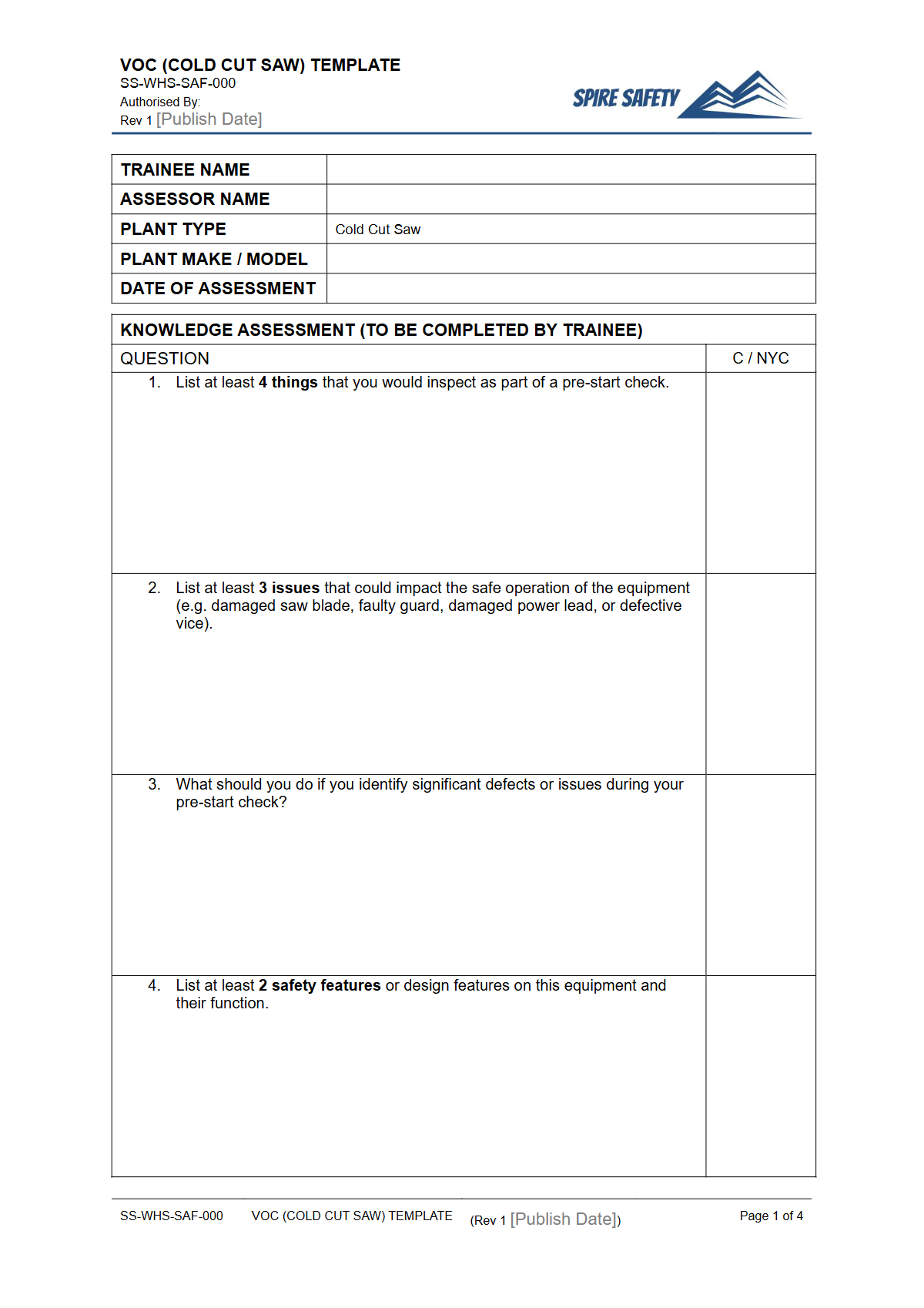
Download our free Cold Cut Saw Verification of Competency (VOC) Template in DOCX and PDF formats. Ensure worker competence today.
Verification of Competency (Cold Cut Saw ) Template
DOCX • 138 KB + PDF
Updated Oct 2026
No signup required
Purpose of the Verification of Competency (Cold Cut Saw) Template
This free Verification of Competency (Cold Cut Saw) Template is a structured starting point for assessing and documenting a worker's ability to safely operate a cold cut saw. Utilising a rigorous process for verifying competency, often referred to as a VOC, is crucial within Australian workplaces to ensure that individuals operating equipment possess the necessary skills, knowledge, and experience.
A cold cut saw, while effective for precision cutting of metals, presents specific hazards that require a high level of operational proficiency to mitigate risks.
The primary purpose of this template is to assist organisations in systematically evaluating whether a worker can perform tasks related to cold cut saw operation to the required industry standards and internal procedures. This includes confirming their understanding of pre-operational checks, safe operating techniques, maintenance requirements, and emergency procedures.
Documenting these assessments not only supports a safer work environment but also provides clear evidence of due diligence in managing plant-related risks.
Video walkthrough
How to use the Verification of Competency (Cold Cut Saw) Template
Our free Verification of Competency (Cold Cut Saw) Template is provided in both DOCX and PDF formats, offering flexibility for your operational needs. To use the DOCX version, download and open the file in a compatible word processor.
You will find sections to record worker details, assessor information, observed performance against key criteria, and a declaration of competency. We recommend populating this template with specific details relevant to the cold cut saw models used in your workplace and the specific tasks workers perform with them.
This template must be customised to your workplace to reflect your unique operational context, hazards, control measures, and specific WHS management systems. For example, you should detail the specific PPE required and site-specific emergency procedures.
For the PDF version, it can be used as a reference or a printable form for manual completion. Remember that an effective VOC involves both theoretical knowledge assessment and practical observation of a worker’s performance.
Ensure the assessor is appropriately qualified and experienced with cold cut saw operations. This template aligns with Australian WHS practice by promoting systematic verification of skills for hazardous plant.
When to use it
A Verification of Competency for a cold cut saw should be conducted in several critical scenarios:
- Initial Assignment: Before a worker operates a cold cut saw for the first time in your workplace, even if they have prior experience or qualifications.
- New Equipment: When a new model or type of cold cut saw is introduced that has different operational characteristics or safety features.
- Refresher Training: Periodically, especially after a set period (e.g., every 2-3 years), to ensure skills remain current and good practices are reinforced.
- Incident Review: Following an incident or near-miss involving a cold cut saw, a VOC can help identify contributing factors related to competency gaps.
- Performance Concerns: If there are observations of unsafe work practices or concerns about a worker's ability to operate the equipment safely.
- Legislative Changes: When significant changes to WHS legislation or codes of practice impact the safe operation of cold cut saws, requiring workers to update their knowledge and skills.
Regular verification helps maintain a high standard of safety and reduces the likelihood of incidents associated with inadequate operational skills.
Who should use it
This Verifications of Competency template is designed for a range of individuals and organisations committed to maintaining high WHS standards. It will be particularly useful for:
- Supervisors and Team Leaders: Responsible for overseeing operations and ensuring their team members are competent.
- WHS Managers and Officers: Tasked with developing, implementing, and monitoring WHS procedures and systems. For broader WHS advice, consider our general WHS consulting services.
- Training Coordinators: Involved in scheduling and documenting competency assessments and training programs.
- HR Departments: For onboarding new employees and managing ongoing competency records.
- Small to Medium Enterprises (SMEs): That may not have extensive WHS resources but need a structured approach to competency assurance.
- Contractors: Who need to demonstrate their workers' competency to principal contractors.
Ultimately, anyone involved in the management of plant safety or workforce competency will find this tool valuable. It complements other VOCs available, such as the Mitre Saw VOC or the Reciprocating Saw VOC, providing a comprehensive set of resources for various equipment.
Common mistakes
Common mistakes to avoid
- Not customising the template to specific workplace cold cut saw models and procedures.
- Using an unqualified or inexperienced person to conduct the VOC assessment.
- Failing to review or refresh VOCs periodically, or after incidents/changes in equipment.
- Confusing initial training with a formal verification of current competency.
Legal references
Legal considerations
The following legal requirements may be relevant to this type of work.
- Work Health and Safety Act (Harmonised) — Provides the primary duties for protecting workers and other people from work health and safety risks.
- Work Health and Safety Regulations (Harmonised) — Sets out requirements supporting the management of workplace hazards and risks.
The following codes may be relevant to this type of work.
- Managing WHS Risks Code of Practice — Provides practical guidance on identifying hazards, assessing risks and applying effective controls.
- Work Health and Safety Consultation, Cooperation and Coordination Code of Practice — Provides practical guidance on consulting workers and coordinating with other duty holders.
- Managing the Work Environment and Facilities Code of Practice — Provides practical guidance on safe work environments, workplace facilities and related controls.
Did you know
Cold Cut Saw vs. Abrasive Saw
Unlike abrasive saws that generate significant heat and sparks, cold cut saws use a slower, geared-down blade and coolant to produce cleaner, burr-free cuts with minimal heat, preserving material integrity.
Hearing Protection is Key
Even though cold cut saws operate with less heat, they can still generate high noise levels. Proper hearing protection is crucial, often requiring more than just basic earplugs to prevent noise-induced hearing loss.
FAQ
Frequently asked questions
01What is a Verification of Competency (VOC) for a cold cut saw?
02How often should a cold cut saw VOC be conducted?
03Who can perform a cold cut saw competency assessment?
04Is this cold cut saw VOC template legally binding in Australia?
Share this resource
Verification of Competency (Cold Cut Saw) Template
Browse Categories
How To Use It
- 1Download and open in Word or PDF.
- 2Replace the placeholders with your business details.
- 3Get it reviewed by a WHS specialist before rollout.
Need it customised?
Our WHS consultants can adapt this template to your site, run a gap analysis, or audit what you already have in place.
Book a Free Consultation WHS consulting servicesor call 1300 156 382
Related templates
- Verification of Competency (Concrete Pump (Stationary)) Template
- Verification of Competency (Concrete Saw or Floor Saw) Template
- Verification of Competency (Die Grinder) Template
- Verification of Competency (Diesel Generator) Template
- Verification of Competency (Electric Hoist or Chain Block) Template
- Verification of Competency (Floor Grinder) Template