
Verification of Competency (Electric Hoist or Chain Block) Template
Download our free Verification of Competency (Electric Hoist or Chain Block) Template. Ensure workers safely operate hoisting equipment. Get started today!
Verification of Competency (Electric Hoist or Chain Block) Template
DOCX • 138 KB + PDF
Updated Oct 2026
No signup required
Purpose of the Verification of Competency (Electric Hoist or Chain Block) Template
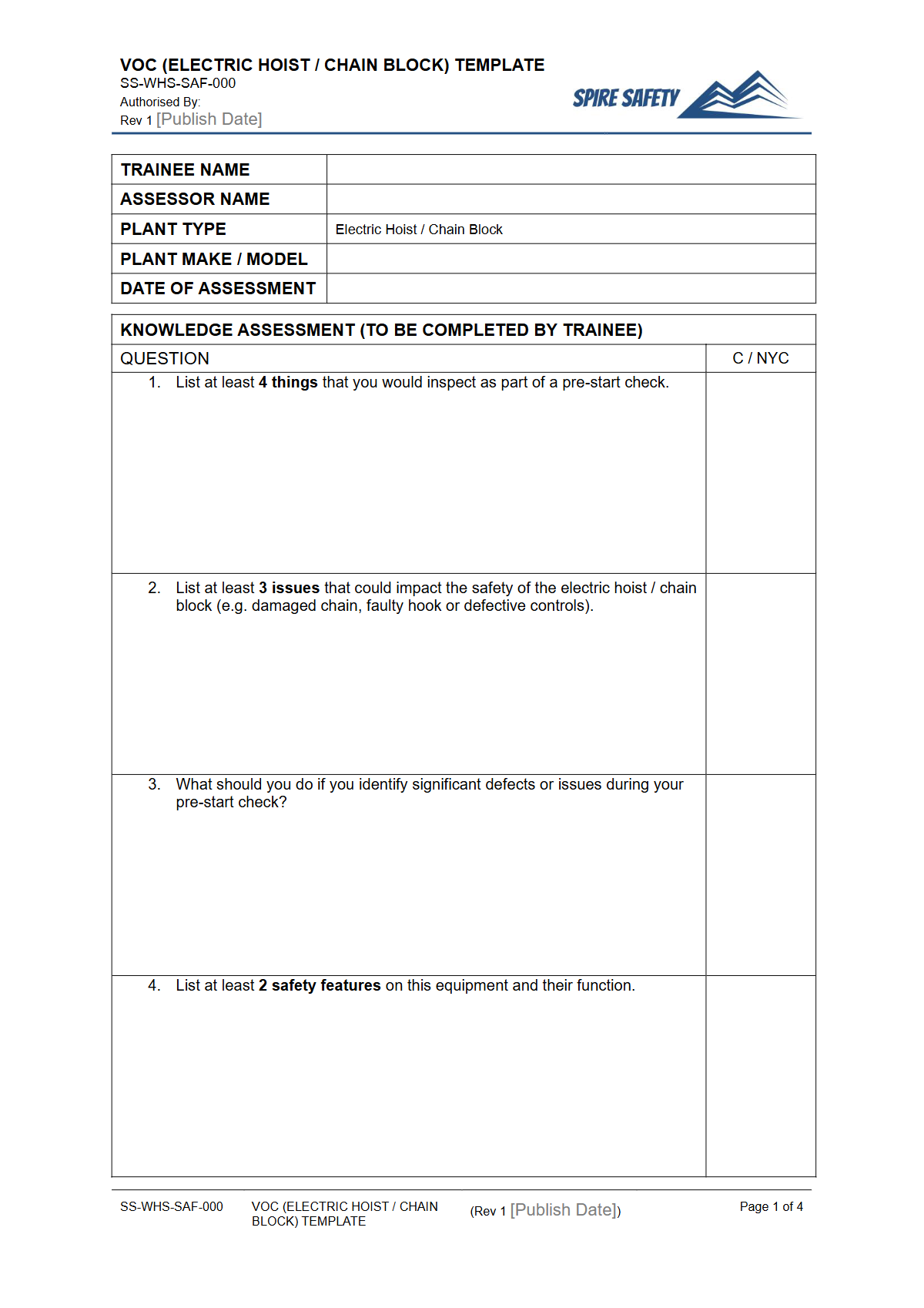
Our free Verification of Competency (Electric Hoist or Chain Block) Template is a practical tool designed to help Australian businesses assess and document the competency of workers operating electric hoists or chain blocks. In any workplace utilising lifting equipment, ensuring that operators possess the necessary skills, knowledge, and experience is paramount for preventing incidents and maintaining a safe working environment.
This template provides a structured approach to evaluate a worker's ability to safely and effectively use this critical plant.
This document acts as a safeguard, confirming that individuals not only understand the operational aspects of electric hoists and chain blocks but also adhere to WHS management systems and safety procedures specific to their use. Regular assessments, facilitated by tools like this, contribute significantly to a proactive safety culture and help businesses meet their general duty of care obligations.
Video walkthrough
How to use the Verification of Competency (Electric Hoist or Chain Block) Template
To effectively use this Verification of Competency (Electric Hoist or Chain Block) Template, download the DOCX version for customisation. Begin by populating the template with specific details relevant to your organisation, the type of electric hoist or chain block used, and the work environment.
It requires the assessor to observe and evaluate the worker's practical skills and knowledge, covering aspects such as pre-operational checks, safe lifting techniques, load securing, emergency procedures, and post-operation maintenance.
The template includes sections for recording theoretical knowledge assessment, practical demonstration results, and overall competency ratings. Remember, this template is a starting point; it must be customised to your workplace’s specific operational procedures, equipment, and any relevant site-specific risks.
Ensure both the assessor and the assessed worker sign off on the document upon completion.
When to use it
A Verification of Competency (VOC) for electric hoists or chain blocks should be conducted in several key situations. Firstly, for new employees who will be operating this equipment, even if they hold prior qualifications.
Secondly, when there’s a change in the type of hoist or chain block used, introducing new features or operational complexities. Regular re-assessments — typically every 2-3 years, or as dictated by your WHS consulting risk assessment — are crucial to confirm ongoing competency and address any skill fade.
Additionally, if there's been an incident involving hoist operation, or if a worker's performance raises concerns, a VOC can identify gaps in knowledge or practice. It is also good practice to conduct a VOC after any significant changes to WHS legislation or codes of practice relating to lifting equipment.
Who should use it
This template is primarily designed for WHS managers, supervisors, trainers, or competent assessors responsible for ensuring the safe operation of electric hoists and chain blocks within a workplace. It's suitable for small and medium businesses, construction companies, manufacturing facilities, warehouses, and any other industry where these pieces of plant are routinely used.
The employer or Person Conducting a Business or Undertaking (PCBU) bears the ultimate responsibility for ensuring workers are competent, and this template aids them in fulfilling that duty. It's also beneficial for workers themselves, as it clearly outlines the expected standards of operation.
Related Resources
For organisations managing a range of plant and equipment, we offer similar VOC templates. Explore our Free Mitre Saw VOC, Free Grader VOC, or Free Scissor Lift VOC templates.
These resources provide a consistent approach to verifying competence across various machinery, supporting a robust ISO 45001 safety framework. Each template is designed to help you document ongoing worker competency effectively.
Common mistakes
Common mistakes to avoid
- Not customising the VOC template to specific equipment or workplace conditions.
- Failing to conduct VOCs regularly, leading to skill fade or outdated practices.
- Allowing unqualified or unverified workers to operate electric hoists or chain blocks.
- Not documenting the VOC outcomes, leaving no proof of competency assessment.
Legal references
Legal considerations
The following legal requirements may be relevant to this type of work.
- Work Health and Safety Act (Harmonised) — Provides the primary duties for protecting workers and other people from work health and safety risks.
- Work Health and Safety Regulations (Harmonised) — Sets out requirements supporting the management of workplace hazards and risks.
The following codes may be relevant to this type of work.
- Managing WHS Risks Code of Practice — Provides practical guidance on identifying hazards, assessing risks and applying effective controls.
- Work Health and Safety Consultation, Cooperation and Coordination Code of Practice — Provides practical guidance on consulting workers and coordinating with other duty holders.
- Managing the Work Environment and Facilities Code of Practice — Provides practical guidance on safe work environments, workplace facilities and related controls.
Did you know
Hoist-related incidents
Incorrect use of hoists and lifting equipment is a significant contributor to workplace injuries, including crush injuries and musculoskeletal disorders.
FAQ
Frequently asked questions
01What is a Verification of Competency (VOC) for an electric hoist or chain block?
02Is a VOC legally required for all hoist operators in Australia?
03How often should an electric hoist or chain block VOC be conducted?
04Can I modify this VOC template to suit my specific workplace needs?
Share this resource
Verification of Competency (Electric Hoist or Chain Block) Template
Browse Categories
How To Use It
- 1Download and open in Word or PDF.
- 2Replace the placeholders with your business details.
- 3Get it reviewed by a WHS specialist before rollout.
Need it customised?
Our WHS consultants can adapt this template to your site, run a gap analysis, or audit what you already have in place.
Book a Free Consultation WHS consulting servicesor call 1300 156 382
Related templates
- Verification of Competency (Floor Grinder) Template
- Verification of Competency (Floor Scrubber) Template
- Verification of Competency (Gas Cutting Torch) Template
- Verification of Competency (Hydrovac or Vacuum Excavator) Template
- Verification of Competency (Impact Driver) Template
- Verification of Competency (Magnetic Drill) Template