
Verification of Competency (Gas Cutting Torch) Template
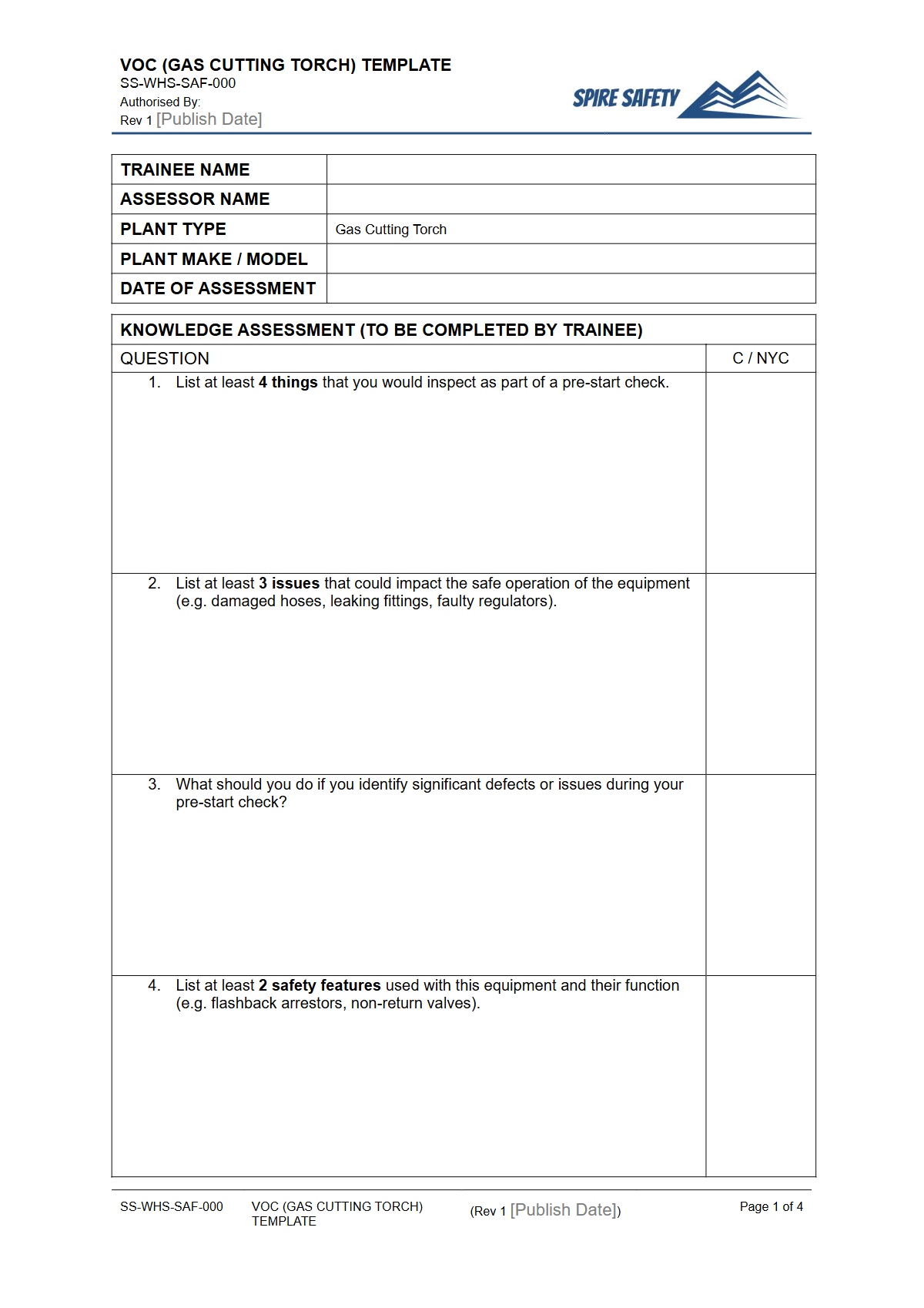
Download our free Verification of Competency (Gas Cutting Torch) Template in DOCX and PDF. A structured starting point for WHS compliance.
Verification of Competency (Gas Cutting Torch) Template
DOCX • 138 KB + PDF
Updated Oct 2026
No signup required
Purpose of the Verification of Competency (Gas Cutting Torch) Template
This Verification of Competency (Gas Cutting Torch) Template is designed to help Australian workplaces systematically assess and document a worker's competency in safely operating gas cutting torches. Operating a gas cutting torch involves significant WHS risks, and ensuring that all operators have the necessary skills, knowledge, and experience is a critical component of hazard control.
This template provides a structured method for evaluators to observe and record a worker's ability to perform tasks in line with recognised safe work practices and operational requirements.
Using a consistent template for competency assessments, like this free WHS resource, helps to standardise the evaluation process across your organisation. It ensures that all critical aspects of gas cutting torch operation – from pre-operation checks to safe shutdown procedures – are covered, fostering a safer work environment and assisting in meeting your WHS obligations.
Regularly verifying competency, particularly for high-risk plant and equipment, is a key preventative measure against incidents and injuries.
Video walkthrough
How to use the Verification of Competency (Gas Cutting Torch) Template
Our free Verification of Competency (Gas Cutting Torch) Template is provided in an editable DOCX format, making it easy for you to adapt it to your specific operational context and machinery. Here’s a general guide to using it:
- Download and Customise: Obtain the DOCX version of the template. Please note, this template must be customised to your specific workplace conditions, gas cutting torch models, and procedural requirements to be effective.
- Identify Competent Assessors: Ensure the person conducting the competency assessment is suitably qualified and experienced with gas cutting torch operations and WHS assessment principles.
- Pre-assessment Review: Before the practical assessment, review the template with the worker. Discuss the criteria, safety procedures, and expected outcomes.
- Practical Demonstration: Observe the worker performing tasks with the gas cutting torch in a live or simulated work environment. Mark off each competency criterion as it is demonstrated satisfactorily.
- Document Evidence: Where applicable, detail specific observations, strengths, or areas requiring further training directly on the template.
- Feedback and Sign-off: Provide constructive feedback to the worker. Both the assessor and the worker should sign and date the completed VOC form.
- Record Keeping: File the completed VOC form in the worker's training records. This creates a valuable historical log of competency.
Effective customisation means reviewing each section of the template against your internal WHS management systems and procedures for gas cutting operations, adding or modifying criteria as necessary.
When to use it
This Verification of Competency template should be used in several key situations to ensure ongoing worker safety and compliance:
- Initial Assignment: Before a worker is permitted to operate a gas cutting torch for the first time in your workplace, even if they hold relevant qualifications.
- Post-incident: Following an incident or near-miss involving a gas cutting torch, to reassess competency and identify any training gaps.
- After Training: After a worker completes formal training on gas cutting torch operation or new safety procedures.
- Changes in Equipment or Process: When new models of gas cutting torches are introduced, or there are significant changes to operational procedures or work methods.
- Periodic Review: As part of your regular WHS review cycle, especially for high-risk tasks, typically every 2-3 years, or as determined by your risk assessments. For example, similar reviews might be needed for mitre saw operation or skid-steer loader use.
- Return to Work: If a worker has had a prolonged absence from gas cutting torch operations.
Who should use it
This template is an essential tool for:
- Employers and Persons Conducting a Business or Undertaking (PCBUs): To fulfil their primary duty of care in providing a safe working environment and ensuring workers are competent for their tasks.
- Supervisors and Team Leaders: Those directly overseeing workers using gas cutting torches, responsible for conducting or arranging competency assessments.
- WHS Managers and Officers: To implement and oversee a robust WHS system that includes systematic verification of competencies for high-risk activities.
- Trainers and Assessors: Professionals responsible for delivering training and assessing the practical skills and knowledge of workers operating gas cutting torches.
- Human Resources Departments: For maintaining accurate and up-to-date records of worker competencies and training.
Common mistakes
Common mistakes to avoid
- Not ensuring the assessor is truly competent and experienced with gas cuttingtorch operations.
- Failing to customise the VOC template to specific workplace hazards and gas cutting torch models.
- Treating the VOC as a 'tick-and-flick' exercise rather than a genuine assessment of practical skills.
- Neglecting to re-verify competency after an incident, prolonged absence, or introduction of new equipment.
Legal references
Legal considerations
The following legal requirements may be relevant to this type of work.
- Work Health and Safety Act (Harmonised) — Provides the primary duties for protecting workers and other people from work health and safety risks.
- Work Health and Safety Regulations (Harmonised) — Sets out requirements supporting the management of workplace hazards and risks.
The following codes may be relevant to this type of work.
- Managing WHS Risks Code of Practice — Provides practical guidance on identifying hazards, assessing risks and applying effective controls.
- Work Health and Safety Consultation, Cooperation and Coordination Code of Practice — Provides practical guidance on consulting workers and coordinating with other duty holders.
- Managing the Work Environment and Facilities Code of Practice — Provides practical guidance on safe work environments, workplace facilities and related controls.
Did you know
Gas Safety Awareness
Acetylene, commonly used in gas cutting, is highly unstable under pressure and must be stored and transported correctly. Always ensure gas cylinders are secured and handled with extreme care to prevent rupture.
Oxygen Enrichment Risk
Even a small increase in oxygen concentration in the air (e.g., from a leaking hose) can significantly lower the ignition temperature of many materials and increase fire intensity, posing a severe risk in cutting areas.
FAQ
Frequently asked questions
01What is a Verification of Competency (VOC) for a gas cutting torch?
02Is a VOC legally required for operating a gas cutting torch in Australia?
03How often should gas cutting torch competency be re-verified?
04What areas does a gas cutting torch VOC typically cover?
Share this resource
Verification of Competency (Gas Cutting Torch) Template
Browse Categories
How To Use It
- 1Download and open in Word or PDF.
- 2Replace the placeholders with your business details.
- 3Get it reviewed by a WHS specialist before rollout.
Need it customised?
Our WHS consultants can adapt this template to your site, run a gap analysis, or audit what you already have in place.
Book a Free Consultation WHS consulting servicesor call 1300 156 382
Related templates
- Verification of Competency (Hydrovac or Vacuum Excavator) Template
- Verification of Competency (Impact Driver) Template
- Verification of Competency (Magnetic Drill) Template
- Verification of Competency (Metal Cut-Off Saw) Template
- Verification of Competency (MIG Welder) Template
- Verification of Competency (Mini Excavator) Template