
Verification of Competency (Hydrovac or Vacuum Excavator) Template
Download our free Verification of Competency (Hydrovac or Vacuum Excavator) Template in Word and PDF format. Ensure worker competence and safety.
Verification of Competency (Hydrovac or Vacuum Excavator) Template
DOCX • 138 KB + PDF
Updated Oct 2026
No signup required
Purpose of the Verification of Competency (Hydrovac or Vacuum Excavator) Template
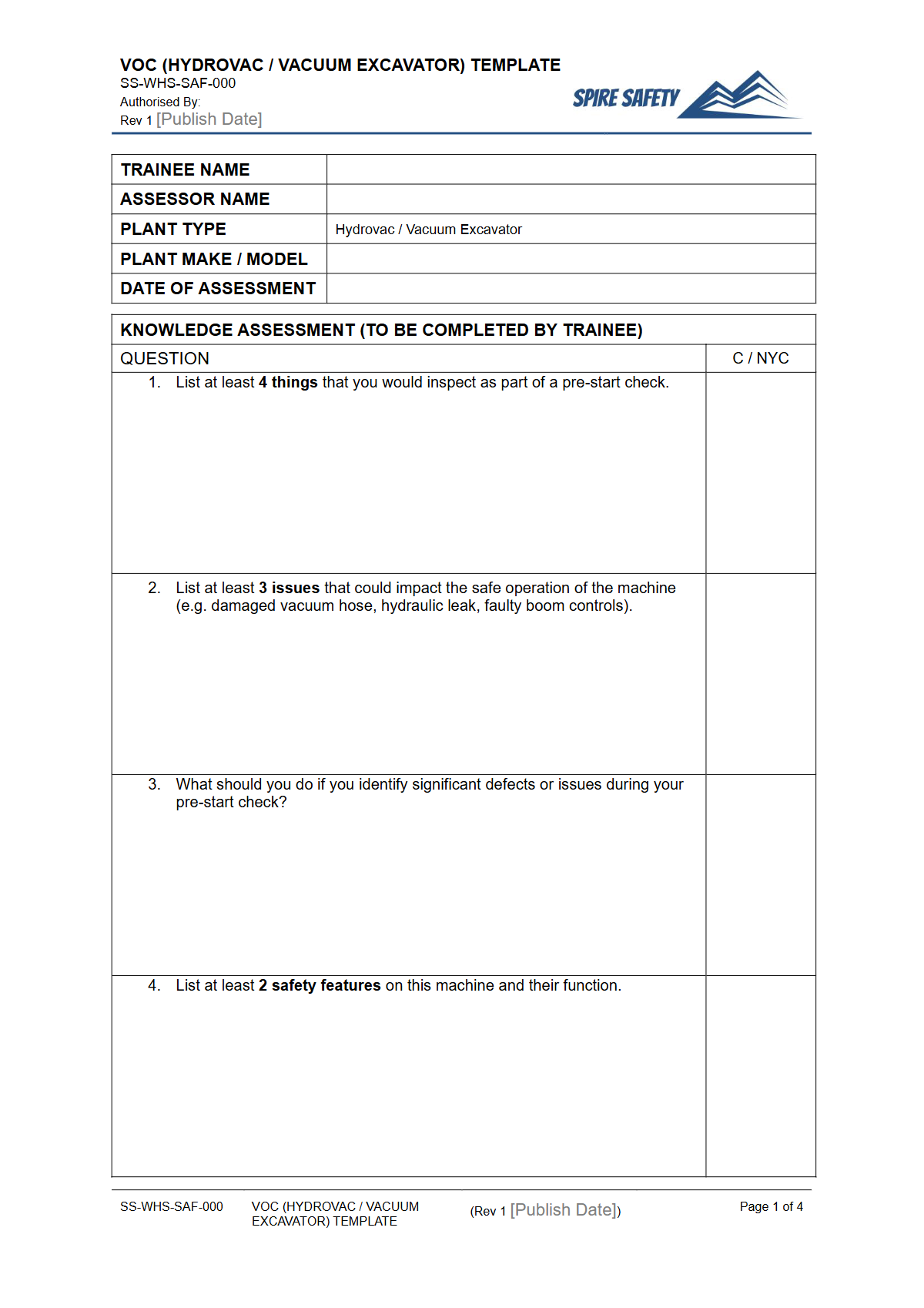
This free Verification of Competency (Hydrovac or Vacuum Excavator) Template provides a structured and detailed framework for assessing and verifying the skills, knowledge, and experience of operators using hydrovac or vacuum excavation equipment. Hydro excavation, also known as vacuum excavation, is a non-destructive digging method that uses pressurised water and a powerful vacuum to excavate soil.
Incorrect operation of this specialised plant can lead to serious incidents, including underground utility strikes, injuries from high-pressure water, or even fatalities due to unstable excavations or contact with energised services. Spire Safety’s template helps organisations conduct thorough competency assessments, aligning with Australian WHS practice for vac truck operation and other high-risk plant.
Using a structured VOC template for hydrovac or vacuum excavators ensures that operators possess the necessary qualifications, understand the specific hazards associated with the equipment, and can implement effective control measures. This proactive approach supports a safer work environment and demonstrates due diligence in managing risks related to plant operation.
Video walkthrough
How to use the Verification of Competency (Hydrovac or Vacuum Excavator) Template
Our free Verification of Competency (Hydrovac or Vacuum Excavator) Template is available in both DOCX and PDF formats, offering flexibility for your organisation’s needs. The DOCX version is fully editable, allowing you to tailor it precisely to your specific operational procedures, equipment models, and site-specific hazards.
We recommend customising the template to include details such as the specific make and model of your hydrovac or vacuum excavator, unique site conditions, and any supplementary training modules your workers may have undertaken. Remember, WHS compliance depends on how you customise and apply this template to your workplace.
To effectively use the template:
- Review and Customise: Begin by reviewing the template's sections, including general information, pre-operational checks, operational procedures, emergency protocols, and post-operational duties. Add or modify elements to reflect your specific plant, work environment, and any unique WHS requirements.
- Assessor Training: Ensure the assessor conducting the VOC is competent, experienced with hydrovac or vacuum excavators, and understands the assessment criteria.
- Practical Demonstration: Operators should perform practical demonstrations of their skills under supervision, covering all aspects of safe operation, including setup, excavation, spoils management, and shutdown procedures.
- Knowledge Assessment: Utilise the template’s knowledge assessment section to evaluate the operator’s understanding of safe operating procedures, WHS regulations, potential hazards (e.g., confined spaces, electrical risks, underground services), and emergency responses.
- Documentation: Accurately complete all sections of the template, noting observed performance, areas for improvement, and the overall outcome of the assessment. Maintain detailed records of all completed VOCs as part of your WHS management system.
Regular review and updates of your VOC procedures for plant operators are crucial to ensure ongoing competency and adaptation to new equipment or operational changes. This template serves as a robust starting point for developing comprehensive VOC programs.
When to use a VOC for Hydrovac or Vacuum Excavators
A Verification of Competency (VOC) for hydrovac or vacuum excavators should be conducted in several key situations to ensure ongoing safety and compliance:
- Initial Assignment: Before a worker operates a hydrovac or vacuum excavator for the first time in your workplace, even if they hold an existing licence or certification.
- New Equipment Introduction: When a new type of hydrovac or vacuum excavation equipment is introduced that has significantly different operating characteristics or controls from previously used plant.
- Refresher Training: Periodically, as part of your organisation's schedule for routine WHS compliance auditing to confirm ongoing competency. This is particularly important for high-risk plant.
- Incident or Near Miss: Following an incident or near-miss involving a hydrovac or vacuum excavator, to reassess operator competency and identify any gaps in training or procedures.
- Changes in Work Procedures: If there are significant changes to the work environment, excavation methods, or safety protocols that impact the operation of the equipment.
- Performance Concerns: When there are observations or reports of unsafe operating practices or a decline in an operator's performance.
Who should use this template
This template is designed for a range of WHS professionals and site management personnel responsible for ensuring safe plant operation in Australian workplaces. This includes:
- WHS Managers and Officers: To develop and implement robust competency assessment programs for hydrovac and vacuum excavator operators.
- Site Supervisors and Foremen: To conduct practical assessments and ensure their teams are competent in operating specialised excavation equipment.
- Training Coordinators: To standardise competency assessments and track operator qualifications.
- Business Owners and Directors: To demonstrate a commitment to WHS due diligence and ensure that all high-risk plant is operated by verified competent personnel.
Organisations that frequently engage in excavation work, particularly near underground services, will find this document invaluable. It forms an essential component of a comprehensive WHS management system, helping businesses meet their obligations regarding worker safety and plant management.
Common mistakes
Common mistakes to avoid
- Not customising the template to specific equipment, site conditions, or operational procedures.
- Using unqualified or inexperienced personnel to conduct the VOC assessment.
- Failing to conduct a practical assessment, relying solely on theoretical knowledge or licences.
- Not regularly reviewing or updating VOC records and operator competencies.
Legal references
Legal considerations
The following legal requirements may be relevant to this type of work.
- Work Health and Safety Act (Harmonised) — Provides the primary duties for protecting workers and other people from work health and safety risks.
- Work Health and Safety Regulations (Harmonised) — Sets out requirements supporting the management of workplace hazards and risks.
The following codes may be relevant to this type of work.
- Managing WHS Risks Code of Practice — Provides practical guidance on identifying hazards, assessing risks and applying effective controls.
- Work Health and Safety Consultation, Cooperation and Coordination Code of Practice — Provides practical guidance on consulting workers and coordinating with other duty holders.
- Managing the Work Environment and Facilities Code of Practice — Provides practical guidance on safe work environments, workplace facilities and related controls.
Did you know
Precision and Safety
Hydrovac excavation is considered up to 10 times safer than mechanical digging methods, significantly reducing the risk of damaging underground utilities like gas lines, electrical cables, and water pipes.
Environmental Benefits
Vacuum excavation minimises disruption to the surrounding environment, as it creates smaller, more precise excavations and typically allows for backfilling with the exact same spoils, reducing waste.
FAQ
Frequently asked questions
01What is a Verification of Competency (VOC) for hydrovac or vacuum excavators?
02Why is a VOC important for hydrovac or vacuum excavator operators?
03Does a VOC replace a formal licence for operating a hydrovac or vacuum excavator?
04How often should a VOC be conducted for hydrovac or vacuum excavator operators?
Share this resource
Verification of Competency (Hydrovac or Vacuum Excavator) Template
Browse Categories
How To Use It
- 1Download and open in Word or PDF.
- 2Replace the placeholders with your business details.
- 3Get it reviewed by a WHS specialist before rollout.
Need it customised?
Our WHS consultants can adapt this template to your site, run a gap analysis, or audit what you already have in place.
Book a Free Consultation WHS consulting servicesor call 1300 156 382
Related templates
- Verification of Competency (Impact Driver) Template
- Verification of Competency (Magnetic Drill) Template
- Verification of Competency (Metal Cut-Off Saw) Template
- Verification of Competency (MIG Welder) Template
- Verification of Competency (Mini Excavator) Template
- Verification of Competency (Mortar Mixer) Template