
Verification of Competency (Impact Driver) Template
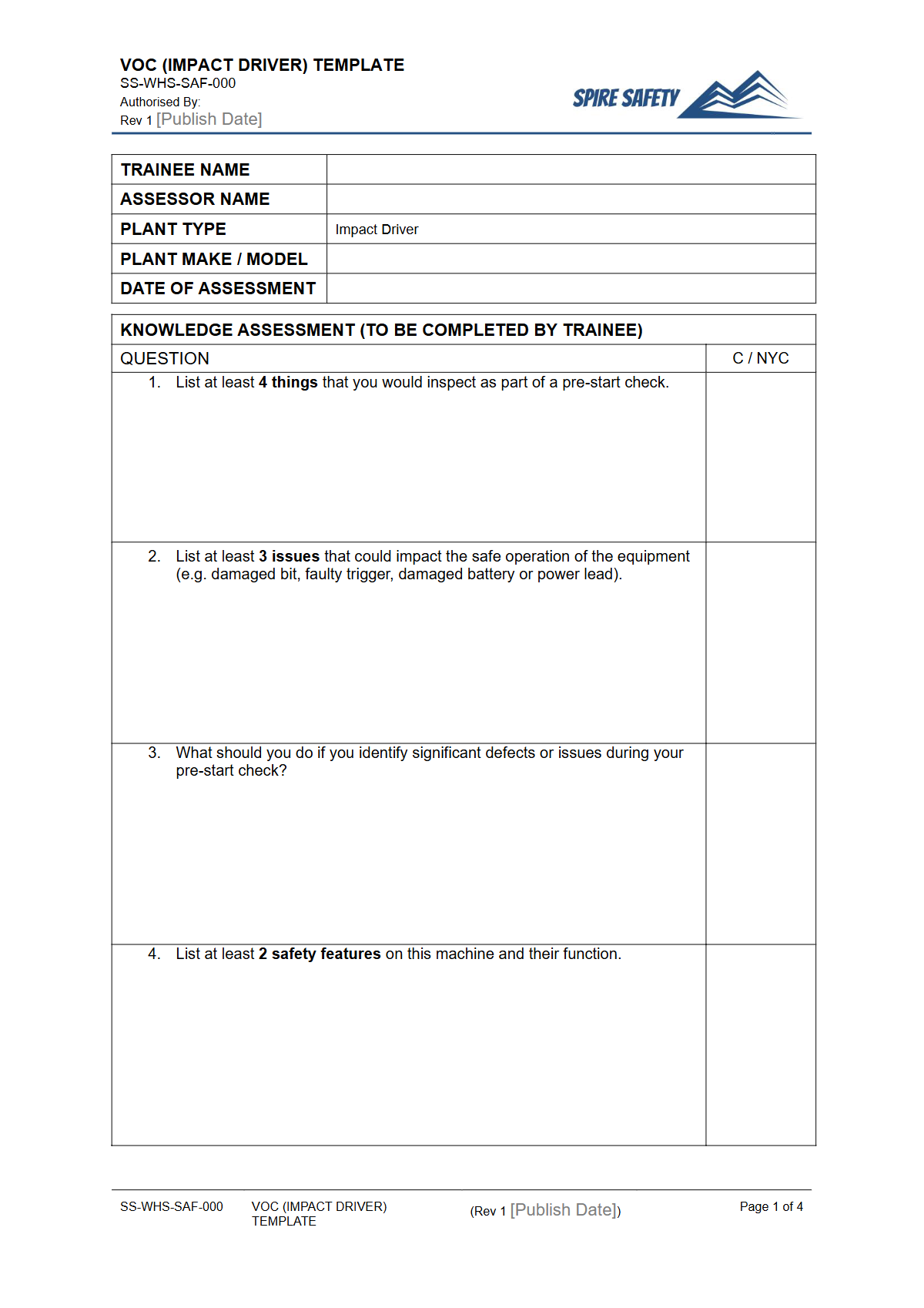
Download our free Verification of Competency (Impact Driver) Template. Ensure worker competency and maintain WHS standards with this essential tool.
Verification of Competency (Impact Driver) Template
DOCX • 138 KB + PDF
Updated Oct 2026
No signup required
Purpose of the Verification of Competency (Impact Driver) Template
This Verification of Competency (Impact Driver) Template is designed to assist Australian workplaces in confirming that workers operating impact drivers possess the necessary skills, knowledge, and experience. An impact driver, while common, can pose significant risks if used incorrectly.
Verifying competency helps organisations meet their WHS duties by ensuring that high-risk plant and equipment are only operated by adequately trained and assessed personnel, thereby mitigating potential hazards and promoting a safer work environment. This template provides a structured framework for assessing operator proficiency against clearly defined criteria, contributing to robust WHS management systems.
Using a structured VOC process for an impact driver allows you to systematically evaluate an individual's ability to safely set up, operate, and maintain the tool in accordance with manufacturer specifications and workplace procedures. This goes beyond initial training, providing ongoing assurance that competency levels are maintained, particularly as practices or equipment evolve.
This template is a valuable addition to your suite of free WHS resources library, helping you proactively manage risks associated with power tools.
Video walkthrough
How to Use the Verification of Competency (Impact Driver) Template
Our free Verification of Competency (Impact Driver) Template provides a robust starting point for assessing your workers. Download the DOCX file to gain editable access.
It is crucial that you customise this template to your specific workplace environment, the exact impact drivers used, and your unique operational procedures. This means reviewing each section, including safety checks, operational steps, and competency criteria, to align with your organisation's context. Consider incorporating photos of your actual equipment or specific site conditions into the template to enhance clarity and relevance for your assessors and operators.
When conducting the VOC, an authorised and competent assessor should observe the worker performing practical tasks with the impact driver, ask questions to gauge theoretical knowledge, and review any relevant historical training or incident records. The template includes sections for recording observations, scoring an individual's performance, and documenting feedback and any required remedial actions.
Ensure that all involved parties sign and date the completed VOC form. Regular reviews of VOC processes are vital to ensure their ongoing effectiveness. For similar high-risk equipment, consider our Free Mitre Saw VOC Template or a Free Skid-Steer Loader VOC Template.
When to Use it
A Verification of Competency for an impact driver should be conducted proactively in several key situations. Firstly, it's essential for any new worker or contractor who will be operating the tool in your workplace, regardless of their previous experience or qualifications.
Secondly, conduct a VOC when there's an introduction of new or significantly different impact driver models or technology. Thirdly, after an incident or near-miss involving an impact driver, a VOC can help identify contributing factors related to operator competency.
Regular re-assessments, perhaps every two to three years, or after a prolonged period where the tool hasn't been used, are also good practice to ensure skills remain current.
Who Should Use It
This Verification of Competency (Impact Driver) Template is intended for WHS managers, supervisors, team leaders, and designated competent persons responsible for managing plant and equipment safety within an Australian workplace. It supports those tasked with conducting competency assessments and maintaining accurate training and competency records.
Businesses seeking comprehensive WHS guidance may also benefit from our general WHS consulting services.
The Importance of Competency in WHS
Demonstrating and verifying worker competency is a cornerstone of effective WHS. It protects workers from harm, reduces the likelihood of incidents, and helps employers meet their primary duty of care.
For impact drivers, like many common tools, understanding capacity, proper attachment use, and safe handling techniques is paramount. A robust VOC process helps ensure that these critical elements are consistently met across your workforce.
Implementing clear plant and equipment operating procedures helps reinforce this.
Customisation is Key for Effective VOCs
No two workplaces are identical, and neither are the specific risks associated with operating an impact driver in different environments. Therefore, simply downloading and using this template verbatim will not be sufficient.
You must tailor it to reflect the specific brand and model of impact drivers you use, the exact tasks they perform, and your site-specific safety protocols. This customisation ensures the VOC is relevant, practical, and truly effective in assessing the competencies required for safe operation in your unique setting.
Regular WHS compliance auditing can help verify the effectiveness of your customised VOC programs.
Common mistakes
Common mistakes to avoid
- Using a generic VOC template without customisation for specific tools or workplace conditions.
- Not formally documenting completed VOCs, leading to gaps in competency records.
- Allowing unqualified personnel to conduct VOC assessments.
- Failing to provide refresher training or re-assessment after changes in equipment or procedures.
Legal references
Legal considerations
The following legal requirements may be relevant to this type of work.
- Work Health and Safety Act (Harmonised) — Provides the primary duties for protecting workers and other people from work health and safety risks.
- Work Health and Safety Regulations (Harmonised) — Sets out requirements supporting the management of workplace hazards and risks.
The following codes may be relevant to this type of work.
- Managing WHS Risks Code of Practice — Provides practical guidance on identifying hazards, assessing risks and applying effective controls.
- Work Health and Safety Consultation, Cooperation and Coordination Code of Practice — Provides practical guidance on consulting workers and coordinating with other duty holders.
- Managing the Work Environment and Facilities Code of Practice — Provides practical guidance on safe work environments, workplace facilities and related controls.
Did you know
Impact vs. Drill Driver
Unlike a drill driver, an impact driver uses rotational impacts to drive fasteners, delivering significantly more torque, which makes it highly effective for driving long screws or bolts into dense materials. This also means it requires specific competency for safe use.
FAQ
Frequently asked questions
01What is a Verification of Competency (VOC)?
02Why is a VOC important for impact drivers?
03How often should an impact driver VOC be done?
04Does this template guarantee WHS compliance?
Share this resource
Verification of Competency (Impact Driver) Template
Browse Categories
How To Use It
- 1Download and open in Word or PDF.
- 2Replace the placeholders with your business details.
- 3Get it reviewed by a WHS specialist before rollout.
Need it customised?
Our WHS consultants can adapt this template to your site, run a gap analysis, or audit what you already have in place.
Book a Free Consultation WHS consulting servicesor call 1300 156 382
Related templates
- Verification of Competency (Magnetic Drill) Template
- Verification of Competency (Metal Cut-Off Saw) Template
- Verification of Competency (MIG Welder) Template
- Verification of Competency (Mini Excavator) Template
- Verification of Competency (Mortar Mixer) Template
- Verification of Competency (Multi-Tool (Oscillating Tool)) Template