
Verification of Competency (Mortar Mixer) Template
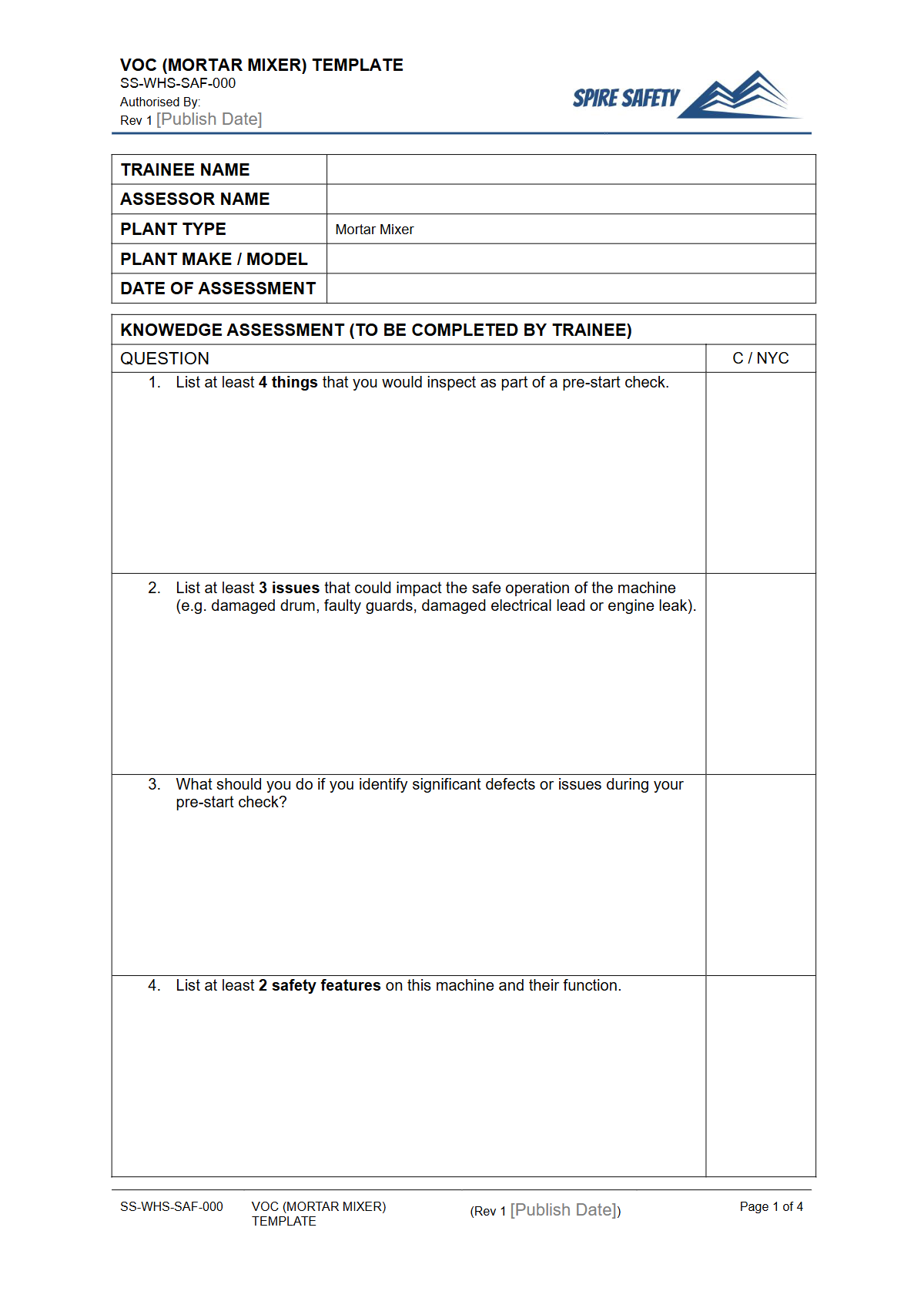
Download our free Verification of Competency (Mortar Mixer) Template. Ensure worker competence for mortar mixer operation on your Australian worksite.
Verification of Competency (Mortar Mixer) Template
DOCX • 137 KB + PDF
Updated Oct 2026
No signup required
Purpose of the Verification of Competency (Mortar Mixer) Template
This Verification of Competency (Mortar Mixer) Template provides a structured framework for assessing and documenting a worker's ability to safely operate a mortar mixer. Mortar mixers, while common on many construction and renovation sites, present inherent risks, including entanglement, crushing, electrical hazards, and noise exposure.
Proving and recording that workers possess the necessary skills, knowledge, and experience to operate this plant safely is crucial for maintaining a safe working environment and meeting WHS obligations. This template acts as a central record for competency assessments, ensuring consistency and accountability in your safety processes.
A well-executed Verification of Competency (VOC) helps organisations identify any skills gaps or retraining needs, contributing to a proactive approach to risk management. It supports the principal of effective WHS management systems by ensuring that only competent personnel are assigned tasks involving hazardous plant.
This aligns with Australian WHS practice, which emphasises the importance of providing appropriate information, training, and instruction to workers.
Video walkthrough
How to use the Verification of Competency (Mortar Mixer) Template
Our free Verification of Competency (Mortar Mixer) Template is provided in both DOCX and PDF formats for your convenience. The DOCX version allows for complete customisation to suit your specific workplace operations and the models of mortar mixers used.
It is designed to be completed by a competent assessor – an individual with demonstrated expertise in operating mortar mixers and an understanding of relevant WHS requirements. The assessment should cover both theoretical knowledge and practical application, including pre-operational checks, safe operation procedures, emergency protocols, and post-operation maintenance.
Please note: This template is a structured starting point and must be customised to your specific workplace, the exact type of mortar mixer you use, and your site-specific risks and procedures. Modify sections to include details relevant to your equipment, environmental conditions, and organisational policies. Integrate it with your existing WHS free resources library and safety documentation.
Key sections to complete:
- Worker details and relevant licences/qualifications.
- Assessor details and competency.
- Date and location of assessment.
- Specific mortar mixer details (make, model, serial number).
- Checklist items for knowledge and practical skills, including observable behaviours.
- Any identified gaps or additional training requirements.
- Sign-offs from both the worker and the assessor.
When to use it
Verifications of Competency for mortar mixers should be conducted in several key situations to ensure ongoing worker safety and compliance:
- Initial Assignment: Before a worker operates a mortar mixer for the first time in your workplace.
- New Equipment: When a new type or model of mortar mixer is introduced to the workplace, requiring different operating procedures or safety considerations.
- Regulatory Changes: Following significant changes to WHS legislation or codes of practice that impact mortar mixer operation.
- Incident Review: After an incident or near-miss involving a mortar mixer, to reassess competency and identify potential training deficiencies.
- Refresher Training: Periodically, as part of a scheduled WHS consulting program, to ensure skills remain current and identify any complacency. This is especially important for plant that is not operated frequently.
- Return to Work: If a worker has been away from mortar mixer operation for an extended period.
Who should use it
This template is primarily intended for:
- Employers and PCBUs (Persons Conducting a Business or Undertaking): To fulfil their primary duty of care by ensuring workers are competent to operate plant and equipment safely.
- Supervisors and Team Leaders: To conduct competency assessments and supervise workers operating mortar mixers.
- WHS Managers and Officers: To integrate VOCs into the overall WHS management system and maintain comprehensive records.
- Trainers and Assessors: As a tool to structure and document their assessments of worker competency.
- Workers: To understand the expected standards of safe operation and demonstrate their capabilities.
Common mistakes
Common mistakes to avoid
- Not customising the VOC template to specific mortar mixer models or site conditions.
- Allowing unqualified individuals to conduct competency assessments.
- Failing to conduct refresher VOCs, leading to skill fade or complacency.
- Not documenting identified knowledge or skill gaps, and failing to provide follow-up training.
Legal references
Legal considerations
The following legal requirements may be relevant to this type of work.
- Work Health and Safety Act (Harmonised) — Provides the primary duties for protecting workers and other people from work health and safety risks.
- Work Health and Safety Regulations (Harmonised) — Sets out requirements supporting the management of workplace hazards and risks.
The following codes may be relevant to this type of work.
- Managing WHS Risks Code of Practice — Provides practical guidance on identifying hazards, assessing risks and applying effective controls.
- Work Health and Safety Consultation, Cooperation and Coordination Code of Practice — Provides practical guidance on consulting workers and coordinating with other duty holders.
- Managing the Work Environment and Facilities Code of Practice — Provides practical guidance on safe work environments, workplace facilities and related controls.
Did you know
Mortar mixer incidents
Entanglement in rotating parts and crush injuries from tipping or uncontrolled movement are common hazards associated with mortar mixers if operated by untrained or incompetent workers.
Noise Exposure
Operating a mortar mixer can expose workers to significant noise levels. Employers must manage the risk of hearing loss under WHS regulations, which often includes providing hearing protection and implementing noise control measures.
FAQ
Frequently asked questions
01What is a Verification of Competency (VOC)?
02Why is a VOC important for mortar mixer operators?
03How often should a mortar mixer VOC be conducted?
04Does this template make my workplace compliant for mortar mixer operation?
Share this resource
Verification of Competency (Mortar Mixer) Template
Browse Categories
How To Use It
- 1Download and open in Word or PDF.
- 2Replace the placeholders with your business details.
- 3Get it reviewed by a WHS specialist before rollout.
Need it customised?
Our WHS consultants can adapt this template to your site, run a gap analysis, or audit what you already have in place.
Book a Free Consultation WHS consulting servicesor call 1300 156 382
Related templates
- Verification of Competency (Multi-Tool (Oscillating Tool)) Template
- Verification of Competency (Orbital Sander) Template
- Verification of Competency (Overhead Bridge Crane) Template
- Verification of Competency (Oxy-Acetylene Welding Equipment) Template
- Verification of Competency (Pallet Jack (Electric)) Template
- Verification of Competency (Pipe Cutter) Template