
Verification of Competency (Oxy-Acetylene Welding Equipment) Template
Download our free Verification of Competency (Oxy-Acetylene Welding Equipment) Template in Word and PDF to assess welder skills effectively.
Verification of Competency (Oxy-Acetylene Welding Equipment) Template
DOCX • 139 KB + PDF
Updated Oct 2026
No signup required
Purpose of the Verification of Competency (Oxy-Acetylene Welding Equipment) Template
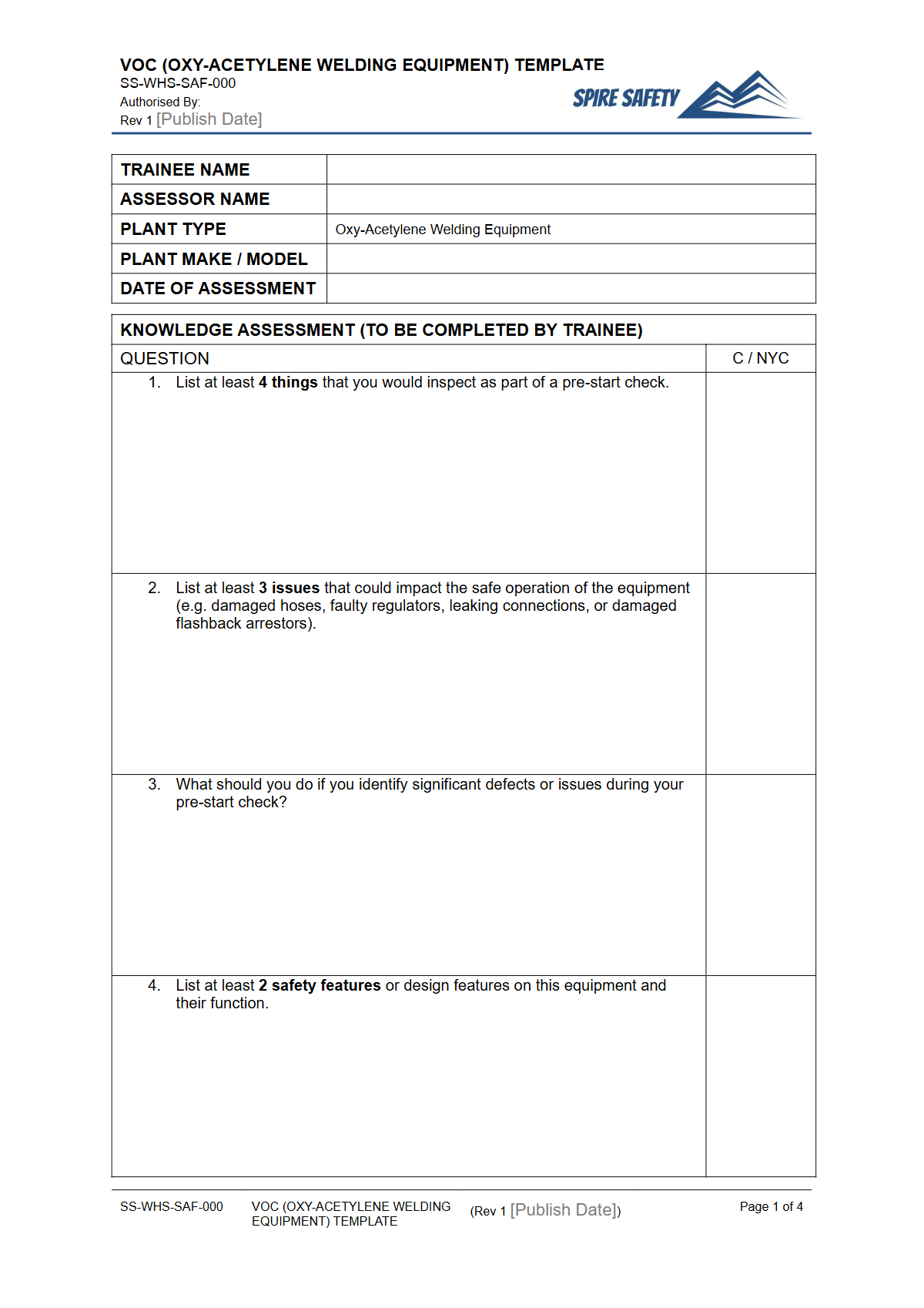
Our free WHS resources library offers this Verification of Competency (Oxy-Acetylene Welding Equipment) Template, designed to help Australian businesses assess the skills and knowledge of workers operating oxy-acetylene welding equipment. This template is a structured starting point for verifying that your personnel can safely and competently use this specialised plant.
It outlines key areas for assessment, ensuring that workers understand the hazards associated with oxy-acetylene use, proper setup, operation, and shutdown procedures, as well as emergency responses.
Using a Verification of Competency template is a proactive approach to managing WHS risks, demonstrating an organisation's commitment to worker safety and compliance with WHS regulations regarding plant operation. It aids in identifying any competency gaps that may require further training or supervision, thereby reducing the likelihood of incidents and injuries in the workplace.
Video walkthrough
How to use the Verification of Competency (Oxy-Acetylene Welding Equipment) Template
This Verification of Competency (VOC) template is provided in both DOCX and PDF formats for your convenience. The DOCX version allows for complete customisation, which is crucial for aligning the assessment criteria with the specific models of oxy-acetylene welding equipment used in your workplace and your unique operational procedures.
When using this template, you must customise it to your workplace's specific requirements, including detailing the exact equipment models, operational environments, and any site-specific safety protocols. It is designed to be completed by a qualified assessor who observes the worker's practical application of skills and knowledge.
The template includes sections for recording worker details, assessor credentials, specific tasks to be performed, and criteria for successful completion. It encourages a thorough assessment process, covering aspects from pre-operational checks to safe dismantling and storage of equipment.
Remember, a VOC is not a substitute for formal qualifications but rather a verification that an already qualified or experienced worker maintains their competency for specific tasks or equipment in a particular work environment.
When to use it
Verifications of Competency should be conducted periodically, or when there are changes in equipment, processes, or even after an incident. Key instances include:
- Initial assignment of a worker to operate oxy-acetylene welding equipment.
- When a worker's competency is questioned or observed to be lacking.
- Following an incident or near-miss involving oxy-acetylene welding equipment.
- After significant changes to the plant, work environment, or procedures.
- As part of a regular training review cycle or WHS compliance auditing schedule.
- When a worker returns to a task after a long absence.
Who should use it
This template is ideal for WHS managers, supervisors, team leaders, and business owners responsible for ensuring worker safety and competency. Anyone tasked with overseeing the safe operation of plant and equipment, particularly hazardous plant like oxy-acetylene welding systems, will find this resource invaluable.
It assists in maintaining robust WHS management systems and fostering a culture of safety. Assessors completing the VOC should possess appropriate qualifications and experience with oxy-acetylene welding equipment and assessment methodologies.
Importance of Competency Verification
Regular verification of competency plays a critical role in preventing workplace accidents and injuries. By systematically checking that workers possess the necessary skills and knowledge, organisations can mitigate risks associated with human error, improper equipment use, and non-compliance with safe work procedures.
This is especially true for high-risk activities like oxy-acetylene welding, where incorrect handling of gases and flames can have severe consequences.
Documentation and Record-Keeping
Maintaining accurate and up-to-date records of all Verifications of Competency is essential. These records serve as evidence of due diligence in managing WHS risks and can be crucial during WHS inspections or in the event of an incident investigation.
Effective record-keeping allows organisations to track worker development, plan future training needs, and demonstrate adherence to WHS legislative requirements.
Common mistakes
Common mistakes to avoid
- Not customising the VOC template to specific equipment or workplace conditions.
- Failing to conduct practical observations and relying solely on theoretical questions.
- Not having a competent or qualified assessor conduct the verification.
- Neglecting to maintain accurate records of completed VOCs and their outcomes.
Legal references
Legal considerations
The following legal requirements may be relevant to this type of work.
- Work Health and Safety Act (Harmonised) — Provides the primary duties for protecting workers and other people from work health and safety risks.
- Work Health and Safety Regulations (Harmonised) — Sets out requirements supporting the management of workplace hazards and risks.
The following codes may be relevant to this type of work.
- Managing WHS Risks Code of Practice — Provides practical guidance on identifying hazards, assessing risks and applying effective controls.
- Work Health and Safety Consultation, Cooperation and Coordination Code of Practice — Provides practical guidance on consulting workers and coordinating with other duty holders.
- Managing the Work Environment and Facilities Code of Practice — Provides practical guidance on safe work environments, workplace facilities and related controls.
Did you know
Oxy-Acetylene Flame Temperature
The oxy-acetylene flame is one of the hottest known, capable of reaching temperatures up to 3,500°C (6,330°F), making it highly effective for cutting and welding metals.
Flammable Gas Risks
Acetylene, when combined with oxygen under pressure, forms a highly explosive mixture, underscoring the critical need for strict safety protocols and competency in handling oxy-acetylene equipment.
FAQ
Frequently asked questions
01What is Verification of Competency (VOC)?
02Is a VOC the same as a qualification?
03How often should VOCs be conducted for oxy-acetylene welding?
04Who can conduct a VOC for oxy-acetylene welding equipment?
Share this resource
Verification of Competency (Oxy-Acetylene Welding Equipment) Template
Browse Categories
How To Use It
- 1Download and open in Word or PDF.
- 2Replace the placeholders with your business details.
- 3Get it reviewed by a WHS specialist before rollout.
Need it customised?
Our WHS consultants can adapt this template to your site, run a gap analysis, or audit what you already have in place.
Book a Free Consultation WHS consulting servicesor call 1300 156 382