
Verification of Competency (Pipe Threader) Template
Download our free Verification of Competency (Pipe Threader) Template in DOCX and PDF. A structured start for assessing worker competence.
Verification of Competency (Pipe Threader) Template
DOCX • 138 KB + PDF
Updated Sep 2026
No signup required
Purpose of the Verification of Competency (Pipe Threader) Template
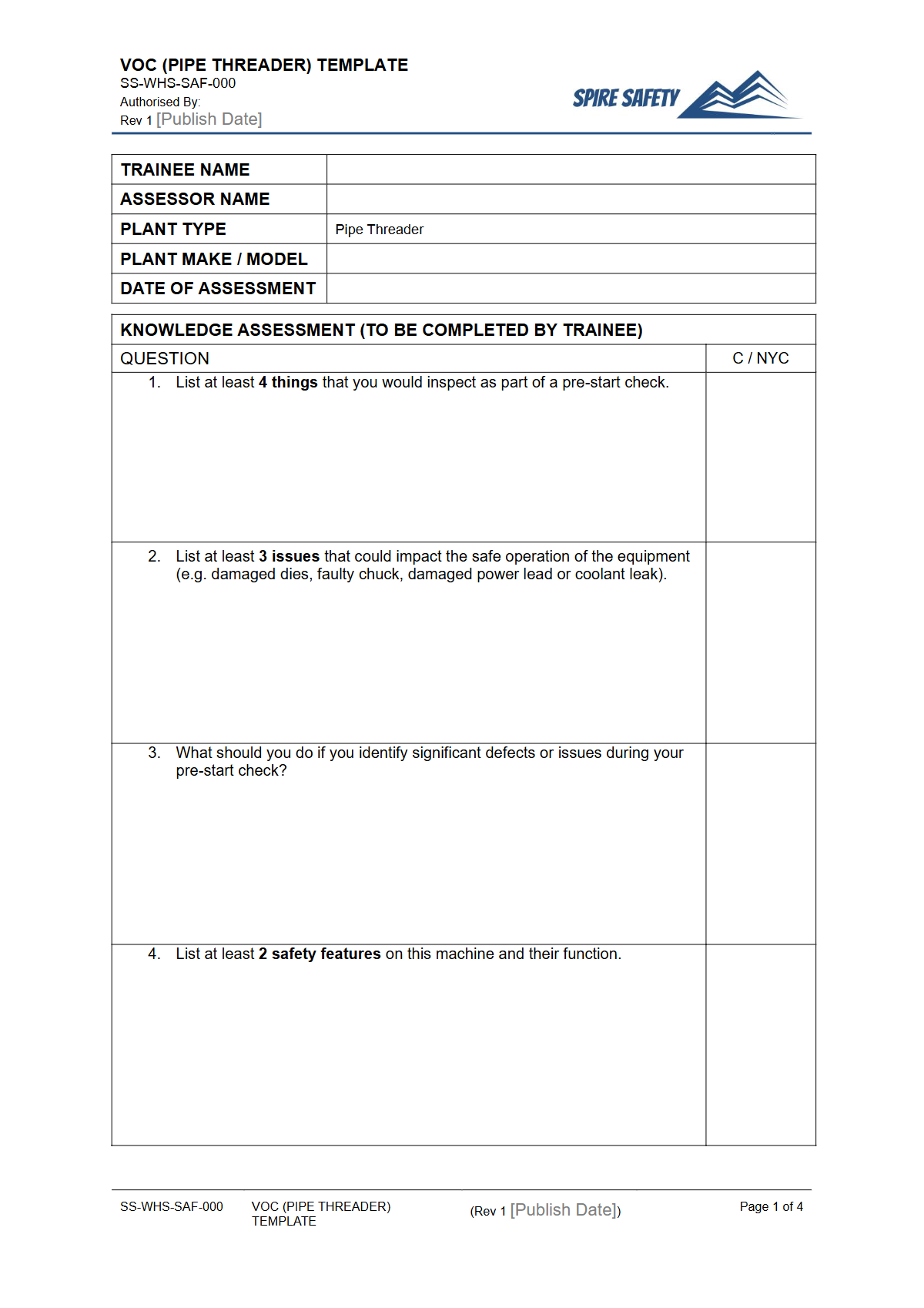
Our free Verification of Competency (Pipe Threader) Template provides a structured framework for assessing and documenting a worker's ability to safely and competently operate a pipe threader. Regularly verifying competency is a critical component of a robust work health and safety (WHS) management system, ensuring that high-risk plant like pipe threaders are operated by appropriately skilled personnel.
This template helps organisations identify knowledge gaps, confirm practical skills, and maintain an ongoing record of assessment.
Using a consistent verification process helps to minimise the risk of incidents related to improper equipment use, protect workers, and uphold organisational safety standards. It’s an essential tool for any business where pipe threading operations are carried out, forming part of a comprehensive approach to managing plant safety and worker training.
This document is aligned with Australian WHS practice and provides key components for a thorough assessment.
Video walkthrough
How to use the Verification of Competency (Pipe Threader) Template
This Verification of Competency (Pipe Threader) Template is designed to be user-friendly and adaptable. Upon downloading, you'll receive it in both DOCX and PDF formats.
We recommend using the DOCX version for customisation. This template offers a starting point, and it must be customised to your workplace's specific pipe threading equipment, operational procedures, and relevant site-specific hazards. Start by clearly defining the specific pipe threader model(s) and associated tasks workers will be assessed on.
The template includes sections for theoretical knowledge assessment, practical demonstration, and a review of safe work procedures. An assessor, who should be competent in both pipe threading operations and assessment techniques, will use this template to evaluate the worker.
Document observations during practical tasks, noting any areas for improvement or re-training. Record the assessment outcome, any recommendations, and the date of verification.
Regular re-assessment is crucial, especially after incidents, near misses, or significant changes to equipment or procedures. For similar equipment, consider our Verification of Competency (Pipe Cutter) Template.
When to use it
The Verification of Competency (Pipe Threader) Template should be used in several key scenarios:
- New Worker Inductions: When a new worker is required to operate a pipe threader.
- New Equipment Introduction: If new or significantly different pipe threading equipment is brought into use.
- Periodic Re-assessment: As part of a scheduled review, typically every 1-3 years, depending on risk and frequency of use.
- After an Incident: Following any incident, near miss, or unsafe act involving a pipe threader.
- Performance Management: If there are concerns about a worker's competency, behaviour, or work quality.
- Changes in Work Procedures: When there are significant changes to the way pipe threading tasks are performed.
Documenting these verifications is an important part of maintaining effective WHS management systems.
Who should use it
This template is invaluable for:
- WHS Managers and Officers: To implement and oversee a structured competency assessment program for high-risk plant.
- Supervisors and Team Leaders: Who are responsible for training, supervising, and verifying the competency of their team members in operating pipe threaders.
- Training Coordinators: To standardise assessment practices and maintain consistent records.
- Business Owners and Directors: To demonstrate due diligence in ensuring a safe working environment and managing the risks associated with plant operation.
- Contract Managers: When engaging contractors whose workers will operate pipe threading equipment on site.
Using resources like this forms a part of sound WHS consulting practice.
Common mistakes
Common mistakes to avoid
- Not customising the template to specific workplace equipment and procedures.
- Using an assessor who is not genuinely competent in pipe threading operations or assessment.
- Failing to conduct re-assessments after incidents, near misses, or significant operational changes.
- Treating the VOC as a one-off event rather than an ongoing part of WHS management.
Legal references
Legal considerations
The following legal requirements may be relevant to this type of work.
- Work Health and Safety Act (Harmonised) — Provides the primary duties for protecting workers and other people from work health and safety risks.
- Work Health and Safety Regulations (Harmonised) — Sets out requirements supporting the management of workplace hazards and risks.
The following codes may be relevant to this type of work.
- Managing WHS Risks Code of Practice — Provides practical guidance on identifying hazards, assessing risks and applying effective controls.
- Work Health and Safety Consultation, Cooperation and Coordination Code of Practice — Provides practical guidance on consulting workers and coordinating with other duty holders.
- Managing the Work Environment and Facilities Code of Practice — Provides practical guidance on safe work environments, workplace facilities and related controls.
Did you know
Pipe Threading Safety
Pipe threaders, especially older models, can pose risks such as entanglement from rotating parts, burns from hot-swarf, and electrical hazards if not properly maintained or operated. Safe work practices are crucial.
Maintaining Competency Records
Maintaining accurate and up-to-date Verification of Competency records is vital for demonstrating due diligence and forms an important part of an organisation's WHS documentation strategy.
FAQ
Frequently asked questions
01What is a Verification of Competency (VOC) for a pipe threader?
02How often should pipe threader competency be verified?
03Can I use this pipe threader VOC template for other types of machinery?
04Who can perform a pipe threader competency assessment?
Share this resource
Verification of Competency (Pipe Threader) Template
Browse Categories
How To Use It
- 1Download and open in Word or PDF.
- 2Replace the placeholders with your business details.
- 3Get it reviewed by a WHS specialist before rollout.
Need it customised?
Our WHS consultants can adapt this template to your site, run a gap analysis, or audit what you already have in place.
Book a Free Consultation WHS consulting servicesor call 1300 156 382