
Verification of Competency (Plasma Cutter)
Assess operator skill with our Verification of Competency (Plasma Cutter) template. Aligned with Australian WHS standards. Download your free DOCX & PDF.
Verification of Competency (Plasma Cutter)
DOCX • 138 KB + PDF
Updated Oct 2026
No signup required
Purpose of the Verification of Competency (Plasma Cutter)
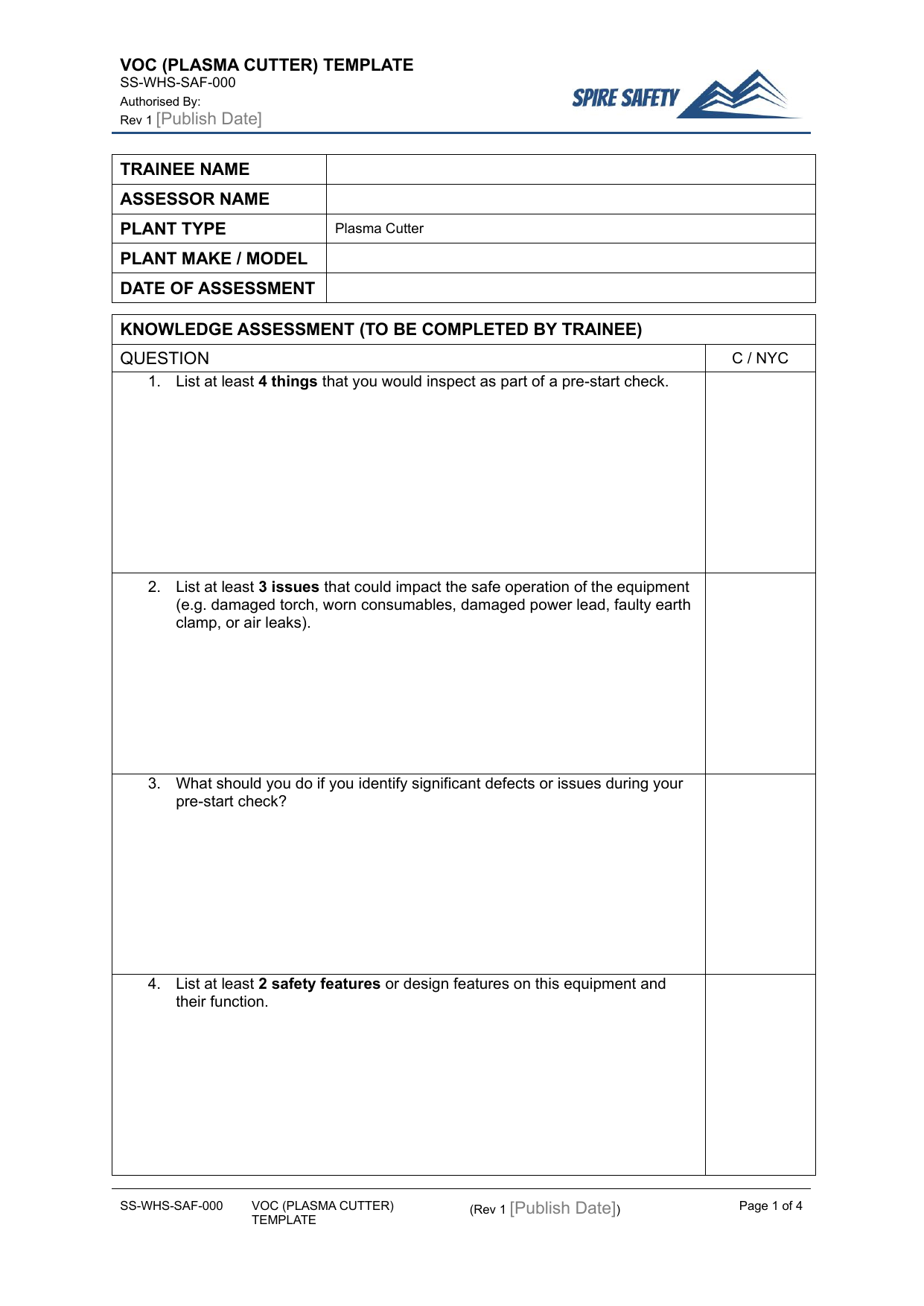
A Verification of Competency (VOC) is a formal process used to confirm that a worker has the current skills, knowledge, and experience to operate specific plant and equipment safely. This Verification of Competency (Plasma Cutter) template provides a structured method to assess an operator's ability to handle the significant risks associated with this equipment, including extreme heat, molten metal, hazardous fumes, electrical hazards, intense ultraviolet light, and high noise levels.
Using this document helps a Person Conducting a Business or Undertaking (PCBU) meet their primary duty of care under WHS legislation. It serves as practical evidence that workers are competent for the tasks they perform, forming a critical component of your broader WHS management systems. It moves beyond a simple training certificate by testing a worker's applied skills in their actual work environment.
While a Safe Work Method Statement (SWMS) outlines the steps for a high-risk task, a VOC confirms the individual's ability to follow those steps correctly. This process is essential for high-energy workshop tools; for instance, it complements other equipment-specific assessments like our Free Bench Grinder VOC (Verification of Competency) Template, ensuring a comprehensive approach to workshop safety.
Video walkthrough
How to use the Verification of Competency (Plasma Cutter)
This template is a starting point for developing a customised assessment for your workplace. It includes a checklist covering pre-operational checks, operational procedures, emergency responses, and shutdown processes.
It also provides space to record assessor feedback and the final competency outcome.
Important: We have designed this document as a general template. You must customise it to reflect the specific plasma cutter models, materials, and unique hazards present in your workplace.
This includes adding or removing criteria to match your site-specific procedures and risk controls.
To effectively use this resource:
- Adapt the checklist to align with the manufacturer's instructions for your plasma cutter and your organisation's SWMS.
- Designate a competent person—someone with deep technical knowledge and experience with the equipment—to act as the assessor.
- The assessor observes the operator performing a range of typical tasks, from setup to clean-up.
- The assessor should ask situational or 'what-if' questions to test the operator's understanding of hazards and emergency procedures.
- Document the assessment outcome, providing clear feedback to the operator. If 'Not Yet Competent', a training plan should be developed and another assessment scheduled. If you require support in customising safety documents, consider engaging professional WHS consulting services.
When to use it
A Verification of Competency should be performed at key points in a worker's employment to ensure skills remain current and aligned with workplace expectations. Triggers for conducting a plasma cutter VOC include:
- Before a worker is authorised to use a plasma cutter for the first time.
- As part of a pre-employment screening process.
- When a new model or type of plasma cutter is introduced to the workplace.
- If a supervisor observes unsafe work practices or non-compliant behaviour.
- Following an incident, near-miss, or hazard report involving a plasma cutter.
- As part of a scheduled re-verification program (e.g., every two years) to ensure skills have not degraded over time. A similar approach can be applied to other cutting tools, as outlined in our Verification of Competency (Pipe Cutter) Template.
Regularly scheduled VOCs demonstrate a proactive approach to safety management and are a key activity that may be reviewed during a formal WHS compliance auditing process. These assessments help identify gaps in knowledge or performance before they can lead to an incident.
Who should use it
This resource is primarily intended for supervisors, team leaders, safety managers, and internal trainers responsible for overseeing workshop operations and ensuring worker safety. The assessment itself must be conducted by a person who is an expert in plasma cutting operations and is also capable of conducting a fair and thorough assessment.
The ideal assessor is not just a skilled operator; they must also understand the principles of competency assessment and be able to provide constructive feedback. This might be a senior tradesperson, a workshop supervisor, or a dedicated trainer who has been deemed competent for this role.
Using a consistent assessment process for all workshop equipment, such as when using our Free Drill Press VOC (Verification of Competency) Template, helps establish a clear standard of safety across your organisation.
This VOC template is one of many documents available to help you build a robust safety system. For more templates, checklists, and guides, browse our complete free WHS resources library.
Common mistakes
Common mistakes to avoid
- Using a generic VOC without customising it for the specific plasma cutter model and workplace risks.
- Failing to verify the assessor is truly competent in both operating the equipment and conducting assessments.
- Treating the VOC as a 'tick and flick' exercise instead of a genuine assessment of practical skill.
- Forgetting to address risks beyond the cut itself, such as hazardous fumes, noise, and radiation (UV/IR light).
Legal references
Legal considerations
The following legal requirements may be relevant to this type of work.
- Work Health and Safety Act (Harmonised) — Provides the primary duties for protecting workers and other people from work health and safety risks.
- Work Health and Safety Regulations (Harmonised) — Sets out requirements supporting the management of workplace hazards and risks.
The following codes may be relevant to this type of work.
- Managing WHS Risks Code of Practice — Provides practical guidance on identifying hazards, assessing risks and applying effective controls.
- Work Health and Safety Consultation, Cooperation and Coordination Code of Practice — Provides practical guidance on consulting workers and coordinating with other duty holders.
- Managing the Work Environment and Facilities Code of Practice — Provides practical guidance on safe work environments, workplace facilities and related controls.
Did you know
Arc Eye
The intense ultraviolet (UV) light from a plasma arc can cause a painful condition called photokeratitis, or 'arc eye,' which is like a sunburn on the cornea of the eyes.
Superheated Gas
A plasma cutter works by sending an electric arc through a gas, heating it to temperatures as high as 25,000°C—hotter than the surface of the sun—to create a jet of plasma that slices through metal.
FAQ
Frequently asked questions
01What's the difference between a VOC and a training certificate?
02How often should we conduct a plasma cutter VOC?
03Can anyone be an assessor for a plasma cutter VOC?
04Is this VOC template enough to be compliant?
Share this resource
Verification of Competency (Plasma Cutter)
Browse Categories
How To Use It
- 1Download and open in Word or PDF.
- 2Replace the placeholders with your business details.
- 3Get it reviewed by a WHS specialist before rollout.
Need it customised?
Our WHS consultants can adapt this template to your site, run a gap analysis, or audit what you already have in place.
Book a Free Consultation WHS consulting servicesor call 1300 156 382