
Verification of Competency (Pop Rivet Gun)
Ensure your team uses pop rivet guns safely and effectively. Our Verification of Competency (Pop Rivet Gun) template helps assess operator skills. Download it.
Verification of Competency (Pop Rivet Gun)
DOCX • 138 KB + PDF
Updated Oct 2026
No signup required
Purpose of the Verification of Competency (Pop Rivet gun)
A pop rivet gun is a common tool in workshops, construction sites, and manufacturing facilities. While seemingly simple, incorrect use can lead to ineffective fastening, equipment damage, or personal injury.
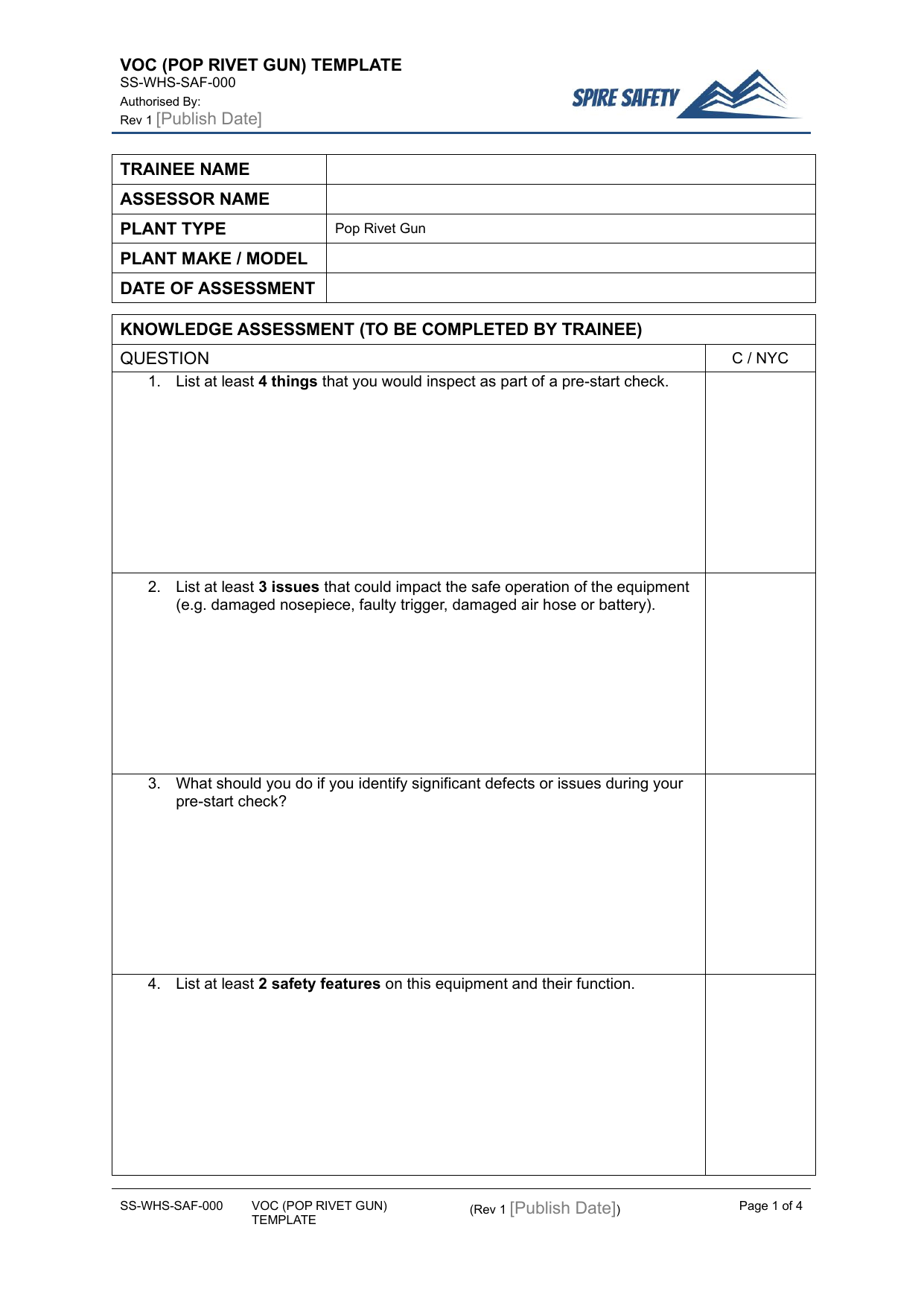
This Verification of Competency (Pop Rivet Gun) template provides a structured framework for a Person Conducting a Business or Undertaking (PCBU) to assess and confirm that a worker has the required skills and knowledge to operate the tool safely and correctly. It formalises the process of checking a worker's ability to perform pre-operational checks, select the correct rivets and nosepieces, operate the tool according to manufacturer instructions, and identify associated hazards like ejected mandrels and noise.
Using a documented assessment process helps a PCBU fulfil its primary duty of care under Australian WHS laws. It creates a clear record that demonstrates steps have been taken to ensure workers are competent for the tasks they perform.
This process is similar for other hand-held tools, and you can find a comparable structure in our Verification of Competency (Orbital Sander) Template, which also focuses on safe operator conduct.
Video walkthrough
How to use the Verification of Competency (Pop Rivet Gun)
This document is designed to be used by a competent assessor observing a worker using a pop rivet gun in a practical setting. The template provides a checklist covering key safety and operational criteria, from initial setup to finishing the task.
The assessor should observe the worker and tick off each demonstrated competency, adding comments where necessary. It is not a theoretical exam but a hands-on confirmation of skill.
The process generally involves:
- The assessor explaining the purpose of the VOC to the worker.
- The worker performing a series of tasks using the pop rivet gun that cover all criteria in the checklist.
- The assessor observing the performance and marking the checklist.
- A concluding discussion where the assessor provides feedback and signs off on the worker's competency or identifies areas for further training.
Important: This is a template, not a finished document. We have designed it to be customised to reflect your specific equipment (e.g., manual, pneumatic, or battery-powered models), unique work environment, and internal procedures.
The structure is aligned with best practice, similar to our Free Bench Grinder VOC (Verification of Competency) Template, but must be adapted for your site.
When to use it
A Verification of Competency should be conducted at several key points to ensure ongoing safety and skill retention. It is not a one-time event. Consider using this VOC process in the following situations:
- Pre-employment or prior to first use: To confirm the skills of new employees or existing workers before they are assigned tasks involving a pop rivet gun.
- Introduction of new equipment: When a new model or type of pop rivet gun (e.g., moving from manual to pneumatic) is introduced to the workplace.
- Post-incident: Following any incident or near miss involving the tool, to identify and rectify any gaps in knowledge or safe practice.
- Refresher training: As part of a regular skills maintenance program, especially for workers who use the tool infrequently.
Integrating VOCs into your safety framework is a core part of robust WHS management systems, ensuring your procedures are practical and effective.
Who should use it
Multiple people are involved in the VOC process:
- The PCBU: The business owner or employer holds the ultimate responsibility for ensuring workers are competent and that a system for verifying this is in place.
- Supervisors and Managers: They are typically responsible for identifying the need for a VOC, scheduling it, and ensuring any required follow-up training is completed.
- The Assessor: The VOC must be conducted by a competent person. This individual must have deep technical knowledge of the pop rivet gun, extensive practical experience, and a thorough understanding of the associated risks and safety controls. This could be an experienced team leader, an internal trainer, or an external safety professional.
- The Worker: The individual being assessed for their competency to use the tool safely and effectively for their assigned tasks.
For organisations lacking an appropriately skilled internal assessor, our WHS consulting services can provide guidance on establishing effective competency frameworks.
Beyond the Checklist: A Holistic Approach
While this VOC template is a valuable tool, it should be part of a broader safety strategy. It complements other critical WHS documents and practices.
For example, the hazards identified during a VOC assessment can inform your risk assessments and Safe Work Method Statements (SWMS). The need for specific Personal Protective Equipment (PPE), such as safety glasses and hearing protection (especially with pneumatic models), should be reinforced. This systematic approach is also crucial for other equipment, as shown in our Free Drill Press VOC (Verification of Competency) Template.
Maintaining completed VOC records is essential for compliance and continuous improvement. These documents serve as proof of training and assessment and can be reviewed during a formal WHS compliance auditing process to demonstrate due diligence.
Common mistakes
Common mistakes to avoid
- Using the wrong size rivet or nosepiece for the hole, leading to a weak joint.
- Failing to wear appropriate PPE, especially safety glasses to protect from ejected mandrels.
- Not ensuring the tool is held perpendicular to the work surface, causing improper rivet setting.
- Neglecting regular cleaning and maintenance, which can lead to tool malfunction or jamming.
Legal references
Legal considerations
The following legal requirements may be relevant to this type of work.
- Work Health and Safety Act (Harmonised) — Provides the primary duties for protecting workers and other people from work health and safety risks.
- Work Health and Safety Regulations (Harmonised) — Sets out requirements supporting the management of workplace hazards and risks.
The following codes may be relevant to this type of work.
- Managing WHS Risks Code of Practice — Provides practical guidance on identifying hazards, assessing risks and applying effective controls.
- Work Health and Safety Consultation, Cooperation and Coordination Code of Practice — Provides practical guidance on consulting workers and coordinating with other duty holders.
- Managing the Work Environment and Facilities Code of Practice — Provides practical guidance on safe work environments, workplace facilities and related controls.
Did you know
Blind Rivets
Pop rivets are also known as "blind rivets" because they can be installed from one side of the workpiece, where the other side is inaccessible or "blind."
Manual vs. Powered
While manual pop rivet guns are common for light tasks, pneumatic and battery-powered versions significantly reduce operator fatigue and increase speed in production settings.
FAQ
Frequently asked questions
01What is a Verification of Competency (VOC) for a pop rivet gun?
02Who can conduct a pop rivet gun VOC?
03Is a pop rivet gun VOC legally required in Australia?
04How often should a pop rivet gun VOC be done?
Share this resource
Verification of Competency (Pop Rivet Gun)
Browse Categories
How To Use It
- 1Download and open in Word or PDF.
- 2Replace the placeholders with your business details.
- 3Get it reviewed by a WHS specialist before rollout.
Need it customised?
Our WHS consultants can adapt this template to your site, run a gap analysis, or audit what you already have in place.
Book a Free Consultation WHS consulting servicesor call 1300 156 382