
Verification of Competency (Rebar Cutter)
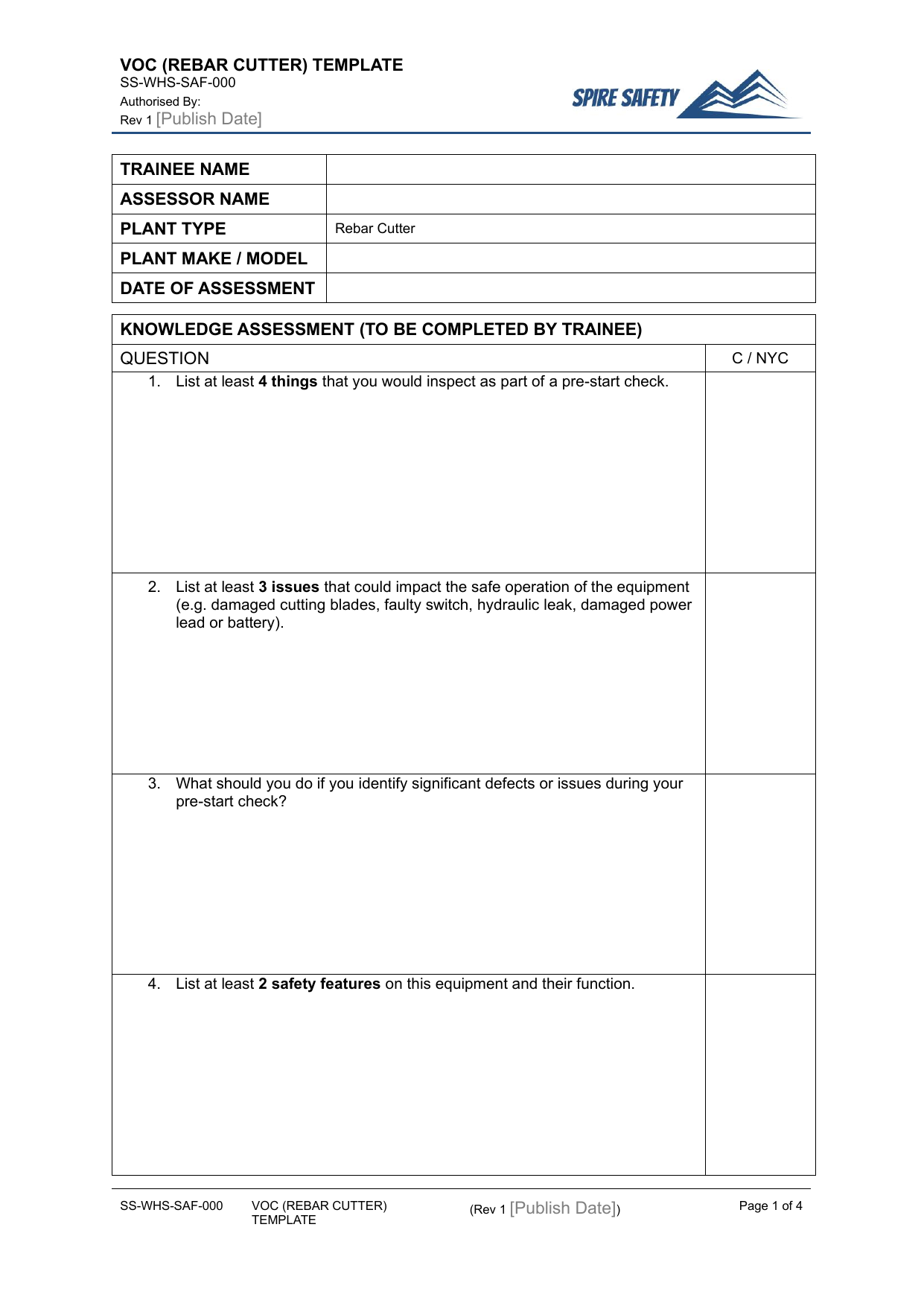
Confirm operator competence for rebar cutters. Our Verification of Competency (Rebar Cutter) template is a great starting point for Australian businesses.
Verification of Competency (Rebar Cutter)
DOCX • 138 KB + PDF
Updated Oct 2026
No signup required
Purpose of the Verification of Competency (Rebar Cutter)
A Verification of Competency (VOC) is a formal process used by employers to confirm that an individual has the current skills and knowledge required to operate specific plant or equipment safely and competently. This Verification of Competency (Rebar Cutter) template provides a structured framework for assessing an operator's ability to handle this powerful tool, aligning with the primary duty of care obligations under Australian WHS legislation.
Using a rebar cutter introduces significant risks, including amputation, lacerations from sharp edges, projectiles, electric shock, and musculoskeletal injuries. A robust VOC process helps ensure that workers not only hold a relevant licence or ticket (if required) but can also demonstrate practical competence on the specific model used in your workplace, effectively managing these risks.
Implementing regular VOCs is a critical component of a proactive safety culture. It demonstrates a commitment to worker safety and serves as tangible evidence of risk management.
These records are an essential part of a comprehensive WHS management system, helping to identify training gaps before they lead to an incident. By verifying skills, you ensure that operators understand the machine's functions, limitations, pre-start checks, and emergency procedures.
Video walkthrough
How to use the Verification of Competency (Rebar Cutter)
This document is designed to be used by a competent assessor—such as a supervisor, manager, or experienced operator—to evaluate a worker's performance. The process should involve a combination of theoretical questioning and practical observation.
The assessor should observe the operator performing tasks they would encounter during a typical workday, from initial setup to shutdown.
The assessment process should cover:
- Pre-start Checks: Verifying the operator inspects the cutter's physical condition, blade sharpness, guards, power cord, and any hydraulic components.
- Safe Operation: Observing the worker's technique, including how they secure the rebar, position their body, use the controls, and manage the cut pieces.
- Hazard Identification: Questioning the operator about potential risks like kickback, electrical hazards, and manual handling, and the control measures they would apply.
- Post-operational Procedures: Ensuring the operator correctly powers down, cleans, and stores the equipment.
Important: This is a template we have developed to get you started. You must customise this document to reflect the specific rebar cutter models, workplace environment, and operational procedures at your site.
Generic, untailored assessments are insufficient for managing specific workplace risks.
When to use it
A Verification of Competency is not a one-time event. It should be integrated into your safety procedures and conducted at key moments to ensure ongoing competence. Consider using this VOC process in the following situations:
- Pre-employment or Mobilisation: Before a new worker starts using a rebar cutter on your site.
- Introduction of New Equipment: When a new make or model of rebar cutter is introduced.
- Post-Incident: Following an incident or near-miss involving the equipment to identify and correct behavioural or knowledge gaps.
- Observed Unsafe Behaviour: If a supervisor notices a worker operating the equipment in a manner that deviates from established procedures.
- Regular Intervals: As part of a scheduled refresher program (e.g., annually or every two years) to prevent skill degradation. Records of these checks are often examined during a formal WHS compliance auditing process.
Who should use it
This Verification of Competency template is intended for use by Persons Conducting a Business or Undertaking (PCBUs), site managers, supervisors, and WHS professionals in the construction, manufacturing, and metal fabrication industries. The actual assessment must be carried out by a person who is not only familiar with the assessment process but is also an expert in the safe use of the rebar cutter themselves.
The assessor must have the technical knowledge to accurately judge the operator's performance and provide corrective instruction if needed. Assigning an assessor who lacks hands-on experience with the equipment undermines the entire verification process.
The document also serves as a critical record for both the employer and the employee. It documents the outcome, notes any areas for improvement, and confirms that the worker has been deemed competent at a specific point in time.
Similar verification processes are essential for related equipment, and our template for a Verification of Competency (Rebar Bender) offers a consistent approach for assessing those skills.
For tasks involving other cutting equipment, a specialised VOC is also necessary. For example, if your operations involve cutting concrete, you may find our concrete saw VOC template useful for assessing those specific competencies.
The same principle applies to thermal cutting tools, where our Verification of Competency (Plasma Cutter) provides a tailored assessment framework.
Spire Safety provides a wide range of templates and checklists to help you manage workplace health and safety effectively. You can explore our complete free WHS resources library for more tools to support your safety management system.
Common mistakes
Common mistakes to avoid
- Using a generic checklist that doesn't match the specific rebar cutter model used on site.
- Allowing an assessor who lacks deep, practical experience with the equipment to conduct the VOC.
- Treating the VOC as a 'tick and flick' administrative task without genuine, critical observation of the operator.
- Failing to document the assessment outcome, including any identified gaps and corrective actions required.
Legal references
Legal considerations
The following legal requirements may be relevant to this type of work.
- Work Health and Safety Act (Harmonised) — Provides the primary duties for protecting workers and other people from work health and safety risks.
- Work Health and Safety Regulations (Harmonised) — Sets out requirements supporting the management of workplace hazards and risks.
The following codes may be relevant to this type of work.
- Managing WHS Risks Code of Practice — Provides practical guidance on identifying hazards, assessing risks and applying effective controls.
- Work Health and Safety Consultation, Cooperation and Coordination Code of Practice — Provides practical guidance on consulting workers and coordinating with other duty holders.
- Managing the Work Environment and Facilities Code of Practice — Provides practical guidance on safe work environments, workplace facilities and related controls.
Did you know
Blade Maintenance Matters
A dull or damaged blade on a rebar cutter doesn't just produce a poor cut; it significantly increases the force required, leading to higher risks of musculoskeletal injury and catastrophic equipment failure.
Kickback Risk
Rebar cutters can kick back violently if the rebar is not properly supported or if the blade binds. This unexpected movement is a leading cause of impact injuries to the operator's hands, arms, and torso.
FAQ
Frequently asked questions
01What is the difference between a licence and a Verification of Competency?
02How often should a rebar cutter VOC be conducted?
03Who is considered 'competent' to conduct a rebar cutter VOC?
04Is this VOC template enough for WHS compliance?
Share this resource
Verification of Competency (Rebar Cutter)
Browse Categories
How To Use It
- 1Download and open in Word or PDF.
- 2Replace the placeholders with your business details.
- 3Get it reviewed by a WHS specialist before rollout.
Need it customised?
Our WHS consultants can adapt this template to your site, run a gap analysis, or audit what you already have in place.
Book a Free Consultation WHS consulting servicesor call 1300 156 382