
Verification of Competency (Rotary Hammer)
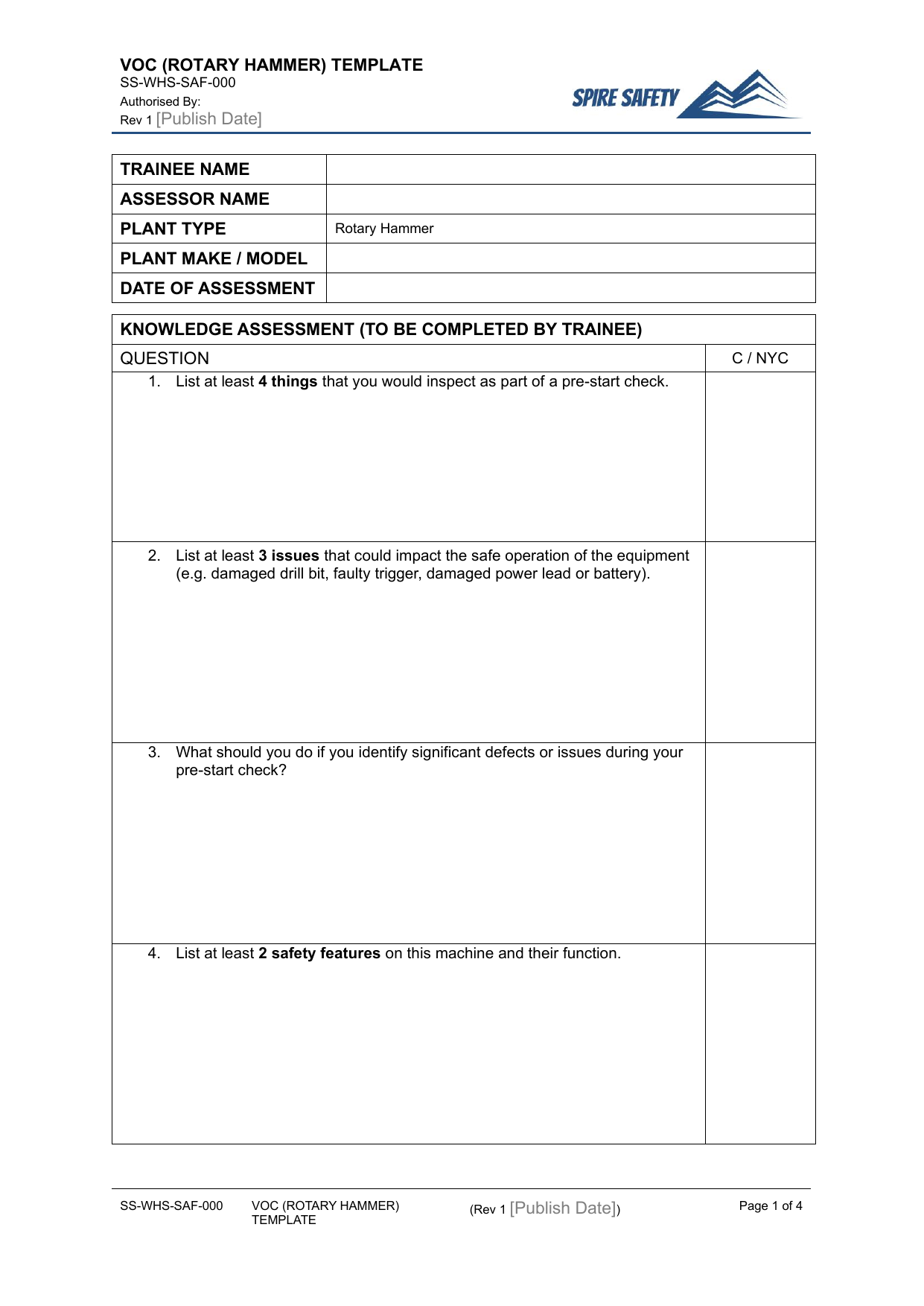
Assess and confirm operator competence with our free Verification of Competency (Rotary Hammer) template. Aligned with Australian WHS standards. Download now.
Verification of Competency (Rotary Hammer)
DOCX • 138 KB + PDF
Updated Oct 2026
No signup required
Purpose of the Verification of Competency (Rotary Hammer)
A Verification of Competency (VOC) is a critical process for any PCBU (Person Conducting a Business or Undertaking) to confirm that a worker has the skills, knowledge, and experience to operate a rotary hammer safely and effectively. This free Verification of Competency (Rotary Hammer) template provides a structured starting point for assessing an operator's ability to manage the specific risks associated with this powerful tool.
It is not a substitute for formal training but serves as a practical assessment to verify that training has been understood and can be applied in the workplace.
Using a rotary hammer exposes workers to significant hazards, including hand-arm vibration, hazardous manual tasks, loud noise, airborne dust (such as crystalline silica), and electrical risks. This VOC process helps you document that workers can apply the necessary control measures, from conducting pre-start checks to using the correct personal protective equipment (PPE) for the task.
The principles here are similar to those in our Verification of Competency (Concrete Saw or Floor Saw) template, focusing on high-risk plant used in construction and maintenance.
Video walkthrough
How to use the Verification of Competency (Rotary Hammer)
This document is a template designed to be adapted to your specific operational needs. To use it effectively, you must review and customise it to reflect the exact models of rotary hammers used in your business, the types of materials being worked on (e.g., concrete, brick, stone), and the unique conditions of your work environment.
The assessment should be conducted by a person who is competent and experienced in the use of rotary hammers and understands the associated hazards and controls.
Important: You must customise this resource for your workplace. The content is a starting point and does not cover all possible hazards or legal requirements.
We recommend seeking professional advice to ensure the document is fully suited to your specific operations. Our WHS consulting services can assist with tailoring documentation to your safety management system.
When to use it
A VOC for a rotary hammer should be conducted at several key points to ensure ongoing safety and competence. It is not a one-off event. Consider using this assessment:
- Before a worker operates a rotary hammer for the first time at your workplace, even if they hold previous qualifications or state they have experience.
- As part of a pre-employment screening process for roles requiring the use of this equipment.
- When a worker is transitioning to a new or different model of rotary hammer with different features or power.
- If a worker has not used a rotary hammer for an extended period and may need a refresher.
- Following a workplace incident or near-miss involving a rotary hammer to identify any competency gaps.
- As part of a scheduled review cycle (e.g., every 2-3 years) to proactively confirm skills remain current.
The process is similar for other handheld power tools, and you may find our Free Hammer Drill VOC useful for assessing operators on related equipment.
Who should use it
This resource is designed for managers, supervisors, and WHS personnel responsible for ensuring plant and equipment safety on site. The direct user of the template will be the assessor—a person designated as competent to evaluate another worker's skills.
An ideal assessor is someone with extensive, current experience operating rotary hammers, who can identify safe and unsafe behaviours and provide constructive feedback.
Integrating VOCs into your safety procedures is a practical way to demonstrate due diligence and build robust WHS management systems. It creates a clear record that you have taken steps to verify that workers are capable of performing their tasks safely, helping to meet your primary duty of care under the WHS Act.
Key Assessment Criteria
A thorough rotary hammer VOC should assess both theory and practice. The assessor should observe the operator performing a relevant task while evaluating their ability to:
- Conduct comprehensive pre-start checks, including inspecting the tool, power cord, and any attachments.
- Select and securely install the correct bit (e.g., drill bit, chisel, core bit) for the intended task and material.
- Demonstrate a safe work stance, correct grip, and appropriate application of pressure during operation.
- Identify potential hazards in the work area, such as hidden electrical or plumbing services.
- Select and correctly use all required PPE, including safety glasses, hearing protection, gloves, and respiratory protection where dust is generated.
- Manage risks from vibration and noise by adhering to designated exposure limits or work-rest schedules.
- Follow correct shutdown, cleaning, and storage procedures.
This structured approach ensures all critical safety steps are checked, similar to the process outlined in our bench grinder VOC template for stationary equipment.
Beyond the Checklist
A Verification of Competency should be more than a simple tick-box exercise. The assessor should engage with the worker, ask open-ended questions to check their understanding of the risks, and observe their behaviour throughout the task.
This holistic approach ensures the worker not only knows what to do but understands why it needs to be done that way. The results of the VOC can help identify needs for further training and are a valuable input for regular WHS compliance audits.
By implementing a thorough VOC program, you foster a proactive safety culture where competence is continuously monitored and maintained. For more tools to support your safety system, browse our complete free WHS resources library for checklists, policies, and procedures.
Common mistakes
Common mistakes to avoid
- Using the VOC as a substitute for initial, hands-on training.
- Failing to customise the template for the specific rotary hammer model and task.
- The assessor lacking sufficient experience or knowledge of the equipment.
- Treating the assessment as a paper exercise without direct observation of the worker.
Legal references
Legal considerations
The following legal requirements may be relevant to this type of work.
- Work Health and Safety Act (Harmonised) — Provides the primary duties for protecting workers and other people from work health and safety risks.
- Work Health and Safety Regulations (Harmonised) — Sets out requirements supporting the management of workplace hazards and risks.
The following codes may be relevant to this type of work.
- Managing WHS Risks Code of Practice — Provides practical guidance on identifying hazards, assessing risks and applying effective controls.
- Work Health and Safety Consultation, Cooperation and Coordination Code of Practice — Provides practical guidance on consulting workers and coordinating with other duty holders.
- Managing the Work Environment and Facilities Code of Practice — Provides practical guidance on safe work environments, workplace facilities and related controls.
Did you know
Hand-Arm Vibration Syndrome (HAVS)
Prolonged use of high-vibration tools like rotary hammers can lead to Hand-Arm Vibration Syndrome (HAVS), a permanent and debilitating condition affecting nerves, blood vessels, and joints. Monitoring exposure time is a critical control measure.
Silica Dust Hazard
Drilling or hammering into concrete, stone, or masonry with a rotary hammer can generate respirable crystalline silica dust. Inhaling this dust can cause silicosis, a serious and incurable lung disease, making respiratory protection and dust suppression vital.
FAQ
Frequently asked questions
01What is the difference between training and a VOC for a rotary hammer?
02Is a VOC for a rotary hammer a legal requirement in Australia?
03How often should a rotary hammer VOC be conducted?
04Who is 'competent' to assess another person on a rotary hammer?
Share this resource
Verification of Competency (Rotary Hammer)
Browse Categories
How To Use It
- 1Download and open in Word or PDF.
- 2Replace the placeholders with your business details.
- 3Get it reviewed by a WHS specialist before rollout.
Need it customised?
Our WHS consultants can adapt this template to your site, run a gap analysis, or audit what you already have in place.
Book a Free Consultation WHS consulting servicesor call 1300 156 382