
Verification of Competency (SDS Max Rotary Hammer)
Assess operator skill with our Verification of Competency (SDS Max Rotary Hammer) template. A structured framework for confirming safe operation and knowledge.
Verification of Competency (SDS Max Rotary Hammer)
DOCX • 138 KB + PDF
Updated Oct 2026
No signup required
Purpose of the Verification of Competency (SDS Max Rotary Hammer)
An SDS Max rotary hammer is a powerful and high-risk piece of equipment used for heavy-duty drilling and demolition tasks in construction and related industries. Ensuring operators are competent is a critical part of a PCBU's primary duty of care.
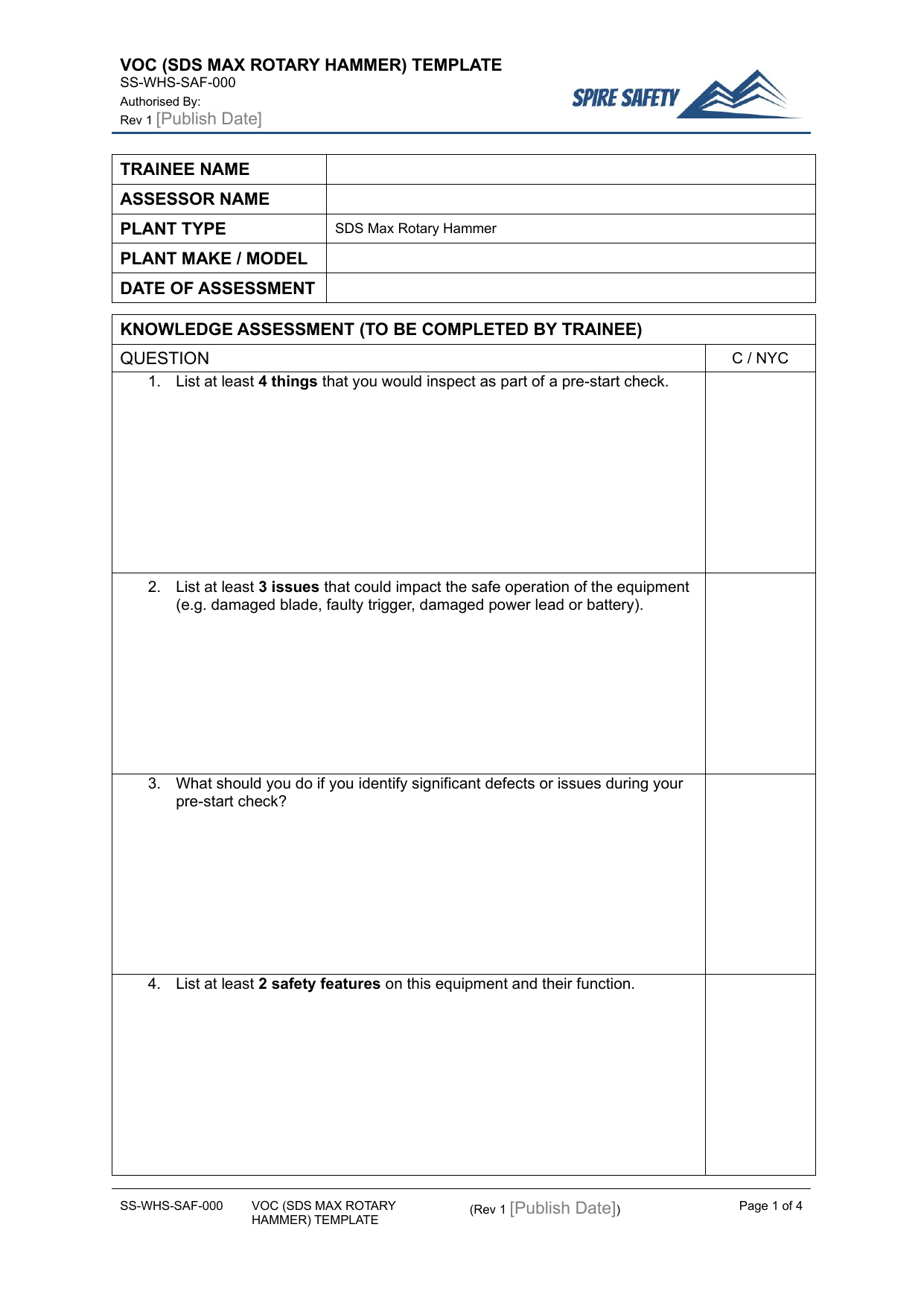
This Verification of Competency (SDS Max Rotary Hammer) template provides a structured framework for assessing an individual's skills, knowledge, and ability to operate the tool safely. It is designed to be a practical tool for supervisors and safety professionals to confirm that workers can not only perform the task but also understand the associated hazards and control measures.
The primary purpose of this Verification of Competency is to provide evidence that a worker can operate the equipment safely and effectively, in line with your organisation's procedures. It goes beyond a simple licence or qualification by testing a worker's practical ability in their specific work environment.
This process helps identify any gaps in training before an incident occurs. A robust VOC program is a key component of effective WHS management systems, demonstrating a commitment to proactive risk management.
It formalises the assessment of critical safety behaviours, including pre-start checks, correct bit selection, safe operating posture to manage kickback, and the proper use of personal protective equipment (PPE) such as hearing protection, eye protection, and anti-vibration gloves.
Video walkthrough
How to use the Verification of Competency (SDS Max Rotary Hammer)
This document should be used by a competent person—typically a supervisor, leading hand, or trainer with extensive experience using SDS Max rotary hammers—to assess another worker. The assessment combines direct observation, where the assessor watches the worker perform specific tasks, and verbal questioning to check their theoretical knowledge of the equipment and associated safety procedures.
The template is divided into sections covering pre-operational checks, operational procedures, and post-operational tasks. The assessor should mark each criterion as 'Competent' (C) or 'Not Yet Competent' (NYC) and include comments to justify their assessment. A similar structured approach can be applied to other power tools, such as the one detailed in our Free Hammer Drill VOC (Verification of Competency) Template.
Important: This is a template only. You must customise it to reflect the specific make and model of the rotary hammer in use, your site-specific hazards, and your organisation’s safe work procedures.
We have made assumptions about common operational tasks, but your workplace activities will be unique.
When to use it
A Verification of Competency should be conducted at several key points in a worker's employment lifecycle to ensure ongoing competence. It is not a one-time event. Key triggers for conducting a VOC include:
- Pre-employment or prior to starting a new role: To verify the skills and claims of a new worker before they begin work unsupervised.
- Introduction of new equipment: When a new make or model of SDS Max rotary hammer is introduced to the workplace.
- Post-incident: As part of an investigation after an incident or near-miss involving the equipment to identify if a lack of competency was a contributing factor.
- Observation of at-risk behaviour: If a supervisor observes a worker operating the equipment in an unsafe manner.
- Routine intervals: As part of a regular safety program, for example, every 1-2 years, to ensure skills have not degraded over time. Competency should also be verified for other high-risk concrete tools, and our Verification of Competency (Concrete Saw or Floor Saw) Template can assist with this.
Who should use it
This template is designed for use by Persons Conducting a Business or Undertaking (PCBUs), site supervisors, WHS managers, and internal trainers. The individual conducting the assessment (the assessor) must be competent and experienced in the operation of an SDS Max rotary hammer themselves.
They need to have the technical knowledge to judge performance accurately and provide corrective feedback if required.
Using this template helps organisations systematically manage high-risk activities and provides clear records of the steps taken to ensure worker safety. These records are invaluable during safety reviews and can be reviewed during a formal WHS compliance auditing process to verify that safety procedures are being followed.
For other specialised plant, such as those used in concrete placement, you might find our free Concrete vibrator VOC useful. If you require assistance in developing or implementing a competency framework for your workplace, our team of experts provides specialised WHS consulting services.
Common mistakes
Common mistakes to avoid
- Treating the VOC as a "tick-and-flick" paperwork exercise without genuine observation.
- Failing to customise the template for the specific rotary hammer model and workplace tasks.
- Using an assessor who is not themselves competent or experienced with the equipment.
- Only assessing practical skills while neglecting to verify the operator's knowledge of hazards like silica dust, noise, and vibration.
Legal references
Legal considerations
The following legal requirements may be relevant to this type of work.
- Work Health and Safety Act (Harmonised) — Provides the primary duties for protecting workers and other people from work health and safety risks.
- Work Health and Safety Regulations (Harmonised) — Sets out requirements supporting the management of workplace hazards and risks.
The following codes may be relevant to this type of work.
- Managing WHS Risks Code of Practice — Provides practical guidance on identifying hazards, assessing risks and applying effective controls.
- Work Health and Safety Consultation, Cooperation and Coordination Code of Practice — Provides practical guidance on consulting workers and coordinating with other duty holders.
- Managing the Work Environment and Facilities Code of Practice — Provides practical guidance on safe work environments, workplace facilities and related controls.
Did you know
What does "SDS" mean?
"SDS" in SDS Max and SDS Plus stands for "Steck-Dreh-Sitz," a German phrase from Bosch meaning "Insert-Twist-Stay." It describes how the drill bit locks into the chuck without needing a key.
Vibration Risk
Prolonged use of powerful tools like SDS Max rotary hammers can lead to Hand-Arm Vibration Syndrome (HAVS). Competency includes knowing how to manage exposure time and use anti-vibration features to minimise this risk.
FAQ
Frequently asked questions
01What's the difference between a VOC and a license?
02How often should I conduct a VOC for an SDS Max Rotary Hammer?
03Can this VOC template be used for other types of rotary hammers?
04Is a Verification of Competency legally required for an SDS Max rotary hammer?
Share this resource
Verification of Competency (SDS Max Rotary Hammer)
Browse Categories
How To Use It
- 1Download and open in Word or PDF.
- 2Replace the placeholders with your business details.
- 3Get it reviewed by a WHS specialist before rollout.
Need it customised?
Our WHS consultants can adapt this template to your site, run a gap analysis, or audit what you already have in place.
Book a Free Consultation WHS consulting servicesor call 1300 156 382
Related templates
- Verification of Competency (SDS Plus Rotary Hammer)
- Verification of Competency (Semi-Trailer or Prime Mover)
- Verification of Competency (Side Tipper Truck)
- Verification of Competency (Skid Steer Auger Attachment)
- Verification of Competency (Spider Lift)
- Verification of Competency (Spray Painter (Airless))