
Verification of Competency (SDS Plus Rotary Hammer)
Assess operator safety and skill for SDS Plus rotary hammers with our VOC template. Aligned with Australian WHS standards. Download your free DOCX & PDF.
Verification of Competency (SDS Plus Rotary Hammer)
DOCX • 138 KB + PDF
Updated Oct 2026
No signup required
Purpose of the Verification of Competency (SDS Plus Rotary Hammer)
Using an SDS Plus rotary hammer introduces significant workplace hazards, including exposure to respirable crystalline silica (RCS), noise, and vibration. This Verification of Competency (SDS Plus Rotary Hammer) template provides a structured method for a Person Conducting a Business or Undertaking (PCBU) to confirm that an operator has the required skills and knowledge to use this powerful tool safely and effectively.
It goes beyond basic training, serving as a practical assessment to verify that a worker can apply safety procedures in a real-world context, mitigating risks before they cause harm. It formalises the process of checking a worker’s ability to manage hazards like electrical shock, hazardous manual tasks, and the selection of appropriate personal protective equipment (PPE).
This document is designed to be integrated into your safety management framework, helping you meet your primary duty of care under WHS legislation. The assessment process is similar in principle to other tool-specific assessments, such as our hammer drill VOC template, focusing on the unique risks of the equipment in question.
It provides documented evidence that you have taken steps to ensure competency, which is a critical part of managing plant and equipment risks in the workplace.
Video walkthrough
How to use the Verification of Competency (SDS Plus Rotary Hammer)
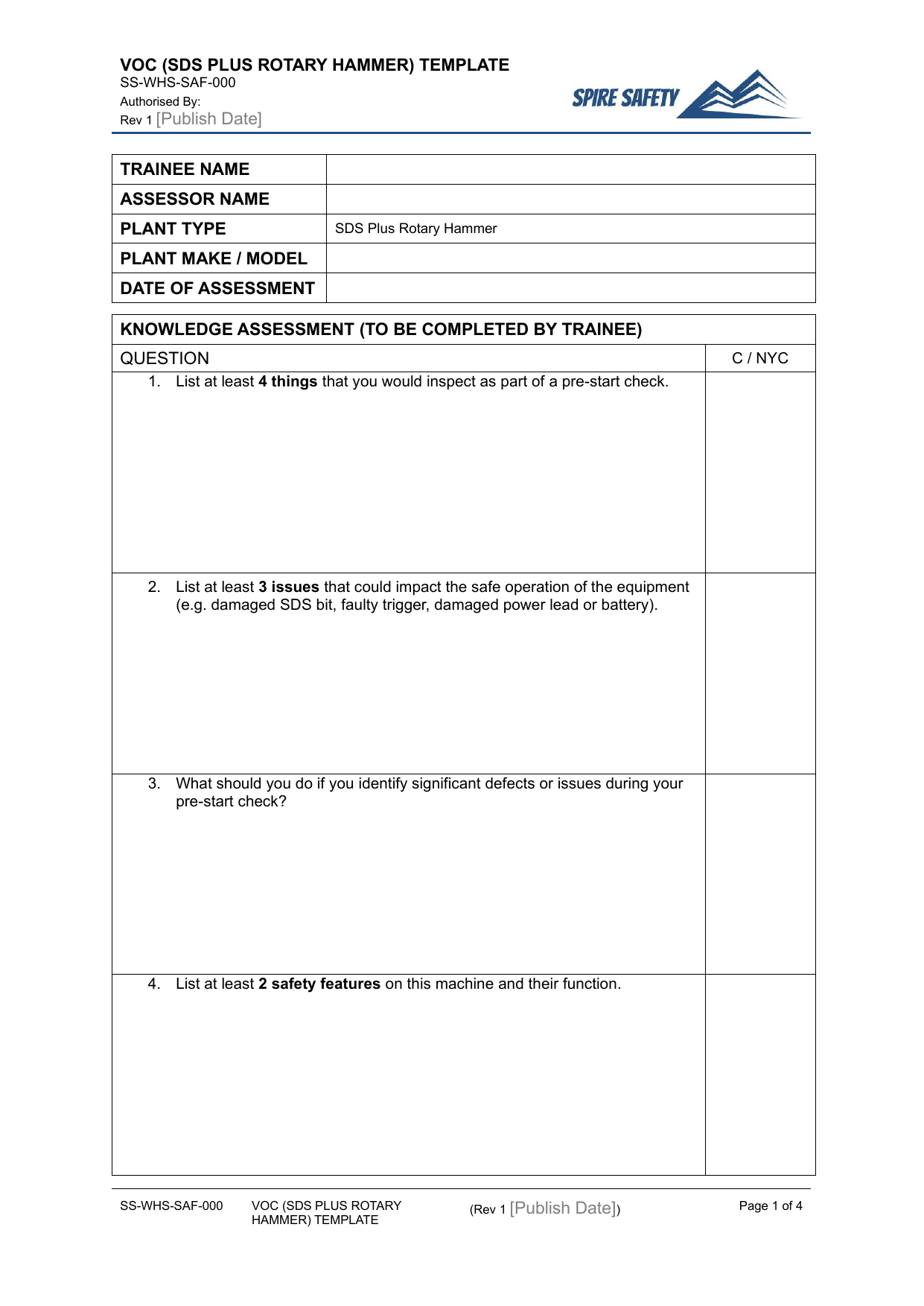
This template is a starting point for developing a customised assessment. It combines theoretical questions with a practical observation checklist to create a comprehensive evaluation of a worker's competency.
The typical process is as follows:
- Customisation: Adapt the document to include the specific make and model of the SDS Plus rotary hammer used at your workplace, your site-specific procedures, and the types of materials being worked on. This step is crucial for relevance and effectiveness.
- Theoretical Assessment: The assessor questions the worker on their understanding of the tool's functions, pre-start checks, potential hazards (like silica dust and vibration), and the control measures outlined in your Safe Work Method Statement (SWMS).
- Practical Observation: The assessor observes the worker performing a task with the rotary hammer. This includes checking their ability to correctly insert a bit, adopt a stable stance, manage the power cord, apply appropriate pressure, and follow shutdown and cleaning procedures.
- Documentation: The assessor records the results, noting any areas where the worker demonstrates a high level of skill or requires further training. Both the assessor and the worker should sign the completed document.
- Action and Review: If competency gaps are identified, a plan for further training or supervision must be implemented and documented before the worker operates the tool again. This process forms part of a continuous improvement loop within your comprehensive WHS management system.
Important: This is a template resource. We strongly recommend you customise it to reflect your specific equipment, site conditions, Safe Work Method Statements, and organisational procedures.
Its effectiveness depends on its direct relevance to your operational environment.
When to use it
A Verification of Competency should be conducted at several key points to ensure ongoing safety. It is not a one-time event. Consider using this VOC template:
- Pre-employment or pre-assignment: To verify the skills and experience claimed by a new worker before they start work.
- Introduction of new equipment: When a new make or model of rotary hammer is introduced, as controls and features may differ.
- Post-incident: Following an incident or near-miss involving a rotary hammer to identify and correct any gaps in competency or procedure.
- Observed behavioural issues: If a supervisor observes a worker operating the tool in an unsafe manner.
- Periodic refreshers: As part of a scheduled competency review program (e.g., annually or biennially) to ensure skills have not degraded over time.
These checks are vital when dealing with high-risk construction materials. For related tasks, consider using a specific concrete saw VOC template to manage cutting hazards separately.
Who should use it
The assessment should be carried out by a person with the necessary skills and experience to make an informed judgement. This is typically a supervisor, leading hand, internal trainer, or safety advisor who is not only an expert in using an SDS Plus rotary hammer but also understands the principles of competency assessment.
The assessor must be familiar with your organisation's specific safety procedures and the relevant Codes of Practice. This focus on specific tools ensures that competency is verified for each distinct risk profile, from drilling to using a bench grinder.
If your organisation lacks the internal expertise for these assessments, engaging WHS consulting services can provide the necessary support and guidance. Regular reviews, and even periodic WHS compliance audits, can ensure the VOC process remains effective and aligned with your legal duties.
This document is one of many available in our library of free WHS resources designed to support Australian businesses.
Common mistakes
Common mistakes to avoid
- Using the template without customising it for the specific model of rotary hammer and workplace conditions.
- Treating the VOC as a 'tick-and-flick' exercise without genuine observation of practical skills.
- Failing to address competency gaps with further training and supervision after the assessment is complete.
- Neglecting to assess the worker's knowledge of secondary risks like silica dust, noise, and vibration.
Legal references
Legal considerations
The following legal requirements may be relevant to this type of work.
- Work Health and Safety Act (Harmonised) — Provides the primary duties for protecting workers and other people from work health and safety risks.
- Work Health and Safety Regulations (Harmonised) — Sets out requirements supporting the management of workplace hazards and risks.
The following codes may be relevant to this type of work.
- Managing WHS Risks Code of Practice — Provides practical guidance on identifying hazards, assessing risks and applying effective controls.
- Work Health and Safety Consultation, Cooperation and Coordination Code of Practice — Provides practical guidance on consulting workers and coordinating with other duty holders.
- Managing the Work Environment and Facilities Code of Practice — Provides practical guidance on safe work environments, workplace facilities and related controls.
Did you know
Vibration Risk
Prolonged use of rotary hammers can lead to Hand-Arm Vibration Syndrome (HAVS), a painful and disabling condition affecting nerves, blood vessels, and joints. Monitoring exposure time is a critical control measure.
SDS Explained
SDS stands for 'Slotted Drive System' (from the German 'Steck – Dreh – Sitz' meaning 'Insert – Twist – Stay'). It allows the bit to move back and forth with the hammering action, independent of the chuck's rotation.
FAQ
Frequently asked questions
01What is the difference between training and a Verification of Competency (VOC)?
02How often should a VOC for an SDS Plus rotary hammer be conducted?
03Can anyone conduct a VOC for an SDS Plus rotary hammer?
04Does this VOC template cover respirable silica dust safety?
Share this resource
Verification of Competency (SDS Plus Rotary Hammer)
Browse Categories
How To Use It
- 1Download and open in Word or PDF.
- 2Replace the placeholders with your business details.
- 3Get it reviewed by a WHS specialist before rollout.
Need it customised?
Our WHS consultants can adapt this template to your site, run a gap analysis, or audit what you already have in place.
Book a Free Consultation WHS consulting servicesor call 1300 156 382