
Verification of Competency (Side Tipper Truck)
Assess side tipper truck operator skills with our detailed Verification of Competency template. Aligned with Australian WHS standards. Download your free DOCX.
Verification of Competency (Side Tipper Truck)
DOCX • 138 KB + PDF
Updated Oct 2026
No signup required
Purpose of the Verification of Competency (Side Tipper Truck)
This Verification of Competency (Side Tipper Truck) template provides a structured framework for employers to confirm that operators have the necessary skills and knowledge to operate this specific type of plant safely. A VOC is a crucial tool for a Person Conducting a Business or Undertaking (PCBU) to meet their primary duty of care under WHS legislation.
It formally assesses an operator’s ability to apply their training and experience to the unique conditions of your workplace, including your specific models of side tipper trucks, site layouts, and operational procedures.
Operating a side tipper truck involves significant risks, including vehicle rollovers (especially on uneven ground), collisions with other vehicles or pedestrians, and unintended contact with overhead powerlines. This assessment process goes beyond a standard driver's licence by verifying that a worker can manage these site-specific hazards effectively.
It forms a key part of your overall safety management, demonstrating that you have taken practical steps to ensure worker competency for high-risk tasks. For similar heavy vehicles, our Moxy VOC template provides a comparable structure.
Video walkthrough
How to use the Verification of Competency (Side Tipper Truck)
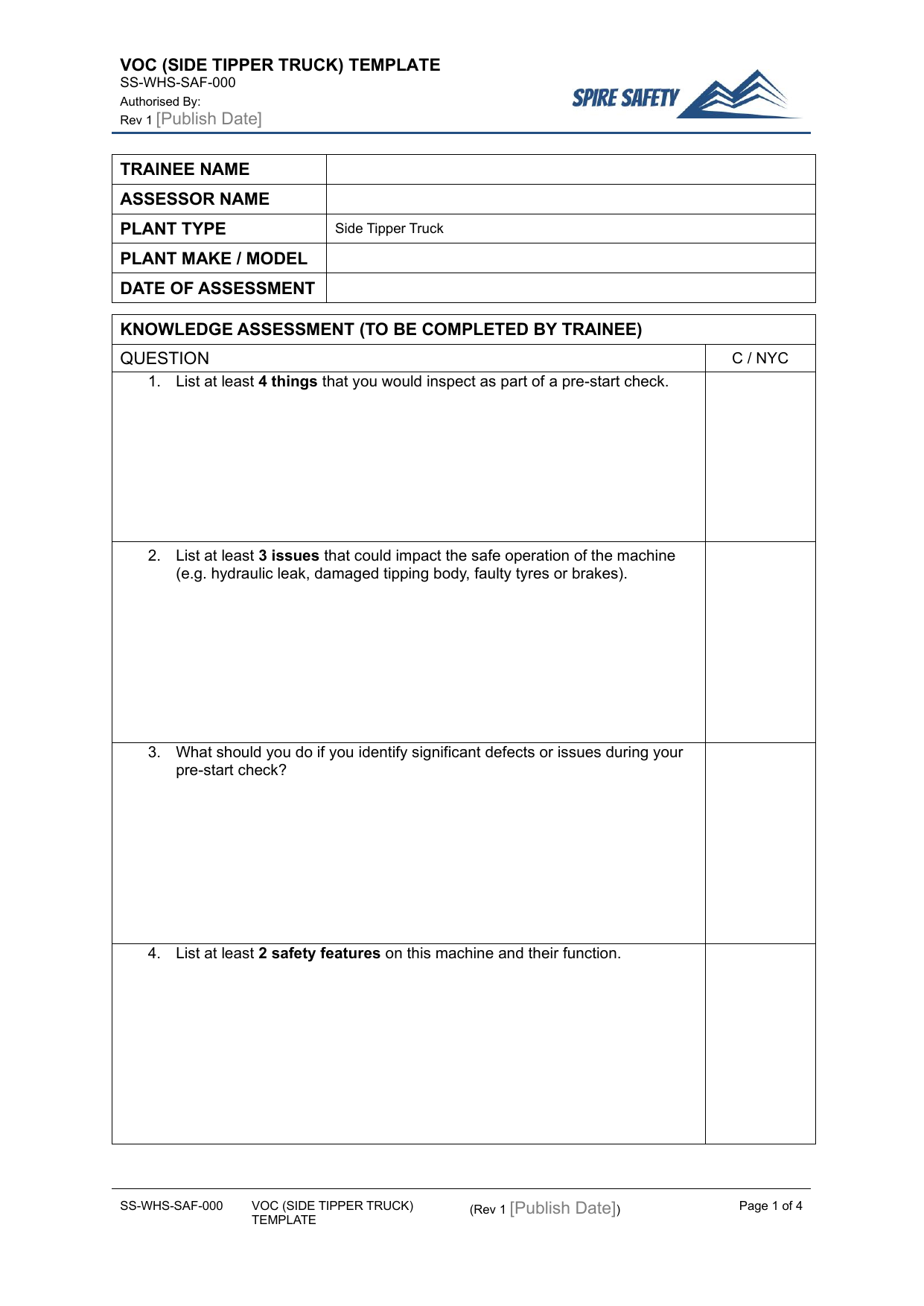
The Verification of Competency (Side Tipper Truck) should be conducted by a qualified and experienced assessor. This individual will observe the operator performing a range of tasks, from pre-start inspections to operational manoeuvres and shutdown procedures.
The template is divided into sections covering theoretical knowledge, practical skills, and safe work behaviours.
Each criterion on the checklist should be marked as 'Competent' (C) or 'Not Yet Competent' (NYC). The assessor should provide detailed comments, especially where gaps in skill or knowledge are identified.
This feedback is essential for developing a targeted training plan if required. This VOC process should be integrated into your broader WHS management systems to ensure consistency and proper record-keeping.
Please note: This document is a template and must be customised to your specific workplace. We have provided a structured starting point, but you must add, remove, or change criteria to reflect your unique side tipper truck models, site conditions, specific tasks, and established safe work procedures.
When to use it
A VOC is not a one-time event. It should be used in various situations to ensure ongoing safety and compliance. Key times to conduct a verification include:
- Pre-employment: To verify the claimed skills and experience of a new hire before they begin work.
- Post-training: To confirm that a worker can apply newly acquired knowledge in a practical setting.
- Introduction of new equipment: When a new make or model of side tipper truck is introduced to the fleet.
- Post-incident: As part of an investigation following a near miss or incident involving a side tipper truck.
- Regular intervals: As part of a scheduled competency review program (e.g., every one to three years, depending on your risk assessment).
- Change in work environment: If the operational area or the nature of the tasks changes significantly.
Regular assessments help maintain high safety standards and can be a key piece of evidence during WHS compliance audits. If your operations also involve other types of heavy trucks, consider using our Body Truck VOC template to maintain consistency in your assessment processes.
Who should use it
This template is designed for use by individuals responsible for workplace safety and operator training. This includes:
- Site Supervisors and Foremen
- WHS Managers and Advisors
- Operations Managers
- Internal Trainers and Assessors
- Human Resources personnel involved in recruitment and onboarding
The most critical factor is that the person conducting the assessment must be competent themselves. This means they must possess deep technical knowledge of side tipper trucks, extensive operational experience, and a thorough understanding of the relevant workplace procedures and WHS legislation.
Using an unqualified assessor undermines the entire verification process. Similar principles apply when assessing operators of other construction plant, such as those covered in our asphalt paver VOC.
For businesses seeking expert guidance on implementing competency frameworks or other safety processes, engaging with a professional WHS consulting firm can provide valuable support and ensure your systems are robust and effective.
This resource is just one of many tools available. You can explore a wide range of checklists, forms, and templates in our free WHS resources library to support your organisation's safety initiatives.
Common mistakes
Common mistakes to avoid
- Using a generic VOC checklist that doesn't account for the specific truck model or site hazards.
- Assigning an assessor who lacks sufficient technical expertise and operational experience with side tippers.
- Treating the VOC as a "tick-and-flick" administrative task rather than a genuine observation of skill.
- Failing to document the assessment properly or not providing retraining for workers found 'not yet competent'.
Legal references
Legal considerations
The following legal requirements may be relevant to this type of work.
- Work Health and Safety Act (Harmonised) — Provides the primary duties for protecting workers and other people from work health and safety risks.
- Work Health and Safety Regulations (Harmonised) — Sets out requirements supporting the management of workplace hazards and risks.
The following codes may be relevant to this type of work.
- Managing WHS Risks Code of Practice — Provides practical guidance on identifying hazards, assessing risks and applying effective controls.
- Work Health and Safety Consultation, Cooperation and Coordination Code of Practice — Provides practical guidance on consulting workers and coordinating with other duty holders.
- Managing the Work Environment and Facilities Code of Practice — Provides practical guidance on safe work environments, workplace facilities and related controls.
Did you know
High Centre of Gravity
Side tipper trucks are particularly vulnerable to rollovers when tipping on soft or uneven ground because the raised tub significantly elevates the vehicle's centre of gravity.
Overhead Powerlines
A significant number of serious and fatal incidents involving tipper trucks are caused by the vehicle's tub or body making contact with overhead powerlines during the tipping cycle.
FAQ
Frequently asked questions
01Is a VOC for a side tipper truck the same as a heavy vehicle licence?
02How often should a side tipper truck VOC be conducted?
03Who is qualified to assess competency on a side tipper truck?
04What happens if a worker is found 'not yet competent'?
Share this resource
Verification of Competency (Side Tipper Truck)
Browse Categories
How To Use It
- 1Download and open in Word or PDF.
- 2Replace the placeholders with your business details.
- 3Get it reviewed by a WHS specialist before rollout.
Need it customised?
Our WHS consultants can adapt this template to your site, run a gap analysis, or audit what you already have in place.
Book a Free Consultation WHS consulting servicesor call 1300 156 382