
Verification of Competency (TIG Welder)
Assess TIG welder skill and safety knowledge with our free Verification of Competency template.
Verification of Competency (TIG Welder)
DOCX • 138 KB + PDF
Updated Oct 2026
No signup required
Purpose of the Verification of Competency (TIG Welder)
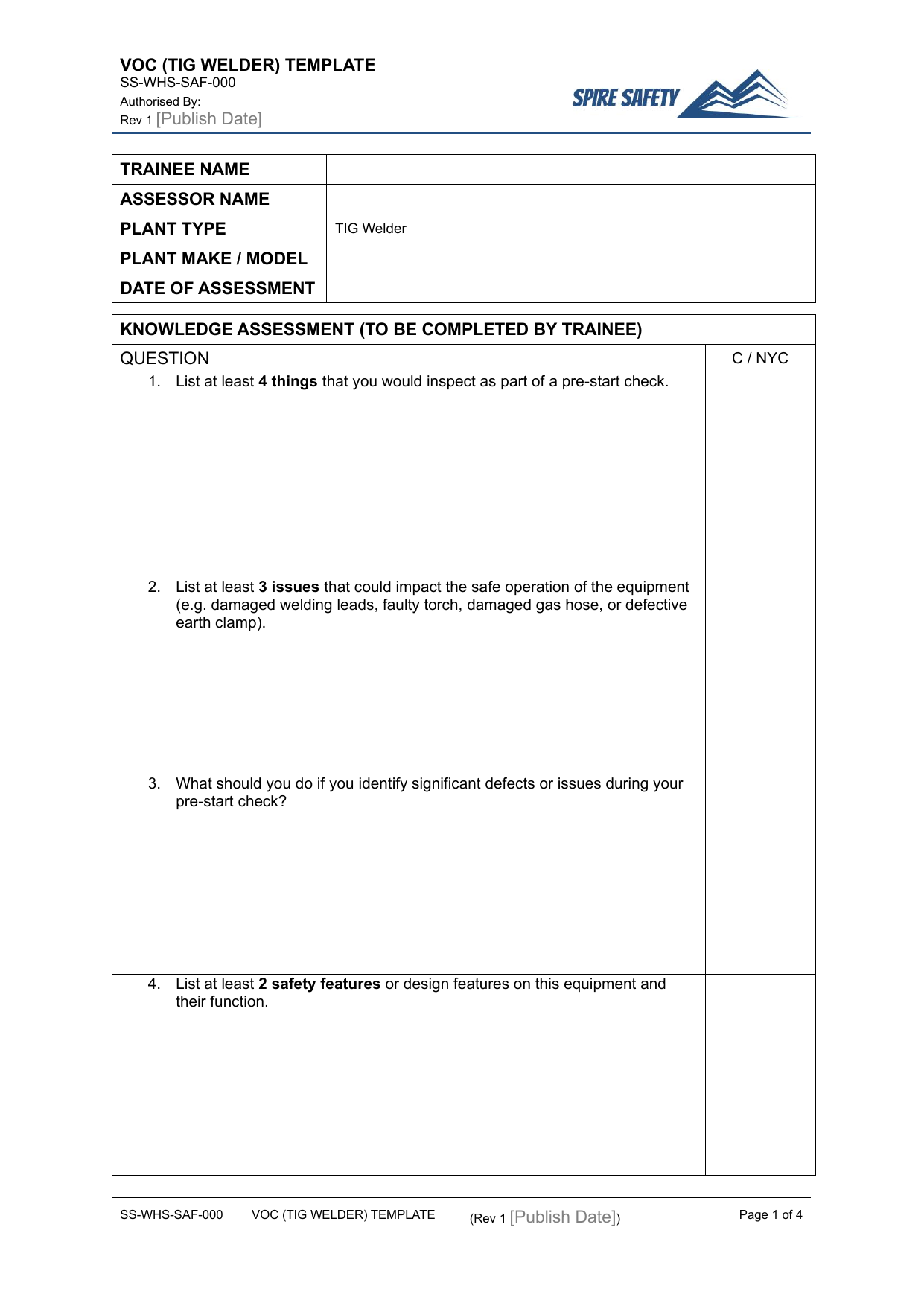
A Verification of Competency (VOC) is a practical process used by employers to confirm that a worker has the current skills, knowledge, and experience to operate equipment or perform a task safely and competently. This Verification of Competency (TIG Welder) template provides a structured framework for assessing an operator’s ability to use Tungsten Inert Gas (TIG) welding equipment according to established safety procedures and workplace standards.
It moves beyond theoretical qualifications, focusing on applied skill in your specific operational context.
Conducting VOCs is a key part of demonstrating due diligence under WHS legislation. It helps a Person Conducting a Business or Undertaking (PCBU) ensure that high-risk activities like welding are only performed by competent individuals, thereby managing risks to health and safety.
Integrating these assessments into your safety processes is a critical component of robust WHS management systems, providing documented evidence of worker capability and helping to prevent incidents.
Video walkthrough
How to use the Verification of Competency (TIG Welder)
This document should be used by a competent assessor to evaluate a TIG welder’s performance. The process typically involves a combination of theoretical questions and direct observation of a practical task.
The assessor uses the checklist to confirm the worker can correctly perform pre-start checks, identify hazards, use appropriate Personal Protective Equipment (PPE), demonstrate correct welding technique, and follow safe shutdown procedures.
To use this template effectively:
- Download the DOCX file and adapt it to your specific needs.
- Identify a competent person to act as the assessor. This individual must have extensive technical knowledge and experience with TIG welding.
- Brief the worker on the assessment process, its purpose, and the standards they will be evaluated against.
- Observe the worker performing a typical TIG welding task from setup to clean-up.
- Document the results, noting any areas of competence and identifying any gaps that require further training or supervision.
- Retain the completed record as part of the worker’s training file.
Note: This template is a starting point. We have developed it to align with Australian WHS principles, but it is impossible to cover every hazard for every make, model, and workplace.
You must customise this document by conducting a risk assessment on your specific equipment and operational environment. This process is similar for other welding types, as shown in our Verification of Competency (MIG Welder) Template.
When to use it
A VOC for a TIG welder should be conducted at several key points to ensure ongoing safety and competence. It is not a one-time event. Consider using this assessment tool:
- Pre-employment: To verify the skills and claims of a new hire before they begin work.
- Post-incident: As part of an investigation following a safety incident or near-miss involving welding equipment.
- Introduction of new equipment: When new or significantly different TIG welding machines are introduced to the workplace.
- Change in work environment: If the conditions or materials being welded change significantly, introducing new hazards.
- Performance concerns: If a supervisor observes unsafe practices or a decline in a worker's performance.
- Periodic re-assessment: As part of a scheduled competency review program, often integrated with activities like regular WHS compliance auditing.
Who should use it
This Verification of Competency template is designed for use by managers, supervisors, and WHS professionals within any organisation that utilises TIG welding. The key roles involved are:
- The PCBU (Employer): Holds the primary duty of care to ensure, so far as is reasonably practicable, that workers are competent to perform their tasks safely.
- The Assessor: Must be a person deemed competent to conduct the assessment. This individual needs deep expertise in TIG welding, familiarity with the specific equipment being used, and an understanding of relevant safety standards and assessment principles. They should be able to objectively judge the operator's skill and safety behaviour.
- The Worker (Operator): The individual being assessed to verify their ongoing competence.
The principles of verifying operator competence apply across various thermal cutting and joining processes. For a related example, see the Verification of Competency (Oxy-Acetylene Welding Equipment) Template.
The assessment criteria within this document cover critical safety checks, hazard control, and operational steps. It prompts the assessor to verify knowledge of electrical safety, fume and gas management, fire prevention, and correct PPE selection, such as wearing the correct shade of welding lens.
Similar principles are crucial when using other high-temperature tools, as outlined in our Verification of Competency (Plasma Cutter) guide.
By systematically working through this template, organisations can create a clear and consistent record of TIG welder competence across their teams. You can explore our entire free WHS resources library for more tools to support your safety management framework.
Common mistakes
Common mistakes to avoid
- Using an assessor who lacks deep technical expertise in TIG welding.
- Failing to customise the template to reflect specific site equipment, procedures, and risks.
- Treating the VOC as a 'tick and flick' administrative task, not a genuine skills assessment.
- Neglecting to document the assessment outcome and any required corrective actions, such as retraining.
Legal references
Legal considerations
The following legal requirements may be relevant to this type of work.
- Work Health and Safety Act (Harmonised) — Provides the primary duties for protecting workers and other people from work health and safety risks.
- Work Health and Safety Regulations (Harmonised) — Sets out requirements supporting the management of workplace hazards and risks.
The following codes may be relevant to this type of work.
- Managing WHS Risks Code of Practice — Provides practical guidance on identifying hazards, assessing risks and applying effective controls.
- Work Health and Safety Consultation, Cooperation and Coordination Code of Practice — Provides practical guidance on consulting workers and coordinating with other duty holders.
- Managing the Work Environment and Facilities Code of Practice — Provides practical guidance on safe work environments, workplace facilities and related controls.
Did you know
Tungsten Inert Gas
TIG welding gets its name from the non-consumable tungsten electrode used to create the arc. An inert shielding gas, typically argon, protects the molten weld pool from atmospheric contamination, resulting in high-quality welds.
Arc Eye Risk
The intense ultraviolet radiation from a TIG welding arc can cause a painful eye condition called photokeratitis or 'arc eye'. Using an auto-darkening helmet with the correct shade rating is essential to prevent this injury.
FAQ
Frequently asked questions
01Is a VOC the same as a TIG welding ticket or qualification?
02How often should a TIG welder's competency be verified?
03Who is 'competent' to conduct a TIG welding VOC?
04Does this template cover all risks associated with TIG welding?
Share this resource
Verification of Competency (TIG Welder)
Browse Categories
How To Use It
- 1Download and open in Word or PDF.
- 2Replace the placeholders with your business details.
- 3Get it reviewed by a WHS specialist before rollout.
Need it customised?
Our WHS consultants can adapt this template to your site, run a gap analysis, or audit what you already have in place.
Book a Free Consultation WHS consulting servicesor call 1300 156 382