
Verification of Competency (Tile Saw or Wet Saw)
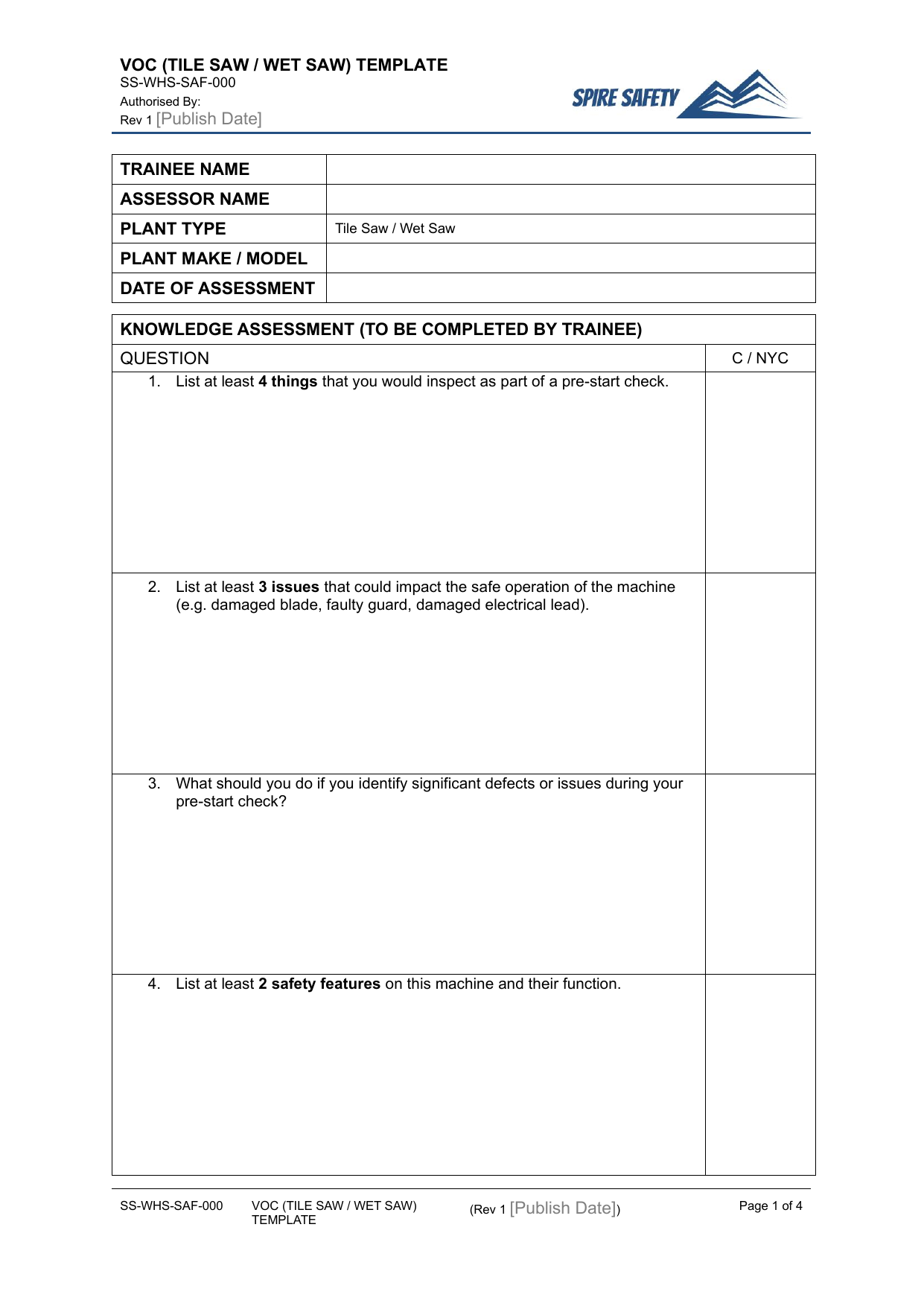
Assess operator skill for tile saws and wet saws with our Verification of Competency template. Aligned with Australian WHS standards.
Verification of Competency (Tile Saw or Wet Saw)
DOCX • 138 KB + PDF
Updated Oct 2026
No signup required
Purpose of the Verification of Competency (Tile Saw or Wet Saw)
A Verification of Competency (VOC) is a formal process used by an organisation to confirm that an individual has the current skills, knowledge, and experience to operate equipment safely and competently. This Verification of Competency (Tile Saw or Wet Saw) template provides a structured method for assessing an operator's ability to handle this specific type of plant.
Tile saws, also known as wet saws, present several significant hazards that must be managed to ensure worker safety. These include severe cuts from the diamond blade, electric shock from the combination of water and power, hazardous noise levels, and risks from hazardous manual tasks when lifting and moving the saw or materials.
Perhaps the most serious long-term health risk is exposure to respirable crystalline silica (RCS) dust, which is generated when cutting tiles, bricks, or stone. A thorough VOC process ensures operators not only know how to use the saw but also understand and apply the critical safety controls required to protect themselves and others.
Using a formal assessment helps a Person Conducting a Business or Undertaking (PCBU) meet their primary duty of care under WHS legislation by ensuring workers are trained and competent for their assigned tasks. This process is similar for other cutting equipment, and you might find our Verification of Competency (Plasma Cutter) template useful for assessing operators of different workshop tools.
This document serves as a starting point, helping supervisors and managers document that they have taken practical steps to verify operator skills against established safety standards and the manufacturer's instructions. It is an essential tool in any workplace where high-risk equipment is used, forming a key part of your overall risk management strategy. While a tile saw is smaller than other construction saws, the principles of verification remain the same, much like those outlined in our Verification of Competency (Concrete Saw or Floor Saw) Template.
Video walkthrough
How to use the Verification of Competency (Tile Saw or Wet Saw)
This template is designed to be used by a competent person, such as a supervisor or experienced operator, to assess another worker. The process should involve a combination of theoretical questioning and practical observation.
The assessor should watch the operator perform a typical task, from initial setup to shutdown and cleaning, ensuring all steps are completed safely and correctly. Key areas to cover include pre-start checks, blade inspection, water system functionality, correct use of guards, appropriate selection and use of Personal Protective Equipment (PPE), and safe cutting techniques.
Important: This is a template only. We have provided a structured starting point, but you must customise this document to reflect the specific make and model of the tile saw used in your workplace, your site-specific hazards, and your organisation's Safe Work Procedures (SWPs).
You should also add, remove, or modify criteria to ensure the assessment is relevant and comprehensive for your unique operational context.
During the assessment, the assessor should document their observations, noting both satisfactory performance and any areas requiring further training. If the operator does not demonstrate competence in a critical safety area, they should not be permitted to use the equipment until they have received the necessary training and are reassessed.
For organisations needing assistance in tailoring safety documents to their specific needs, engaging expert advice through WHS consulting can provide valuable guidance and ensure your systems are robust.
When to use it
A Verification of Competency for a tile saw should be conducted at several key points in a worker's employment lifecycle. It is not a one-time event. Consider using this VOC template:
- Pre-employment or prior to first use: To verify the skills and claims of a new worker or a worker new to the equipment, even if they hold external qualifications.
- After a significant break: If an operator has not used a tile saw for an extended period, a VOC ensures their skills remain current.
- Introduction of new equipment: When a new make or model of wet saw is introduced, as controls and operating procedures may differ.
- Following an incident or near-miss: To identify and address any gaps in knowledge or performance that may have contributed to the event.
- As part of a scheduled review: At regular intervals as determined by your risk assessment, typically every 1-3 years, to ensure skills are maintained. Regular reviews as part of a WHS compliance auditing program can help formalise this schedule.
Who should use it
This resource is intended for two main groups within an organisation:
- Assessors: This includes supervisors, team leaders, WHS managers, or other experienced personnel who have been deemed competent to conduct the assessment. The assessor must have a high level of technical knowledge of the tile saw, a deep understanding of the associated hazards (especially silica dust and electrical risks), and familiarity with the workplace's safety procedures.
- Operators: The worker being assessed for their competency to use the tile saw safely.
Ultimately, the responsibility for implementing a VOC program lies with the PCBU. This template helps those in management and supervisory roles fulfil their duties to provide a safe working environment.
Integrating VOCs into your broader safety framework is a practical measure that demonstrates proactive safety management. A well-implemented VOC process is a hallmark of a mature WHS management system, showing a commitment to safety beyond basic compliance. For more tools to help build out your safety systems, browse our complete free WHS resources library.
Common mistakes
Common mistakes to avoid
- Treating the VOC as a simple 'tick-and-flick' exercise without genuine observation.
- Forgetting to check the condition of the diamond blade for cracks, warping, or excessive wear before use.
- Neglecting to verify the operator's knowledge of electrical safety, including the function and testing of RCDs.
- Assuming wet cutting completely removes the need for respiratory protection and other silica dust controls.
Legal references
Legal considerations
The following legal requirements may be relevant to this type of work.
- Work Health and Safety Act (Harmonised) — Provides the primary duties for protecting workers and other people from work health and safety risks.
- Work Health and Safety Regulations (Harmonised) — Sets out requirements supporting the management of workplace hazards and risks.
The following codes may be relevant to this type of work.
- Managing WHS Risks Code of Practice — Provides practical guidance on identifying hazards, assessing risks and applying effective controls.
- Work Health and Safety Consultation, Cooperation and Coordination Code of Practice — Provides practical guidance on consulting workers and coordinating with other duty holders.
- Managing the Work Environment and Facilities Code of Practice — Provides practical guidance on safe work environments, workplace facilities and related controls.
Did you know
Wet Cutting Efficiency
Wet cutting systems on tile saws can reduce airborne respirable crystalline silica (RCS) by over 90%, but they do not eliminate the risk. Respiratory protection is often still required to control the residual hazard.
Electrical Safety
Most portable wet saws are 'double insulated' (Class II), meaning they have two layers of insulation. However, using a portable residual current device (RCD) is still a critical and life-saving backup protection against electric shock, especially when working with water.
FAQ
Frequently asked questions
01What is the difference between a VOC and a licence for equipment?
02How often should a tile saw VOC be conducted?
03Who is a 'competent person' to conduct a wet saw VOC?
04Does this VOC cover respirable crystalline silica (RCS) risks?
Share this resource
Verification of Competency (Tile Saw or Wet Saw)
Browse Categories
How To Use It
- 1Download and open in Word or PDF.
- 2Replace the placeholders with your business details.
- 3Get it reviewed by a WHS specialist before rollout.
Need it customised?
Our WHS consultants can adapt this template to your site, run a gap analysis, or audit what you already have in place.
Book a Free Consultation WHS consulting servicesor call 1300 156 382