
Verification of Competency (Water Blaster (High Pressure))
Assess operator skill for high-pressure water blasters with our Verification of Competency template. A structured starting point for Australian workplaces.
Verification of Competency (Water Blaster (High Pressure))
DOCX • 138 KB + PDF
Updated Oct 2026
No signup required
Purpose of the Verification of Competency (Water Blaster (High Pressure))
High-pressure water blasters are powerful tools that pose significant risks, including fluid injection injuries, lacerations, slips, and exposure to hazardous noise levels. A Verification of Competency (VOC) is a formal process used to confirm that a worker has the necessary skills, knowledge, and experience to operate this equipment safely and effectively.
This document provides a structured framework for assessing an individual's ability to identify hazards, apply control measures, and perform operational tasks according to your organisation's procedures and Australian WHS best practices.
Conducting a VOC helps a Person Conducting a Business or Undertaking (PCBU) meet their primary duty of care. It is a critical component in ensuring that high-risk work is only performed by competent personnel.
Integrating this process into your safety framework demonstrates a commitment to proactive risk management. A robust VOC program is a cornerstone of effective WHS management systems, helping to prevent incidents before they occur.
Video walkthrough
How to use the Verification of Competency (Water Blaster (High Pressure))
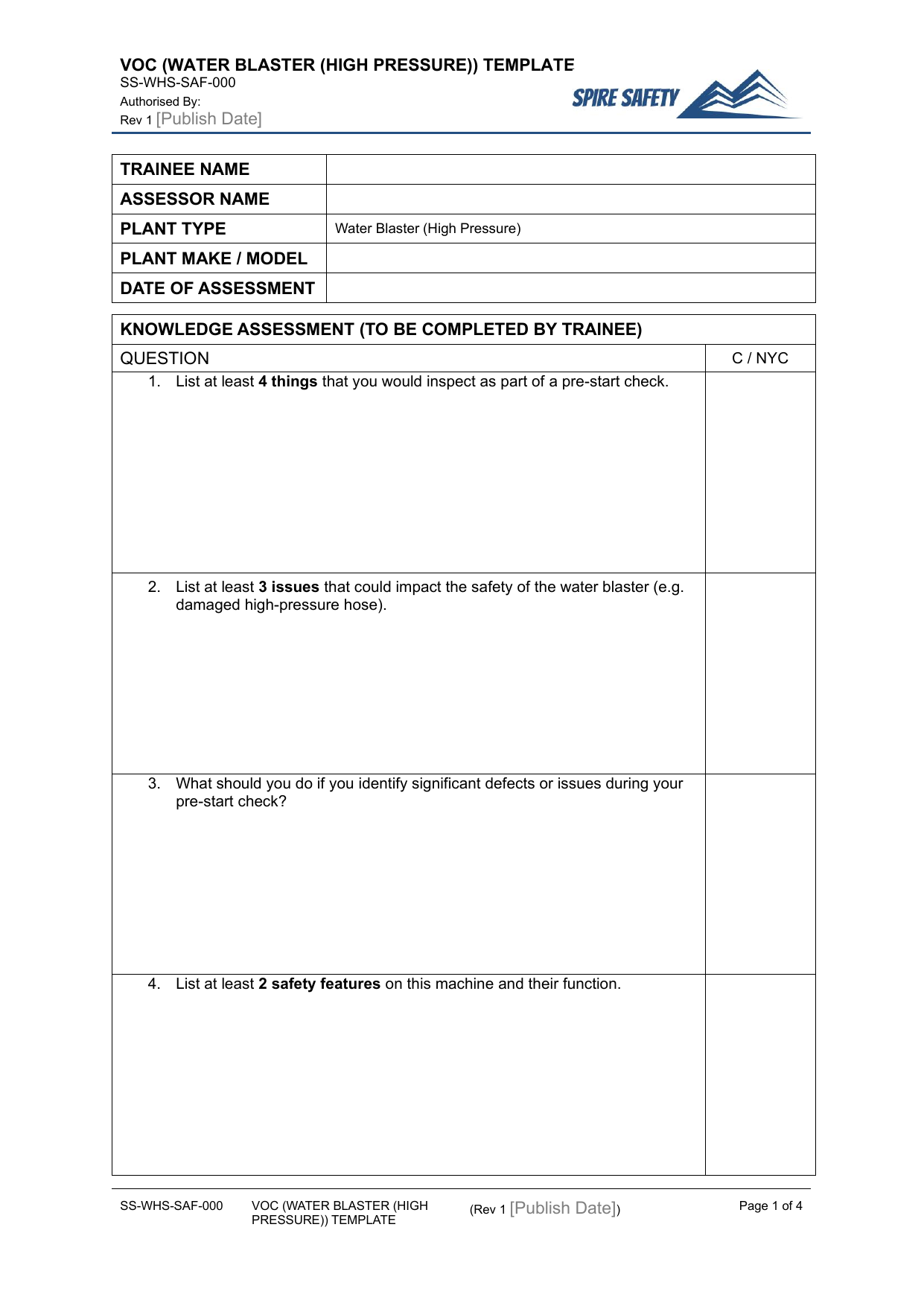
This template is designed to be used by a competent assessor to evaluate a water blaster operator. The process should involve both a theoretical and a practical component.
The assessor asks the operator a series of questions to gauge their understanding of safety procedures, equipment features, and emergency responses. Following this, the assessor observes the operator performing a range of tasks, from pre-start checks and setup to operation and shutdown, assessing their practical skills against a set of established criteria.
Please note: this document is a template. We have designed it as a starting point, but you must customise it to reflect the specific water blaster models (e.g., Class A or Class B), pressure ratings, tasks, and hazards found in your workplace.
This may include adding criteria related to specific nozzles, accessories, or work environments. For other plant-specific assessments, you might find our Verification of Competency for a concrete or floor saw a useful reference.
When to use it
A Verification of Competency should be conducted at several key points to ensure ongoing safety and compliance. It is not a one-time event. Consider using this VOC process in the following situations:
- Pre-employment: To verify the skills and claims of a new hire before they commence work.
- Introduction of new equipment: When a new make or model of water blaster is introduced to the workplace.
- Post-training: To confirm that skills and knowledge from a training course have been successfully transferred to the workplace context.
- Following an incident: After a near-miss or incident involving a water blaster to identify and close any competency gaps.
- Periodic re-assessment: As part of a scheduled competency review program (e.g., annually or every two years) to ensure skills have been maintained.
Regularly scheduled assessments form a key part of a company's safety assurance activities. These activities are often reviewed during WHS compliance auditing to verify that the organisation is actively managing worker competency for high-risk tasks.
Who should use it
This template is intended for use by individuals responsible for workplace safety and operational supervision. This includes WHS Advisors, Safety Managers, Site Supervisors, and Team Leaders.
The person conducting the assessment (the assessor) must be competent themselves. This means they must possess deep technical knowledge of high-pressure water blasting, extensive practical experience, and a thorough understanding of the associated hazards and control measures.
The assessor should also have the skills to conduct an assessment fairly and objectively, provide constructive feedback, and clearly document the outcomes. They act as a subject matter expert, capable of making a reliable judgement on the operator's competence. Similar principles apply when assessing operators of other industrial equipment, as outlined in resources like our plasma cutter VOC template.
This VOC is just one of many tools available to help manage plant and equipment safety. For more templates and guides on a wide range of topics, explore our complete free WHS resources library.
Common mistakes
Common mistakes to avoid
- Using a generic template without customising it for specific equipment, pressures, and workplace tasks.
- Assigning an assessor who lacks sufficient technical expertise or experience with the specific water blaster model.
- Treating the VOC as a paper-based exercise without direct observation of the operator performing practical tasks.
- Failing to formally document and address any competency gaps identified during the assessment process.
Legal references
Legal considerations
The following legal requirements may be relevant to this type of work.
- Work Health and Safety Act (Harmonised) — Provides the primary duties for protecting workers and other people from work health and safety risks.
- Work Health and Safety Regulations (Harmonised) — Sets out requirements supporting the management of workplace hazards and risks.
The following codes may be relevant to this type of work.
- Managing WHS Risks Code of Practice — Provides practical guidance on identifying hazards, assessing risks and applying effective controls.
- Work Health and Safety Consultation, Cooperation and Coordination Code of Practice — Provides practical guidance on consulting workers and coordinating with other duty holders.
- Managing the Work Environment and Facilities Code of Practice — Provides practical guidance on safe work environments, workplace facilities and related controls.
Did you know
Extreme Pressure
The pressure from some industrial water blasters can exceed 40,000 PSI (2750 bar). This is powerful enough to cut through steel and concrete, highlighting the extreme danger of an uncontrolled jet.
Hidden Danger
Fluid injection injuries from high-pressure water may appear as a minor puncture wound but are a medical emergency. The injected fluid can cause severe internal tissue damage and infection, potentially leading to amputation if not treated immediately by specialists.
FAQ
Frequently asked questions
01What is the difference between training and a Verification of Competency?
02How often should a water blaster VOC be repeated?
03Who can conduct a VOC for a high-pressure water blaster operator?
04Is this VOC template suitable for all types of water jetting?
Share this resource
Verification of Competency (Water Blaster (High Pressure))
Browse Categories
How To Use It
- 1Download and open in Word or PDF.
- 2Replace the placeholders with your business details.
- 3Get it reviewed by a WHS specialist before rollout.
Need it customised?
Our WHS consultants can adapt this template to your site, run a gap analysis, or audit what you already have in place.
Book a Free Consultation WHS consulting servicesor call 1300 156 382
Related templates
- Verification of Competency (Water Cart)
- Verification of Competency (Wood Chipper)
- Verification of Competency (Wrecker or Impact Wrench (Hydraulic))
- Free Angle Grinder VOC (Verification of Competency) Template
- Free Backhoe VOC (Verification of Competency) Template
- Free Band Saw VOC (Verification of Competency) Template