
Verification of Competency (Wrecker or Impact Wrench (Hydraulic))
Download our free Verification of Competency (Wrecker or Impact Wrench) template. A structured starting point for assessing operator competency in Australia.
Verification of Competency (Wrecker or Impact Wrench (Hydraulic))
DOCX • 138 KB + PDF
Updated Oct 2026
No signup required
Purpose of the Verification of Competency (Wrecker or Impact Wrench (Hydraulic))
A hydraulic wrecker or impact wrench is powerful plant capable of generating extreme levels of torque, vibration, and noise. Its operation involves significant risks, including musculoskeletal injuries from reactive forces, hearing loss, fluid injection injuries from hydraulic systems, and impact injuries from failed components.
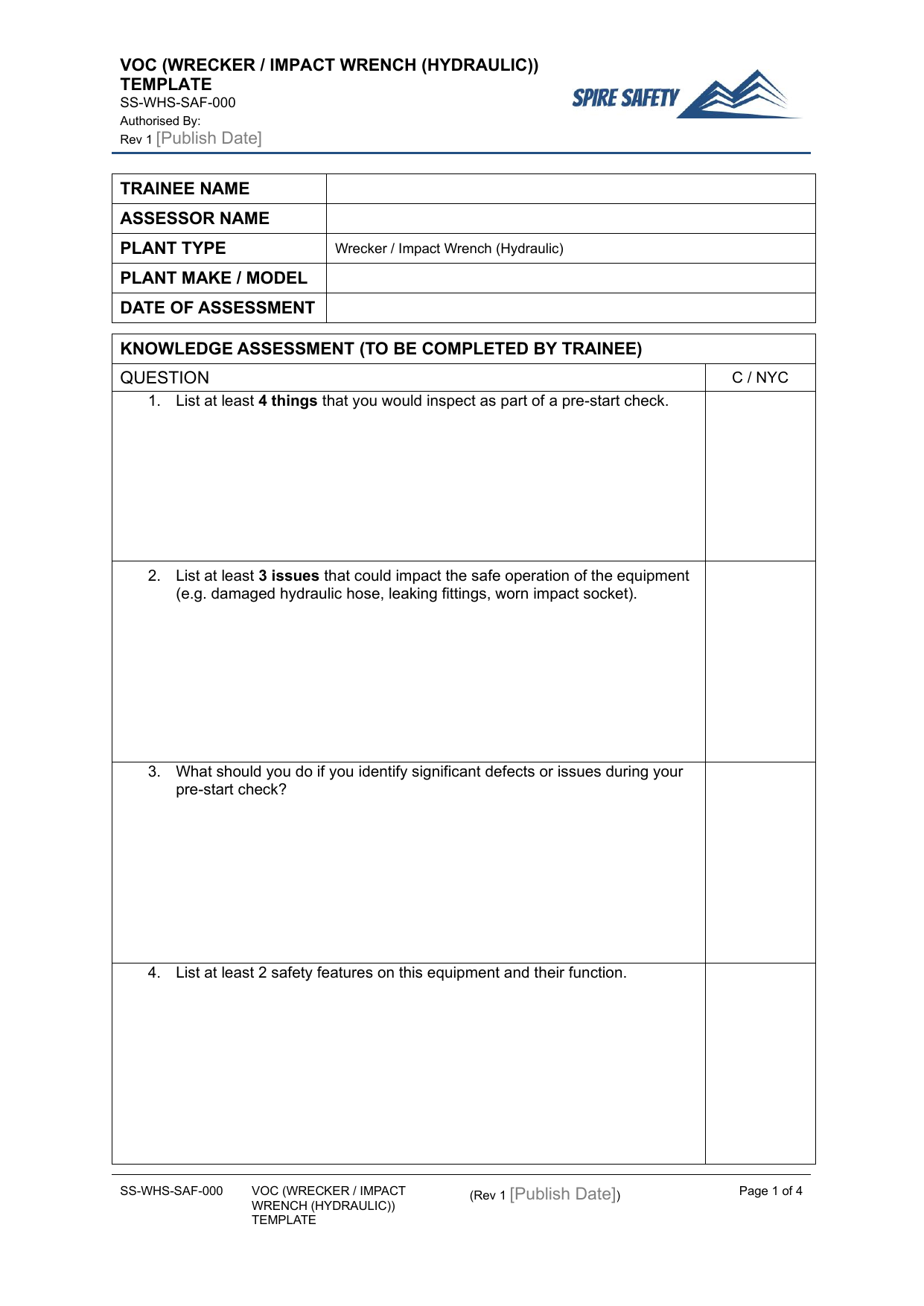
This Verification of Competency (Wrecker or Impact Wrench (Hydraulic)) template provides a structured method for a Person Conducting a Business or Undertaking (PCBU) to confirm that an operator has the necessary skills and safety knowledge to use this equipment competently.
The primary purpose is not to replace formal training but to verify that the training has been understood and can be applied safely in a practical, workplace environment. It serves as a critical record, demonstrating that you have taken steps to ensure worker competency as part of your primary duty of care.
Using a standardised assessment like this helps integrate safety checks into your operational procedures, forming a key component of more robust WHS management systems that actively manage high-risk tasks.
Video walkthrough
How to use the Verification of Competency (Wrecker or Impact Wrench (Hydraulic))
This document is designed as a template to be adapted to your specific operational context. It guides an assessor through a process of theoretical questioning and practical observation to form a holistic view of an operator's competence. The process generally involves:
- Preparation: The assessor reviews the tool's manual, relevant Safe Work Method Statements (SWMS), and site-specific procedures.
- Theory Assessment: The assessor asks the operator a series of questions to confirm their understanding of the risks, pre-start checks, controls, and emergency procedures.
- Practical Observation: The assessor observes the operator performing a task with the hydraulic wrench, from pre-start inspection and setup through to operation and shutdown. Key observation points include correct manual handling, proper use of PPE, control of the tool's reactive torque, and management of hydraulic hoses.
- Documentation: The assessor records their findings, notes any identified gaps in competency, and signs the form. The operator also signs to acknowledge the assessment outcome.
Note: We have developed this resource as a structured starting point. You must customise it to reflect the specific make and model of your equipment, your established safe work procedures, and the unique hazards present in your workplace.
This is a crucial step for ensuring the assessment is relevant and effective. The principles are similar to those in our Verification of Competency for torque wrenches, where equipment-specific details are vital.
When to use it
A Verification of Competency is a valuable tool for risk management at several key points. It should be conducted:
- Before first use: For any new employee or a current worker assigned to use a hydraulic impact wrench for the first time, even if they hold an existing qualification.
- After an incident: Following any near miss or incident involving the equipment to identify and correct any unsafe behaviours or knowledge gaps.
- At regular intervals: As part of a scheduled competency review program (e.g., annually or biennially) to ensure skills have not degraded over time.
- If performance changes: When a supervisor observes a change in a worker's behaviour or a decline in their safe operation of the tool.
Regular assessments help maintain high safety standards for high-risk equipment. This proactive approach is similar for other high-speed tools, as seen in our VOC template for impact drivers, where familiarity can sometimes lead to complacency.
Who should use it
This Verifications of Competency should be completed by a person with the authority and expertise to assess others. This is typically a supervisor, team leader, site foreman, or internal trainer.
The single most important criterion is that the assessor must be competent themselves—they must possess deep technical knowledge of the hydraulic wrecker, extensive practical experience in its use, and a thorough understanding of the associated hazards and control measures. Assigning an assessor without this expertise undermines the entire process.
The results are used by management and WHS personnel to maintain training records and inform risk assessments. These records are often reviewed during a formal WHS compliance audit to verify that the organisation is systematically managing plant-related risks. While this VOC is specific to hydraulic wrenches, the assessment framework can be adapted for other workshop equipment, such as the process outlined in our Verification of Competency for plasma cutters.
This template is one of many documents available in our free WHS resources library, designed to help Australian businesses manage their safety obligations effectively.
Common mistakes
Common mistakes to avoid
- Failing to customise the template for the specific model of hydraulic wrench used.
- Using an assessor who is not competent or familiar with the equipment.
- Treating the VOC as a simple tick-box exercise without genuine observation and questioning.
- Neglecting to assess knowledge of hydraulic hose safety, pressure hazards, and emergency procedures.
Legal references
Legal considerations
The following legal requirements may be relevant to this type of work.
- Work Health and Safety Act (Harmonised) — Provides the primary duties for protecting workers and other people from work health and safety risks.
- Work Health and Safety Regulations (Harmonised) — Sets out requirements supporting the management of workplace hazards and risks.
The following codes may be relevant to this type of work.
- Managing WHS Risks Code of Practice — Provides practical guidance on identifying hazards, assessing risks and applying effective controls.
- Work Health and Safety Consultation, Cooperation and Coordination Code of Practice — Provides practical guidance on consulting workers and coordinating with other duty holders.
- Managing the Work Environment and Facilities Code of Practice — Provides practical guidance on safe work environments, workplace facilities and related controls.
Did you know
Hydraulic Power
Hydraulic impact wrenches can generate immense torque, often exceeding 50,000 Nm, which is why incorrect use can lead to severe injuries from uncontrolled reactions or component failure.
Vibration Risk
Prolonged use of high-vibration tools like hydraulic wreckers is a leading cause of Hand-Arm Vibration Syndrome (HAVS), a permanent and debilitating condition affecting nerves and blood vessels.
FAQ
Frequently asked questions
01What is a Verification of Competency (VOC)?
02Is this VOC a substitute for a formal qualification or licence?
03How often should a VOC for a hydraulic impact wrench be conducted?
04Who can conduct a Verification of Competency?
Share this resource
Verification of Competency (Wrecker or Impact Wrench (Hydraulic))
Browse Categories
How To Use It
- 1Download and open in Word or PDF.
- 2Replace the placeholders with your business details.
- 3Get it reviewed by a WHS specialist before rollout.
Need it customised?
Our WHS consultants can adapt this template to your site, run a gap analysis, or audit what you already have in place.
Book a Free Consultation WHS consulting servicesor call 1300 156 382
Related templates
- Free Angle Grinder VOC (Verification of Competency) Template
- Free Backhoe VOC (Verification of Competency) Template
- Free Band Saw VOC (Verification of Competency) Template
- Free Belt Sander VOC (Verification of Competency) Template
- Free Bench Grinder VOC (Verification of Competency) Template
- Free Body Truck VOC (Verification of Competency) Template