
Verification of Competency (Torque Wrench)
Assess operator skill and safety for torque wrenches with our free Verification of Competency template. Aligned with Australian WHS practice. Download now.
Verification of Competency (Torque Wrench)
DOCX • 138 KB + PDF
Updated Oct 2026
No signup required
Purpose of the Verification of Competency (Torque Wrench)
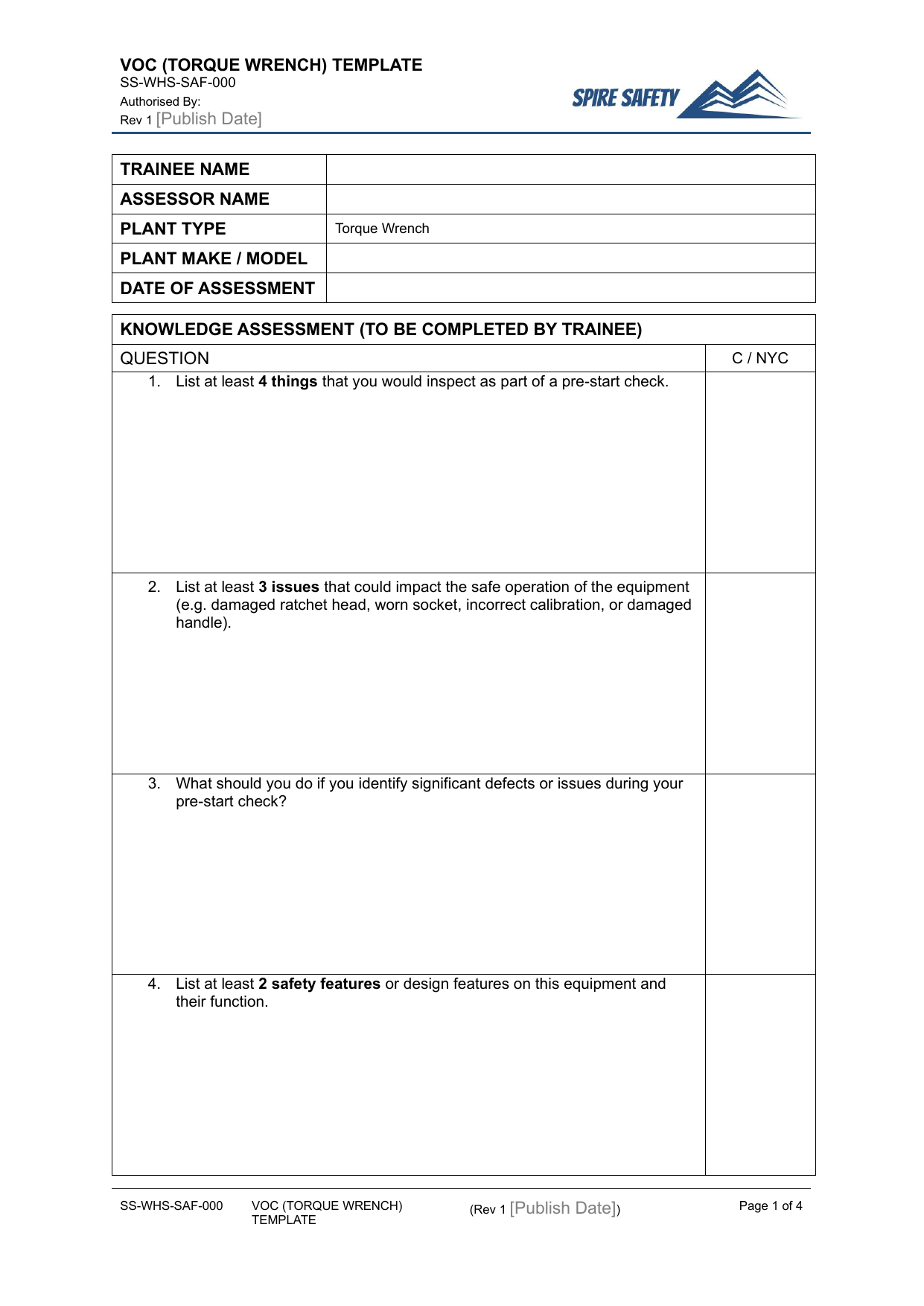
A Verification of Competency (VOC) is a formal process used to confirm that a worker has the necessary skills, knowledge, and experience to operate equipment or perform a task safely and correctly. This Verification of Competency (Torque Wrench) template provides a structured method for assessing a worker’s ability to use various types of torque wrenches—such as click-type, dial, or digital models—according to specific job requirements and safety standards.
It goes beyond initial training or licences, providing documented evidence that a person's competence is current and job-specific.
Using a torque wrench correctly is critical in many industries, including automotive, aviation, and construction, where under-tightening or over-tightening fasteners can lead to equipment failure, structural collapse, or serious incidents. This assessment helps a Person Conducting a Business or Undertaking (PCBU) meet their primary duty of care by ensuring that workers assigned to tasks involving torque application are verifiably competent, minimising risks associated with incorrect fastener tensioning.
Video walkthrough
How to use the Verification of Competency (Torque Wrench)
This document is a template and must be customised to your specific workplace. We are not lawyers or WHS consultants, and this resource does not constitute legal advice.
You must adapt it to reflect your specific tools, tasks, torque specifications, and the unique hazards present in your operational environment. The assessment should be conducted by a person who is themselves competent and experienced with the specific torque wrenches used on site.
To use the template effectively:
- Customise the criteria: Update the checklist with the specific types of torque wrenches used (e.g., beam, click, digital), required torque values for common tasks, and relevant pre-use inspection points.
- Brief the worker: Explain the purpose and process of the assessment. Ensure they have access to the manufacturer's instructions and any relevant Safe Work Method Statements (SWMS).
- Conduct the assessment: The process should include a mix of theoretical questions and practical observation. Observe the worker as they select the correct tool, set the required torque, demonstrate the proper tightening technique, and perform any necessary pre-start checks, such as verifying calibration dates. This process is similar for other specialised tools, such as the steps outlined in a Verification of Competency for a pipe threader.
- Record the outcome: Document the results, including any areas where the worker excelled or requires further training. Both the assessor and the worker should sign the completed form. Retain the document as a formal record of competency.
When to use it
A VOC for torque wrench use is a proactive risk management tool. It should be conducted at several key points to maintain a safe system of work:
- Pre-employment or mobilisation: To verify the skills and claims of new employees or contractors before they start work.
- Introduction of new equipment: When a new type or model of torque wrench is introduced to the workplace.
- Post-incident: Following an incident or near miss where incorrect torque application was a potential contributing factor.
- Identified skills gap: If a supervisor observes a worker using a torque wrench incorrectly or unsafely.
- Periodic reassessment: As part of a scheduled competency review program, often integrated with regular WHS compliance audits, to ensure skills remain current.
Who should use it
This Verification of Competency should be implemented and managed by key personnel within an organisation's safety framework. This typically includes:
- Supervisors and Team Leaders: As the designated assessors, they are responsible for conducting the VOC, providing feedback, and identifying training needs. Assessors must be deemed competent themselves, possessing deep practical and theoretical knowledge of torque wrench operation.
- WHS Managers and Advisors: They oversee the competency program, ensuring it is implemented consistently and that records are maintained as part of the broader WHS management system. They also use the aggregated data to identify systemic risks or training gaps across the organisation.
- Workers: The individuals being assessed. The VOC process provides them with clear performance expectations and an opportunity to demonstrate their skills in a formal setting.
Ultimately, the PCBU is responsible for ensuring these assessments are carried out. Integrating VOCs for critical tools helps create a robust safety culture where skill is formally recognised and continuously managed.
This same principle applies to other precision equipment, where a Verification of Competency for a TIG welder would confirm an operator's ability to perform high-stakes tasks correctly. For businesses needing support to establish these processes, engaging specialist WHS consulting can provide valuable guidance and structure.
You can find many more templates like this in our free WHS resources library to build out your competency program.
Common mistakes
Common mistakes to avoid
- Using the VOC as a 'tick-and-flick' exercise without meaningful practical observation.
- Failing to use a properly calibrated torque wrench during the assessment.
- Neglecting to customise the template with site-specific torque settings and job requirements.
- Allowing an assessor to conduct the VOC without being genuinely competent in the torque wrench's use themselves.
Legal references
Legal considerations
The following legal requirements may be relevant to this type of work.
- Work Health and Safety Act (Harmonised) — Provides the primary duties for protecting workers and other people from work health and safety risks.
- Work Health and Safety Regulations (Harmonised) — Sets out requirements supporting the management of workplace hazards and risks.
The following codes may be relevant to this type of work.
- Managing WHS Risks Code of Practice — Provides practical guidance on identifying hazards, assessing risks and applying effective controls.
- Work Health and Safety Consultation, Cooperation and Coordination Code of Practice — Provides practical guidance on consulting workers and coordinating with other duty holders.
- Managing the Work Environment and Facilities Code of Practice — Provides practical guidance on safe work environments, workplace facilities and related controls.
Did you know
Torque vs. Tension
Torque is the rotational force applied to a fastener, but the goal is to achieve correct 'tension' or 'clamping force' in the bolt. Factors like friction mean that applying the right torque doesn't always guarantee the right tension, a key reason why operator technique is so critical.
Calibration is Key
Torque wrenches are precision instruments that lose accuracy with use and time. Australian Standard AS 4115-1993 recommends they be recalibrated at intervals not exceeding 12 months or approximately 5,000 cycles.
FAQ
Frequently asked questions
01What is the difference between training and a VOC for a torque wrench?
02How often should a torque wrench VOC be conducted?
03Does a torque wrench need to be calibrated before a VOC assessment?
04Can any supervisor conduct a Verification of Competency for a torque wrench?
Share this resource
Verification of Competency (Torque Wrench)
Browse Categories
How To Use It
- 1Download and open in Word or PDF.
- 2Replace the placeholders with your business details.
- 3Get it reviewed by a WHS specialist before rollout.
Need it customised?
Our WHS consultants can adapt this template to your site, run a gap analysis, or audit what you already have in place.
Book a Free Consultation WHS consulting servicesor call 1300 156 382