
Verification of Competency (Tower Crane)
Assess and confirm operator competence for tower cranes with our free Verification of Competency template. Aligned with Australian WHS standards. Download now.
Verification of Competency (Tower Crane)
DOCX • 138 KB + PDF
Updated Oct 2026
No signup required
Purpose of the Verification of Competency (Tower Crane)
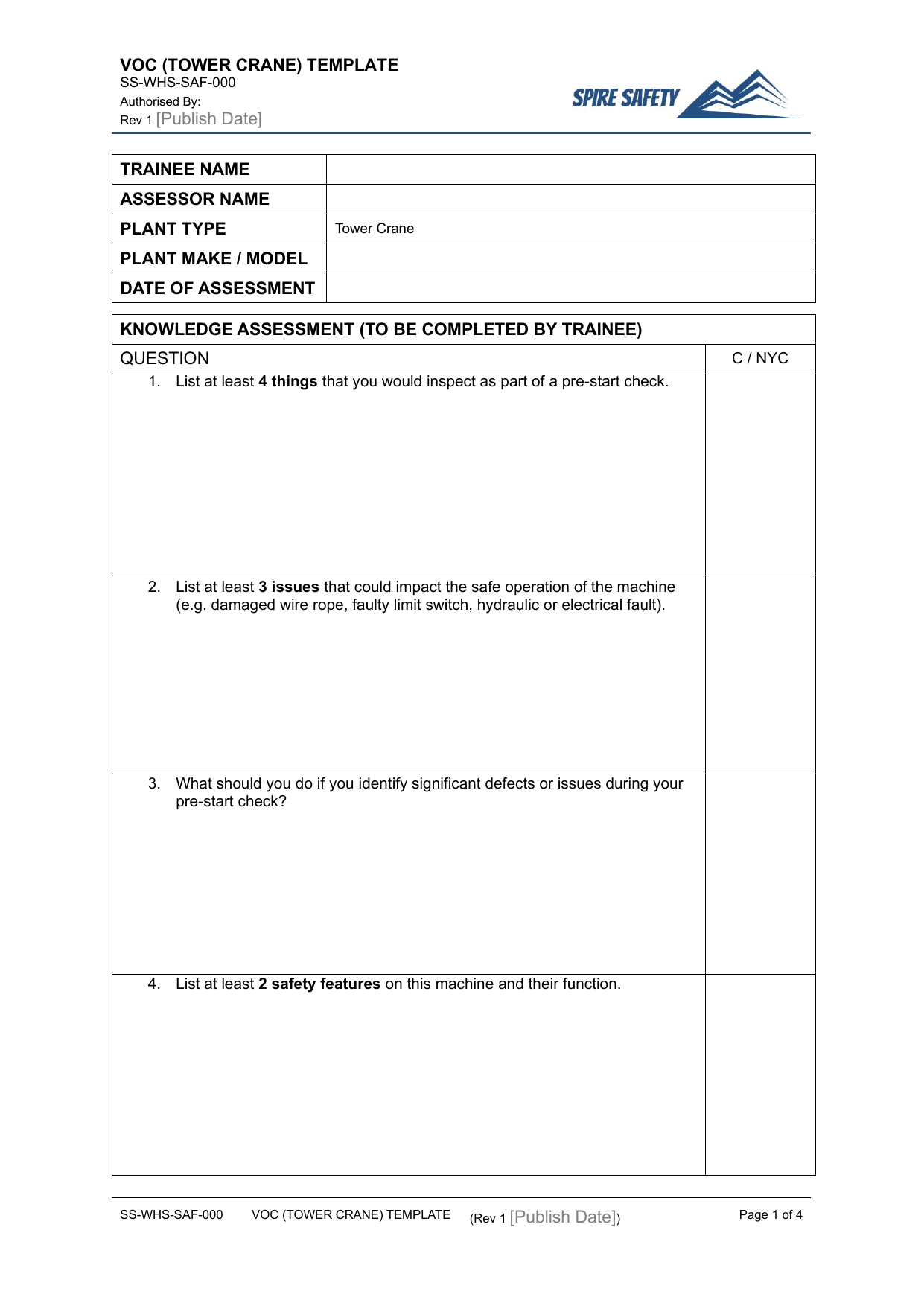
Operating a tower crane is a high-risk activity that demands a high level of skill, knowledge, and safety awareness. This Verification of Competency (Tower Crane) template provides a structured framework for a Person Conducting a Business or Undertaking (PCBU) to assess and confirm that an operator can perform their duties safely and competently.
It helps you go beyond simply sighting a High Risk Work Licence (HRWL) by formally documenting a worker's ability to operate the specific make and model of crane in the context of your worksite's unique conditions and hazards. Using this document helps demonstrate how your organisation meets its primary duty of care to ensure worker safety.
A thorough VOC process is a critical component of managing plant-related risks on a construction site. It verifies that the theoretical knowledge from licencing is being applied correctly in a practical, operational environment.
This includes assessing an operator's understanding of pre-start checks, load chart interpretation, communication protocols, and emergency procedures. Proper verification helps prevent incidents by identifying knowledge gaps or unsafe behaviours before they lead to an accident.
The process also supports the development of robust WHS management systems by creating a clear, auditable record of operator competency.
Video walkthrough
How to use the Verification of Competency (Tower Crane)
This document is a starting point for developing a customised assessment for your workplace. It should be used by a person with the appropriate knowledge, skills, and experience to assess crane operations.
The process typically involves a combination of theoretical questioning and direct observation of the operator performing routine tasks. The assessor should observe the operator conducting pre-operational checks, lifting and moving loads, communicating with doggers or riggers, and executing a safe shutdown.
Key steps include:
- Reviewing the operator's existing qualifications, including their High Risk Work Licence (Class CT).
- Customising the checklist to reflect the specific tower crane model, site layout, common lift types, and environmental factors (e.g., wind, proximity to other structures).
- Briefing the operator on the assessment process and the tasks they will be asked to perform.
- Observing the operator's performance against the criteria in the checklist, making detailed notes on both correct procedures and any areas for improvement.
- Asking targeted questions to test their understanding of load calculations, operational limits, and site-specific safety rules.
- Providing clear feedback to the operator and documenting the outcome, including any recommendations for further training or supervision.
Customisation is Key
Generic checklists can miss critical site-specific risks. We have designed this document as a template that you must customise to your specific workplace, equipment, and operational procedures.
You should adapt the criteria to include checks relevant to your crane's unique features and the specific hazards present on your construction site, such as powerlines, public access areas, or complex lift paths. This tailored approach is essential for an effective verification process, similar to how you would customise a Verification of Competency (Overhead Bridge Crane) Template for a different type of crane.
When to use it
A Verification of Competency for a tower crane operator should be conducted at several key points to ensure ongoing safety and compliance. It is not a one-off event. Consider using this process:
- Pre-employment or prior to engagement: To verify the skills and claims of a new operator before they commence work.
- Before using new or unfamiliar equipment: When an operator is assigned to a different make or model of tower crane.
- Following an incident or near miss: To identify any competency gaps that may have contributed to the event.
- As part of a scheduled review: Periodically (e.g., annually or biennially) to ensure skills remain current, especially for operators who work infrequently.
- When performance concerns are raised: If a supervisor or co-worker observes unsafe practices or has doubts about an operator's ability.
Regularly scheduled VOCs can be an integral part of a proactive safety culture and can provide valuable data for WHS compliance auditing activities, demonstrating a commitment to maintaining a safe system of work.
Who should use it
This template is intended for use by individuals responsible for workplace health and safety and the management of high-risk work. This includes:
- Project Managers and Site Managers: To ensure all plant operators on their site are competent for the tasks they are assigned.
- WHS Advisors and Safety Officers: As a tool for implementing and documenting safety procedures related to high-risk plant.
- Supervisors and Forepersons: To conduct practical assessments of the operators under their direct supervision.
- Internal or External Trainers/Assessors: As a basis for conducting formal competency assessments and identifying training needs.
The person conducting the VOC must be competent themselves. This means they must have the relevant knowledge and experience in tower crane operations to make an informed judgement about the operator's skills.
This principle applies to all heavy machinery, whether you are assessing an operator using this document or a Free Forklift VOC (Verification of Competency) Template. For all your safety documentation needs, you can explore our extensive free WHS resources library for more templates and guides.
Common mistakes
Common mistakes to avoid
- Relying solely on a High Risk Work Licence without conducting a site-specific VOC.
- Using a generic checklist that doesn't account for the specific crane model or site hazards.
- Conducting a 'tick and flick' assessment without meaningful observation of practical tasks.
- Failing to document the VOC process, outcome, and any required actions, creating a gap in safety records.
Legal references
Legal considerations
The following legal requirements may be relevant to this type of work.
- Work Health and Safety Act (Harmonised) — Provides the primary duties for protecting workers and other people from work health and safety risks.
- Work Health and Safety Regulations (Harmonised) — Sets out requirements supporting the management of workplace hazards and risks.
The following codes may be relevant to this type of work.
- Managing WHS Risks Code of Practice — Provides practical guidance on identifying hazards, assessing risks and applying effective controls.
- Work Health and Safety Consultation, Cooperation and Coordination Code of Practice — Provides practical guidance on consulting workers and coordinating with other duty holders.
- Managing the Work Environment and Facilities Code of Practice — Provides practical guidance on safe work environments, workplace facilities and related controls.
Did you know
Weathervaning Cranes
When not in use, tower cranes are often left with the slew brake off, allowing the jib to rotate freely and align with the wind. This 'weathervaning' reduces wind load on the crane's structure, preventing potential damage.
FAQ
Frequently asked questions
01What is the difference between a High Risk Work Licence (HRWL) and a Verification of Competency (VOC)?
02How often should a tower crane operator's competency be verified?
03Who is a 'competent person' to conduct a tower crane VOC?
04Does this VOC template cover rigging and dogging activities?
Share this resource
Verification of Competency (Tower Crane)
Browse Categories
How To Use It
- 1Download and open in Word or PDF.
- 2Replace the placeholders with your business details.
- 3Get it reviewed by a WHS specialist before rollout.
Need it customised?
Our WHS consultants can adapt this template to your site, run a gap analysis, or audit what you already have in place.
Book a Free Consultation WHS consulting servicesor call 1300 156 382