
Verification of Competency (Walkie Stacker)
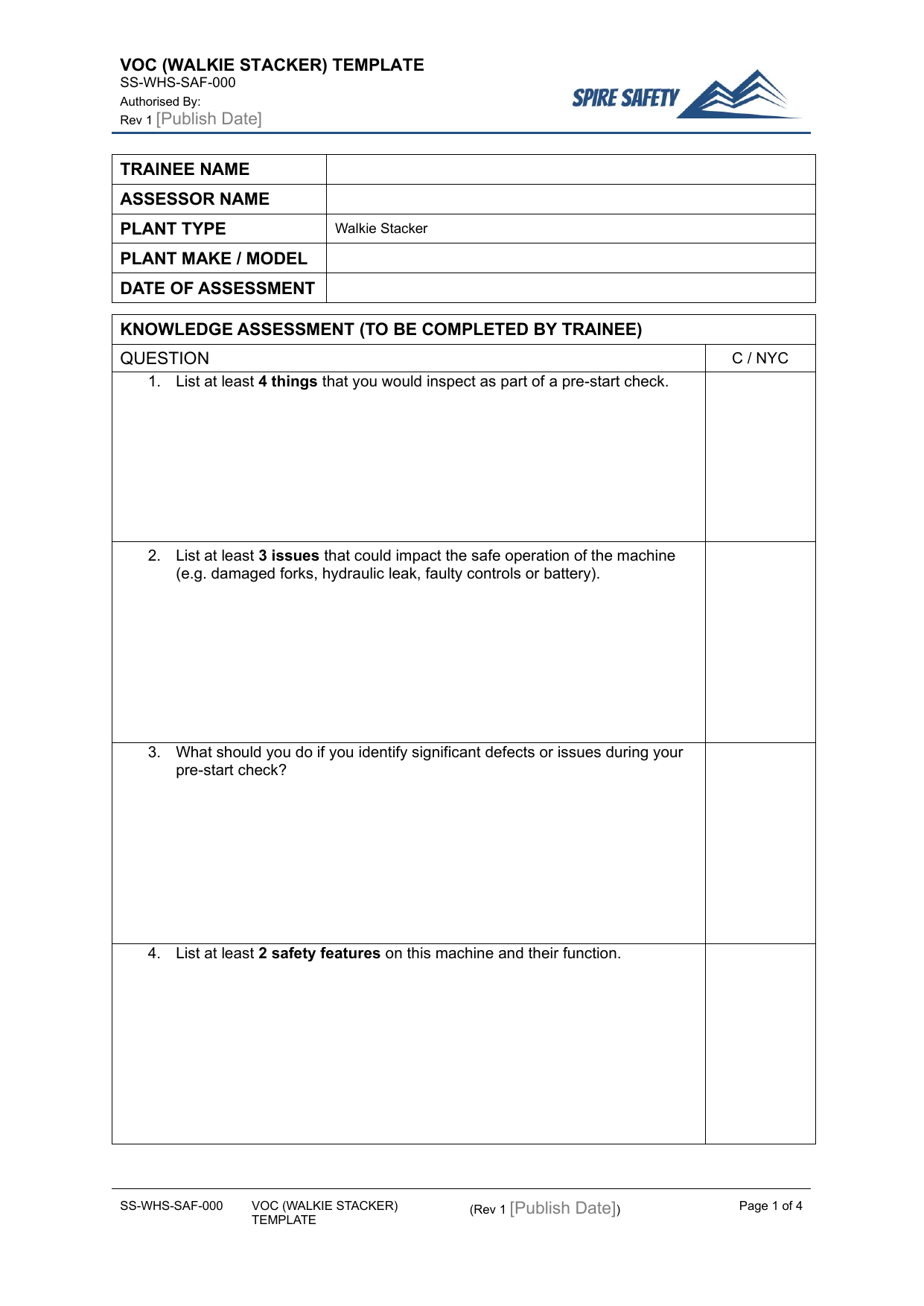
Assess and confirm operator competence for walkie stackers. Our free Verification of Competency (Walkie Stacker) template is a structured starting point.
Verification of Competency (Walkie Stacker)
DOCX • 138 KB + PDF
Updated Oct 2026
No signup required
Purpose of the Verification of Competency (Walkie Stacker)
A Verification of Competency (VOC) is a practical assessment used by an organisation to confirm that an individual possesses the current skills and knowledge to operate equipment safely and effectively. This free Verification of Competency (Walkie Stacker) template provides a structured method to assess an operator’s ability to handle this specific type of plant.
It serves as a critical tool for a Person Conducting a Business or Undertaking (PCBU) to meet their primary duty of care under WHS legislation, ensuring workers are competent for the tasks they perform.
Using a VOC helps identify any gaps in training or unsafe work habits before they lead to an incident. It is a key component in the risk management process for plant, supplementing initial training and licensing. Formalising this process demonstrates due diligence and contributes to the continuous improvement of your overall WHS management systems.
Video walkthrough
How to use the Verification of Competency (Walkie Stacker)
This document is a template designed as a starting point. It requires customisation to reflect the specific walkie stacker models used at your site, your unique operational environment, and your organisation's safety procedures.
An effective VOC process involves more than just a checklist; it requires direct observation and interaction.
To use this Verifications of Competency template effectively:
- Customise the Checklist: Review and adapt the criteria to match the specific make and model of the walkie stacker, the types of loads handled, and the physical environment (e.g., ramps, tight aisles, pedestrian traffic).
- Brief the Operator: Explain the purpose and process of the assessment to the operator to ensure they understand what is expected. This is not a test, but a confirmation of their existing skills.
- Observe Practical Use: Have the operator perform a range of tasks they would typically undertake during their work. This should include pre-start checks, manoeuvring, lifting and lowering loads, and correct shutdown procedures. For other common warehouse plant, you might use our free Forklift VOC template.
- Assess and Document: The assessor, who must be a competent person, observes the operator and records their findings against the checklist criteria. Provide clear feedback to the operator on their performance.
- Finalise the Record: Complete the document, noting whether the operator was found competent or if further training is required. Both the assessor and the operator should sign the record.
Note: We have developed this as a guide based on common WHS practice. You must adapt it to your specific workplace, equipment, and legal obligations.
When to use it
A VOC is not a one-time event. It should be integrated into your safety procedures and conducted at regular intervals and in specific situations. Consider performing a walkie stacker VOC:
- Pre-Employment or Mobilisation: To verify the skills of new employees or contractors before they begin work unsupervised.
- Post-Incident: As part of an investigation following an incident or near miss involving a walkie stacker to identify any competency gaps.
- Introduction of New Equipment: When a new model of walkie stacker is introduced, as controls and operating characteristics may differ.
- Periodic Re-assessment: At regular intervals (e.g., every one to three years) as part of a scheduled competency maintenance program. These regular checks are often reviewed during a WHS compliance auditing process.
Who should use it
This template is designed for use by individuals responsible for workplace safety and operational supervision. This typically includes:
- Supervisors and Team Leaders: Those with direct oversight of operators in warehouses, manufacturing facilities, and retail environments.
- WHS/HSE Officers and Advisors: Safety professionals responsible for implementing and monitoring safety procedures and competency frameworks.
- Trainers and Assessors: Internal or external personnel tasked with training and evaluating equipment operators.
Crucially, the person conducting the VOC must be competent themselves. This means they must have the necessary technical knowledge of the walkie stacker, a deep understanding of safe operating procedures, and the skills to conduct an assessment fairly and accurately.
For different types of specialised plant, such as those covered in our Verification of Competency (Reach Stacker) template, the assessor must have specific expertise. You can find many other machine-specific templates in our free WHS resources library.
Common mistakes
Common mistakes to avoid
- Using a generic checklist without customising it for the specific make and model of the walkie stacker.
- Treating the VOC as a 'tick-and-flick' exercise instead of a genuine assessment of practical skill and safety behaviour.
- Failing to document corrective actions and provide further training when an operator is found not yet competent.
- Allowing an assessor to conduct the VOC who is not themselves competent and familiar with the equipment and assessment process.
Legal references
Legal considerations
The following legal requirements may be relevant to this type of work.
- Work Health and Safety Act (Harmonised) — Provides the primary duties for protecting workers and other people from work health and safety risks.
- Work Health and Safety Regulations (Harmonised) — Sets out requirements supporting the management of workplace hazards and risks.
The following codes may be relevant to this type of work.
- Managing WHS Risks Code of Practice — Provides practical guidance on identifying hazards, assessing risks and applying effective controls.
- Work Health and Safety Consultation, Cooperation and Coordination Code of Practice — Provides practical guidance on consulting workers and coordinating with other duty holders.
- Managing the Work Environment and Facilities Code of Practice — Provides practical guidance on safe work environments, workplace facilities and related controls.
Did you know
Pedestrian-Operated Plant
Walkie stackers are a leading cause of foot and lower leg injuries in warehouses, often due to operator error, inadequate training, or a lack of awareness of the machine's crush zones.
Duty of Care
Because most walkie stackers don't require a formal high-risk work licence, the responsibility falls heavily on the employer (PCBU) to provide adequate information, training, instruction, and supervision.
FAQ
Frequently asked questions
01What is the difference between a licence and a VOC for a walkie stacker?
02Is a VOC legally required for a walkie stacker in Australia?
03How often should a walkie stacker VOC be conducted?
04Who is considered a 'competent person' to conduct a VOC?
Share this resource
Verification of Competency (Walkie Stacker)
Browse Categories
How To Use It
- 1Download and open in Word or PDF.
- 2Replace the placeholders with your business details.
- 3Get it reviewed by a WHS specialist before rollout.
Need it customised?
Our WHS consultants can adapt this template to your site, run a gap analysis, or audit what you already have in place.
Book a Free Consultation WHS consulting servicesor call 1300 156 382
Related templates
- Verification of Competency (Water Blaster (High Pressure))
- Verification of Competency (Water Cart)
- Verification of Competency (Wood Chipper)
- Verification of Competency (Wrecker or Impact Wrench (Hydraulic))
- Free Angle Grinder VOC (Verification of Competency) Template
- Free Backhoe VOC (Verification of Competency) Template