
Verification of Competency (Wood Chipper)
Assess operator competence for wood chippers with our free Verification of Competency template. Aligned with Australian WHS standards. Download now.
Verification of Competency (Wood Chipper)
DOCX • 138 KB + PDF
Updated Oct 2026
No signup required
Purpose of the Verification of Competency (Wood Chipper)
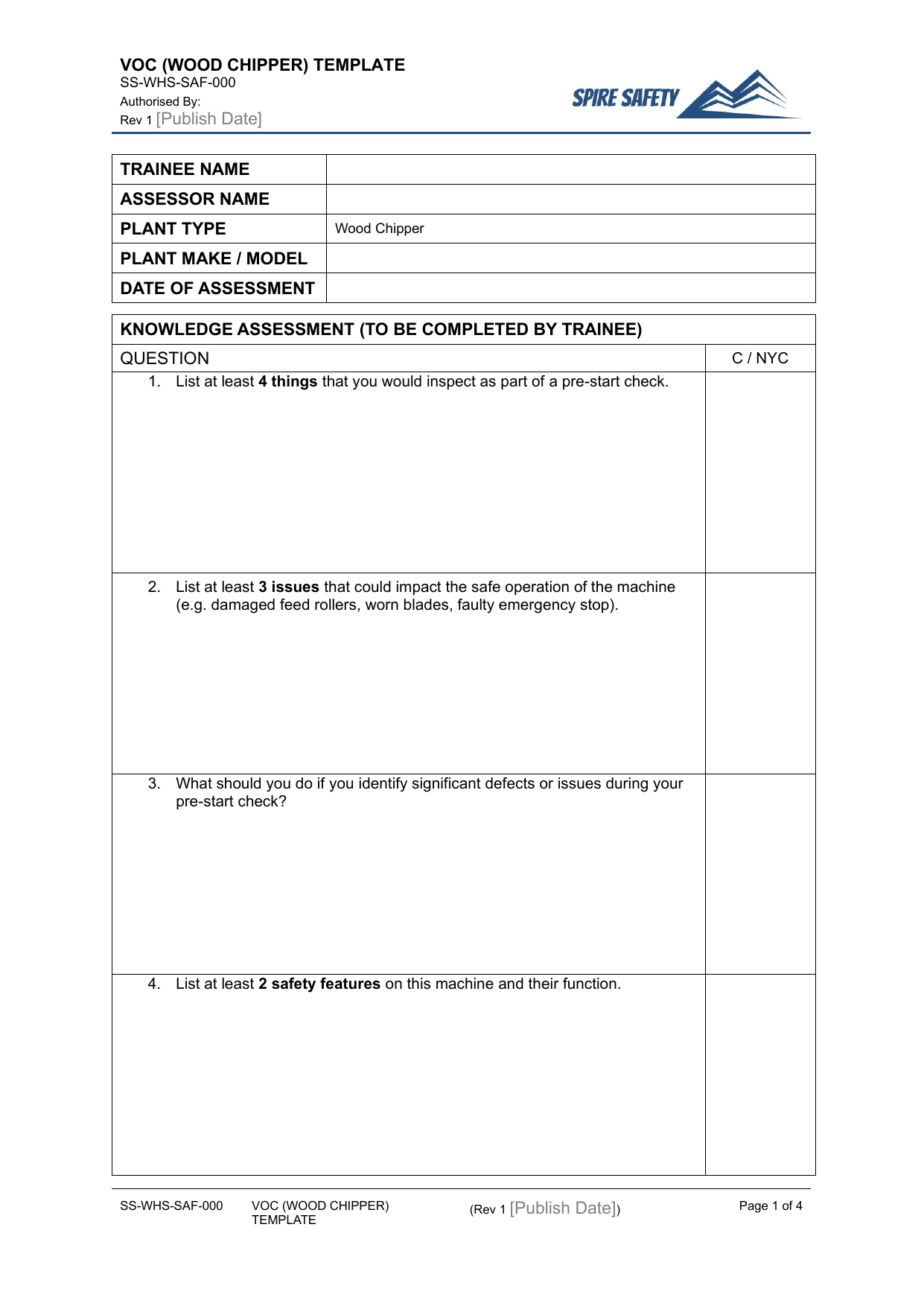
Operating a wood chipper presents significant risks, including entanglement, impact from projectiles, and extreme noise exposure. This Verification of Competency (Wood Chipper) provides a structured framework for employers to confirm that an operator has the necessary skills and knowledge to use this high-risk plant safely.
It is a practical tool to help Persons Conducting a Business or Undertaking (PCBUs) meet their primary duty of care under WHS law.
A VOC is not a formal qualification or licence; rather, it is a method of assessing a worker's current ability to perform a task safely in their specific work environment. It documents that the worker can apply their existing knowledge to the machine and conditions found on your site.
This process is crucial for many types of high-risk groundskeeping and construction equipment, including those covered by our Verification of Competency (Stump Grinder) template.
By systematically verifying competence, you create a clear record of the steps taken to manage risks and ensure workers are adequately trained, which is a fundamental part of any safety system.
Video walkthrough
How to use the Verification of Competency (Wood Chipper)
This template is designed to be used by a competent assessor to observe and evaluate a worker operating a wood chipper. The process should involve both theoretical questions and direct observation of practical tasks.
The goal is to confirm that the operator's skills are current and aligned with your organisation's Safe Work Method Statement (SWMS) and operational procedures.
The document is split into key sections covering pre-start checks, operational safety, shutdown procedures, and hazard awareness. The assessor uses the checklist to mark the operator's performance as satisfactory or note any areas requiring further training.
Integrating these checks into your broader safety framework helps create a robust and proactive safety culture. A comprehensive approach ensures these verifications are part of your routine WHS management systems, not just a standalone activity.
Important Customisation Note
This document is a general template aligned with Australian WHS principles. It is essential that you customise this Verification of Competency to your specific workplace. We have included common criteria, but you must review and adapt it to reflect the specific make and model of your wood chipper, unique site conditions, your SWMS, and the outcomes of your risk assessments.
Without customisation, the document may not be sufficient for your needs.
When to use it
A Verification of Competency should be conducted at several key points to ensure ongoing safety. It is not a one-time event. Consider using this assessment:
- Before a worker operates a wood chipper for the first time.
- When a new make or model of wood chipper is introduced to the workplace.
- If a supervisor or co-worker observes unsafe practices or a near miss.
- Following an incident or accident involving the equipment.
- As part of a scheduled periodic review (e.g., every 2-3 years) to ensure skills have not degraded.
This proactive approach to competency is best practice for all high-risk plant, not just chippers. The principles are the same whether you are assessing operators of warehouse equipment using a Free Forklift VOC or construction tools like those in our Verification of Competency (Concrete Saw or Floor Saw) Template.
Who should use it
The effectiveness of a VOC depends heavily on the person conducting it. The assessor must be a 'competent person' who has:
- Extensive technical knowledge and hands-on experience with the specific wood chipper being assessed.
- A thorough understanding of the manufacturer’s instructions, relevant safety standards, and your site’s SWMS.
- The ability to assess performance objectively, provide clear feedback, and identify knowledge gaps.
This person is often a supervisor, an experienced team leader, or an internal trainer. If you lack a suitably qualified person in-house, it is advisable to engage external expertise to ensure the assessment is valid and robust.
Our team can provide specialised WHS consulting to help establish effective competency and training programs. The worker being assessed is any person whose role requires them to operate, maintain, or work in close proximity to a wood chipper. Records of all completed VOCs should be maintained for each worker, as these documents form part of the evidence reviewed during WHS compliance auditing.
Common mistakes
Common mistakes to avoid
- Using a generic template without customising it for the specific make, model, and condition of the chipper.
- Assigning an assessor who lacks deep, practical experience with the equipment.
- Treating the VOC as a paperwork exercise instead of a genuine observation of skill and behaviour.
- Failing to document the assessment outcome and any corrective actions, such as retraining.
Legal references
Legal considerations
The following legal requirements may be relevant to this type of work.
- Work Health and Safety Act (Harmonised) — Provides the primary duties for protecting workers and other people from work health and safety risks.
- Work Health and Safety Regulations (Harmonised) — Sets out requirements supporting the management of workplace hazards and risks.
The following codes may be relevant to this type of work.
- Managing WHS Risks Code of Practice — Provides practical guidance on identifying hazards, assessing risks and applying effective controls.
- Work Health and Safety Consultation, Cooperation and Coordination Code of Practice — Provides practical guidance on consulting workers and coordinating with other duty holders.
- Managing the Work Environment and Facilities Code of Practice — Provides practical guidance on safe work environments, workplace facilities and related controls.
Did you know
Extreme Feed-Roller Force
The feed rollers on an industrial wood chipper can have a pull-in force strong enough to overcome an adult's resistance, making entanglement the machine's most severe hazard. This is why strict exclusion zones and emergency stop controls are non-negotiable.
Hearing Damage Risk
A wood chipper can produce noise levels exceeding 110 decibels (dB). The Australian exposure standard for noise is 85 dB, meaning unprotected exposure to a chipper can cause permanent hearing loss in a very short time.
FAQ
Frequently asked questions
01What is the difference between a VOC and a formal qualification?
02Who is considered 'competent' to assess a wood chipper operator?
03How often should a wood chipper Verification of Competency be done?
04Is a VOC a legal requirement for operating a wood chipper in Australia?
Share this resource
Verification of Competency (Wood Chipper)
Browse Categories
How To Use It
- 1Download and open in Word or PDF.
- 2Replace the placeholders with your business details.
- 3Get it reviewed by a WHS specialist before rollout.
Need it customised?
Our WHS consultants can adapt this template to your site, run a gap analysis, or audit what you already have in place.
Book a Free Consultation WHS consulting servicesor call 1300 156 382
Related templates
- Verification of Competency (Wrecker or Impact Wrench (Hydraulic))
- Free Angle Grinder VOC (Verification of Competency) Template
- Free Backhoe VOC (Verification of Competency) Template
- Free Band Saw VOC (Verification of Competency) Template
- Free Belt Sander VOC (Verification of Competency) Template
- Free Bench Grinder VOC (Verification of Competency) Template