
Verification of Competency (Stump Grinder)
Assess operator skill and safety knowledge for stump grinders with our free Verification of Competency template. Download your DOCX and PDF today.
Verification of Competency (Stump Grinder)
DOCX • 138 KB + PDF
Updated Oct 2026
No signup required
Purpose of the Verification of Competency (Stump Grinder)
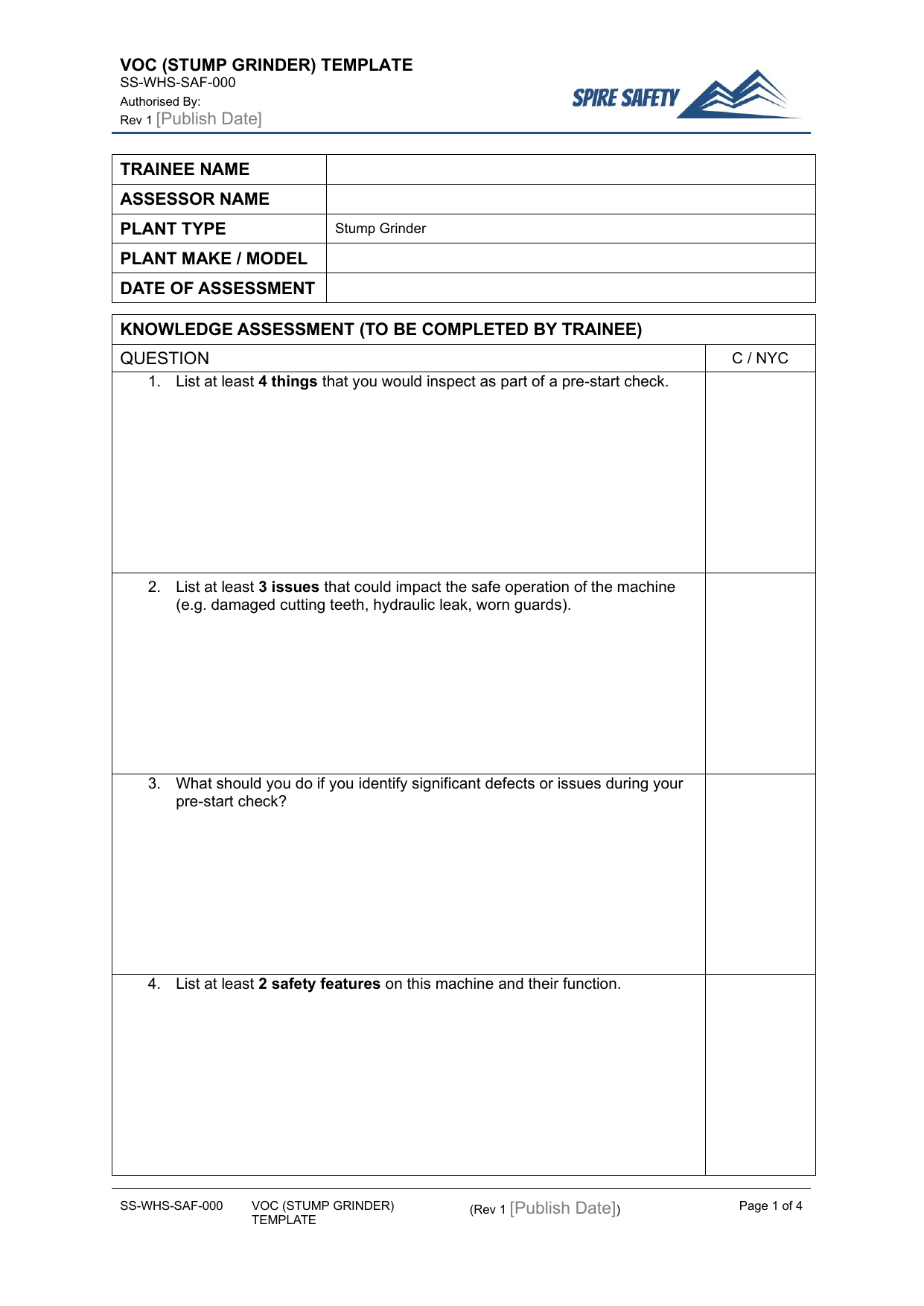
A Verification of Competency (VOC) is a practical assessment used to confirm that a worker has the current skills and knowledge to operate a stump grinder safely and proficiently. While formal training and licensing provide a baseline, this Verification of Competency (Stump Grinder) template allows a Person Conducting a Business or Undertaking (PCBU) to document that an operator’s skills are current, specific to the workplace environment, and meet expected safety standards.
It goes beyond a licence by evaluating on-the-job application of safe work procedures, hazard identification, and emergency response. This process is a critical component of demonstrating due diligence under WHS legislation.
Conducting VOCs helps ensure that operators are not only trained but remain competent over time, addressing any bad habits that may have developed. It is a key tool for managing plant-related risks and forms an integral part of robust WHS management systems, providing tangible evidence of proactive safety management.
The assessment covers key criteria from pre-start checks and hazard assessment to operational techniques and shutdown procedures, offering a comprehensive evaluation of an operator's abilities.
Video walkthrough
How to use the Verification of Competency (Stump Grinder)
This template provides a structured checklist for assessing an operator. A competent and authorised person, such as a supervisor or an experienced operator, should observe the worker performing all the tasks listed in the document.
The observer assesses the operator’s performance against each criterion, noting whether the task was completed competently and safely. The process should include both theoretical questions to test knowledge (e.g., identifying hazards, understanding controls) and practical observation of the stump grinder in use.
After the assessment, the observer and the operator should discuss the results. If any gaps in competency are identified, a plan for further training or supervision should be established and documented before the worker is permitted to operate the equipment independently.
This form can be used as a standalone record or integrated with other safety documentation, similar to how you might use our Angle Grinder VOC template for other types of grinding equipment.
Please note: this document is a template and must be customised to your specific workplace, equipment models, and operational risks. We have provided it as a starting point, not a complete solution.
You must adapt it to reflect your own safe work procedures, the specific make and model of the stump grinder, and the unique hazards of your work environment, such as slopes, underground services, and public access areas.
When to use it
A VOC for a stump grinder should be conducted at several key points to maintain a safe working environment. It is commonly used for pre-employment screening to verify the skills claimed by a potential new hire.
It should also be used when an existing worker is assigned to operate a new or unfamiliar model of stump grinder, as controls and features can vary significantly. Following a workplace incident or a near miss involving a stump grinder, a VOC is essential to identify and rectify any competency issues that may have contributed to the event.
Regular, periodic assessments are also a cornerstone of good safety practice. Many organisations schedule VOCs annually or biennially as part of their safety assurance program.
The need for such assessments may also be highlighted during WHS compliance audits, where an auditor might recommend them as a necessary control measure to ensure ongoing competency. Ultimately, a VOC should be conducted anytime there is uncertainty about an operator's ability to use the equipment safely.
Who should use it
This resource is designed for supervisors, team leaders, WHS advisors, and managers in industries such as arboriculture, landscaping, construction, and council works. The assessment itself must be carried out by a person who is not only competent in using a stump grinder but also has the skills and authority to assess another worker's performance effectively.
This assessor must have a deep understanding of the machine's operation, the relevant safety procedures, and the specific risks associated with the task and environment.
Human resources (HR) departments may also use this document as part of their onboarding and skills verification processes. It provides a standardised method for ensuring all operators of specific plant and equipment, from stump grinders to larger machinery, meet the required safety and operational standards.
For example, on a large site, you may need a system to manage assessments for multiple types of plant, such as a Verification of Competency for boom lifts, in addition to this one. This creates a consistent and defensible approach to managing high-risk work across the organisation.
Common mistakes
Common mistakes to avoid
- Failing to conduct a thorough site assessment, including checking for underground utilities using 'Dial Before You Dig' services.
- Neglecting to establish and enforce a sufficiently large exclusion zone to protect other workers and the public from flying debris.
- Operating the machine without appropriate Personal Protective Equipment (PPE), especially eye, face, and hearing protection.
- Skipping pre-start checks, particularly inspecting the condition and security of the cutting teeth and guards.
Legal references
Legal considerations
The following legal requirements may be relevant to this type of work.
- Work Health and Safety Act (Harmonised) — Provides the primary duties for protecting workers and other people from work health and safety risks.
- Work Health and Safety Regulations (Harmonised) — Sets out requirements supporting the management of workplace hazards and risks.
The following codes may be relevant to this type of work.
- Managing WHS Risks Code of Practice — Provides practical guidance on identifying hazards, assessing risks and applying effective controls.
- Work Health and Safety Consultation, Cooperation and Coordination Code of Practice — Provides practical guidance on consulting workers and coordinating with other duty holders.
- Managing the Work Environment and Facilities Code of Practice — Provides practical guidance on safe work environments, workplace facilities and related controls.
Did you know
Underground Dangers
One of the greatest risks in stump grinding is striking unidentified underground services. A ruptured gas line or a severed electrical cable can have catastrophic consequences, making service location a critical pre-start step.
Projectile Speed
Debris ejected by a stump grinder's cutting wheel can travel at speeds exceeding 160 km/h. This is why establishing and maintaining a proper exclusion zone is a non-negotiable safety control.
FAQ
Frequently asked questions
01What is a VOC for a stump grinder?
02Is a licence required to operate a stump grinder in Australia?
03How often should stump grinder competency be verified?
04What are the key hazards of operating a stump grinder?
Share this resource
Verification of Competency (Stump Grinder)
Browse Categories
How To Use It
- 1Download and open in Word or PDF.
- 2Replace the placeholders with your business details.
- 3Get it reviewed by a WHS specialist before rollout.
Need it customised?
Our WHS consultants can adapt this template to your site, run a gap analysis, or audit what you already have in place.
Book a Free Consultation WHS consulting servicesor call 1300 156 382