
Verification of Competency (Trencher)
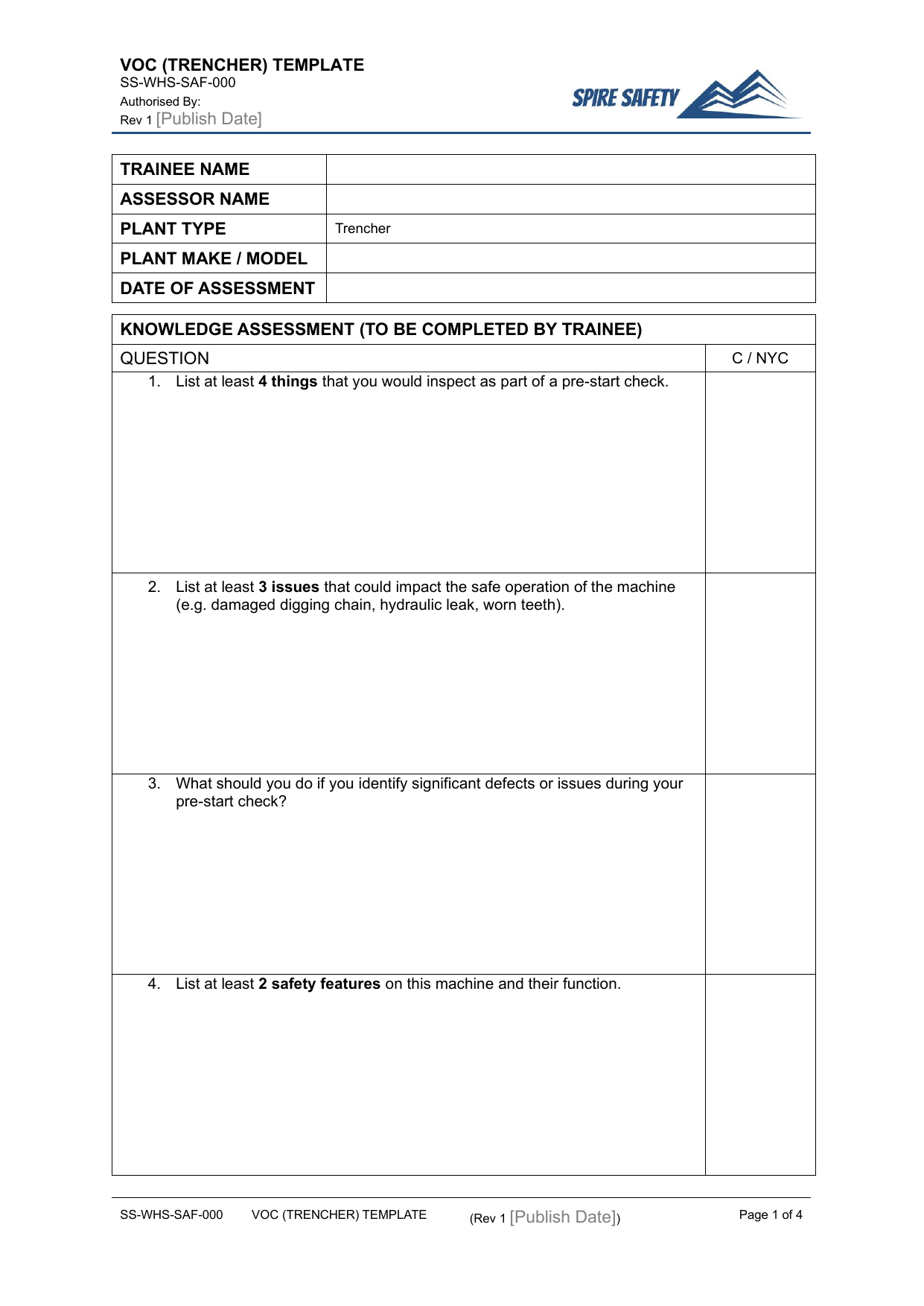
Assess trencher operator skills with our Verification of Competency (Trencher) template. Aligned with Australian WHS practice. Download your free DOCX.
Verification of Competency (Trencher)
DOCX • 138 KB + PDF
Updated Oct 2026
No signup required
Purpose of the Verification of Competency (Trencher)
Operating a trencher involves significant risks, including trench collapse, striking underground services, and general mobile plant hazards. While a worker may hold a relevant licence or ticket, a Verification of Competency (VOC) confirms their ability to operate a specific model of trencher safely and effectively in a real-world work environment.
This document provides a structured framework to assess an operator's knowledge of WHS procedures, pre-start checks, operational skills, and shutdown processes. A formal VOC process helps a Person Conducting a Business or Undertaking (PCBU) meet their primary duty of care by ensuring workers are competent for the tasks they perform.
This assessment goes beyond basic training by focusing on practical application and site-specific rules. It creates a formal record that competence has been verified, which is a key component of effective risk management for high-risk work like excavation.
The process is similar for other ground-engaging equipment, and our guide on verifying competency for stump grinders provides another relevant example for outdoor plant operations.
Video walkthrough
How to use the Verification of Competency (Trencher)
This Verification of Competency (Trencher) template provides a solid starting point for developing your own assessment tool. It is designed to be downloaded and customised to suit your specific needs.
- Step 1: Customise the Template. Review and modify the checklist to reflect the specific make and model of the trencher being used, your site-specific hazards (e.g., soil types, known underground services, overhead powerlines), and your organisation's safe work procedures.
- Step 2: Conduct the Assessment. A competent and authorised assessor observes the worker perform tasks across the full operational cycle, from planning and pre-start inspections to trenching and shutdown procedures. The assessor uses the customised checklist to record observations.
- Step 3: Document the Outcome. The assessor provides feedback to the worker and formally records the outcome. If the worker is deemed competent, the record is filed. If not yet competent, a plan for further training and reassessment must be documented and implemented.
Important: This document is a template and must be customised. We are not WHS consultants and have not prepared this document with your specific plant, site, or operations in mind.
You must adapt it to your workplace to ensure all local risks and control measures are included. For best practice, this process should be integrated into your broader WHS management system.
When to use it
A VOC for trenching equipment should be conducted at several key points to ensure ongoing safety and competence. It is not a one-off event. Consider using this assessment tool in the following situations:
- Pre-employment or prior to starting a new role: To verify the skills and safety awareness of new hires or workers moving into a new position involving trencher operation.
- Introduction of new equipment: When a new make or model of trencher is introduced to the workplace, even experienced operators should be verified on the new machine.
- Post-incident or near miss: If a trencher is involved in a safety incident, a VOC can help identify any competency gaps that may have contributed.
- Periodic reassessment: As part of a regular schedule (e.g., every 1-3 years, as determined by a risk assessment) to ensure skills have not degraded over time.
- Upon request or observation: If a supervisor observes unsafe behaviour or has concerns about an operator's ability.
The principles of verification apply to many high-risk construction tasks, such as those detailed in our Verification of Competency for a concrete or floor saw.
Who should use it
This resource is designed for individuals responsible for workplace safety and operator training. This includes:
- Supervisors and Line Managers: Those who directly oversee workers operating trenchers and are responsible for authorising their work.
- Work Health and Safety (WHS) Managers and Advisors: Professionals tasked with developing, implementing, and reviewing safety procedures and competency frameworks.
- Trainers and Assessors: Internal or external personnel who conduct the practical assessments. Crucially, any person acting as an assessor must be competent themselves, with extensive experience on the specific trencher and a strong understanding of assessment principles.
If your organisation lacks the in-house expertise to confidently customise this template or conduct the assessment, it is advisable to seek advice from a qualified WHS consultant to ensure the process is robust and effective.
Common mistakes
Common mistakes to avoid
- Using a generic 'trencher' checklist that doesn't account for the specific model's controls or safety features.
- Assigning an assessor who is a 'competent operator' but lacks experience in training or formal assessment techniques.
- Treating the VOC as a paperwork exercise without genuine, thorough observation of the operator's practical skills.
- Failing to document corrective actions and follow-up training when a worker is found 'not yet competent'.
Legal references
Legal considerations
The following legal requirements may be relevant to this type of work.
- Work Health and Safety Act (Harmonised) — Provides the primary duties for protecting workers and other people from work health and safety risks.
- Work Health and Safety Regulations (Harmonised) — Sets out requirements supporting the management of workplace hazards and risks.
The following codes may be relevant to this type of work.
- Managing WHS Risks Code of Practice — Provides practical guidance on identifying hazards, assessing risks and applying effective controls.
- Work Health and Safety Consultation, Cooperation and Coordination Code of Practice — Provides practical guidance on consulting workers and coordinating with other duty holders.
- Managing the Work Environment and Facilities Code of Practice — Provides practical guidance on safe work environments, workplace facilities and related controls.
Did you know
The Weight of Soil
A single cubic metre of soil can weigh more than 1.5 tonnes. A trench collapse, even in a shallow excavation, can be fatal, highlighting the critical importance of safe trenching procedures and competent operators.
Dial Before You Dig
Striking underground assets like electrical cables, gas lines, or water mains is a major risk. A crucial part of any trenching plan involves consulting 'Dial Before You Dig' services to obtain plans for all buried utilities in the area.
FAQ
Frequently asked questions
01Is a Verification of Competency for a trencher the same as a licence?
02How often should a trencher VOC be conducted?
03Who is considered a competent person to assess a trencher operator?
04What happens if a worker is found 'not yet competent' in a trencher VOC?
Share this resource
Verification of Competency (Trencher)
Browse Categories
How To Use It
- 1Download and open in Word or PDF.
- 2Replace the placeholders with your business details.
- 3Get it reviewed by a WHS specialist before rollout.
Need it customised?
Our WHS consultants can adapt this template to your site, run a gap analysis, or audit what you already have in place.
Book a Free Consultation WHS consulting servicesor call 1300 156 382
Related templates
- Verification of Competency (Truck-Mounted Crane or Franna)
- Verification of Competency (Walkie Stacker)
- Verification of Competency (Water Blaster (High Pressure))
- Verification of Competency (Water Cart)
- Verification of Competency (Wood Chipper)
- Verification of Competency (Wrecker or Impact Wrench (Hydraulic))