
Verification of Competency (Truck-Mounted Crane or Franna)
Verify operator skills for truck-mounted and Franna cranes with our free Verification of Competency template. Download your DOCX and PDF files now.
Verification of Competency (Truck-Mounted Crane or Franna)
DOCX • 138 KB + PDF
Updated Oct 2026
No signup required
Purpose of the Verification of Competency (Truck-Mounted Crane or Franna)
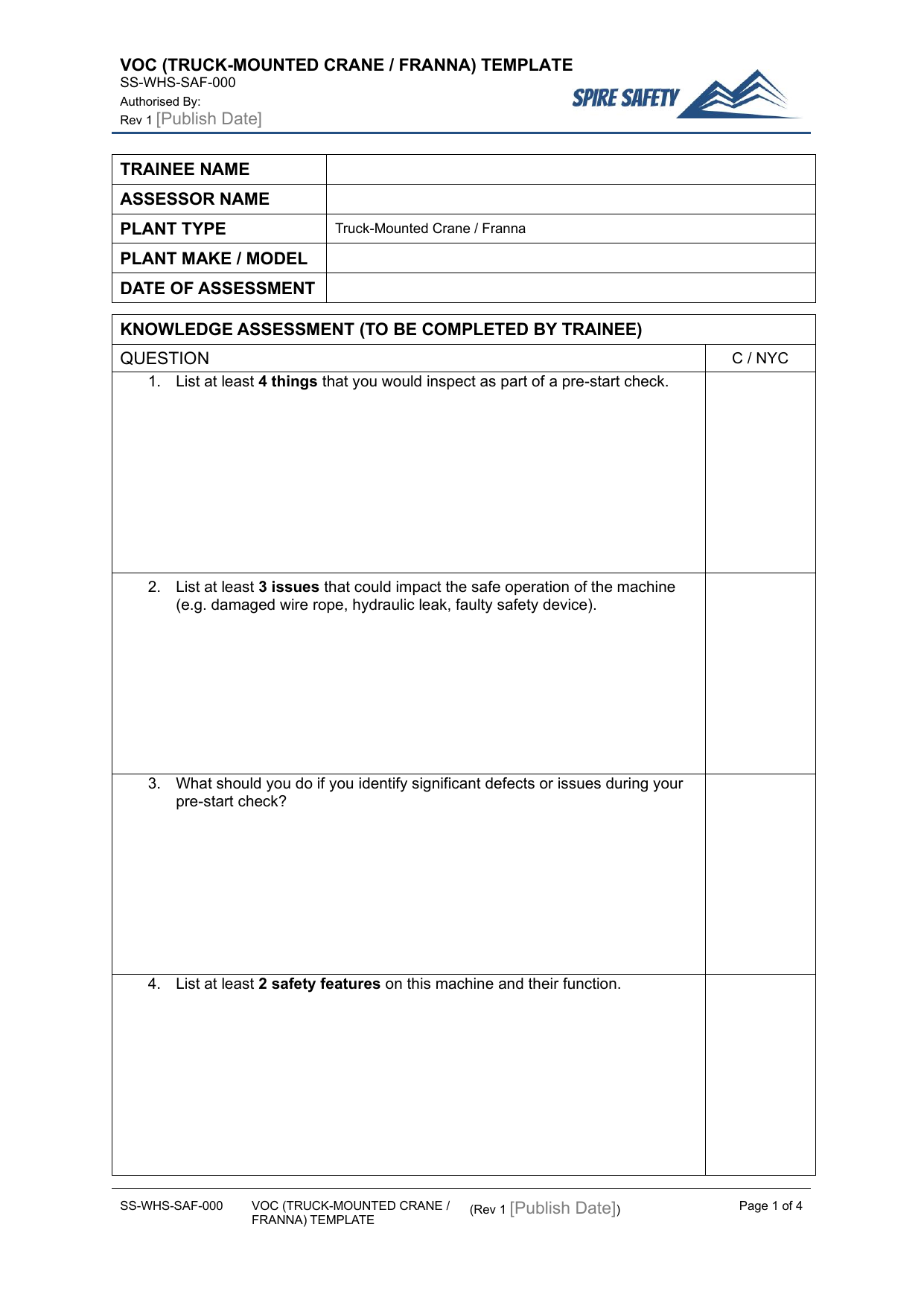
A Verification of Competency (VOC) is a critical process used by Persons Conducting a Business or Undertaking (PCBUs) to confirm that workers have the current skills and knowledge to operate equipment safely and competently. This Verification of Competency (Truck-Mounted Crane or Franna) template provides a structured framework for assessing an operator's ability to handle these specialised cranes, which are common in construction, logistics, and mining.
It goes beyond the basic high-risk work licence (HRWL) by evaluating practical skills in a specific workplace context, considering site-specific hazards and operational procedures.
The objective is to ensure that operators not only hold the required licence but can also demonstrate their proficiency in pre-start checks, hazard identification, safe lifting techniques, load chart interpretation, and emergency procedures relevant to the specific model of truck-mounted or Franna crane they will be using. This process helps fulfil the primary duty of care to provide a safe working environment and is a key component of effective risk management for high-risk plant.
Video walkthrough
How to use the Verification of Competency (Truck-Mounted Crane or Franna)
This document serves as a starting point for developing your own site-specific assessment. It includes a checklist of theoretical knowledge questions and practical tasks an operator should be able to perform.
The process typically involves a competent person—such as a supervisor, trainer, or external expert with extensive experience on the specific crane—observing the operator and recording their performance against the established criteria. The assessment should cover the entire operational cycle, from planning the lift and setting up the crane to executing the lift and shutting down the equipment.
Important: This is a template, not a finished document. We cannot know your specific site, crane models, loads, or operational risks.
You must customise this document by adding or removing criteria to reflect your unique workplace hazards and safe operating procedures. Integrating this process into your broader WHS management systems ensures it is applied consistently and reviewed regularly.
The Assessment Process
The assessor should guide the operator through a series of tasks, including:
- Pre-operational Checks: Verifying that the operator correctly inspects the crane's mechanical, structural, and safety components before use.
- Hazard and Risk Assessment: Assessing the operator's ability to identify site hazards like overhead powerlines, unstable ground, and pedestrian traffic.
- Setup and Configuration: Observing the correct deployment of outriggers (if applicable) and general crane setup for the intended lift.
- Operational Skills: Evaluating the smooth and controlled operation of the boom, articulation (for Frannas), and winching functions.
- Load Management: Confirming the operator can correctly interpret load charts and conduct pick-and-carry operations within the crane's rated capacity.
- Shutdown Procedures: Ensuring the crane is stowed and secured correctly according to manufacturer specifications.
When to use it
A Verification of Competency for a truck-mounted or Franna crane is not a one-off event. It should be conducted at various points during a worker's employment to ensure ongoing competence.
Common triggers include pre-employment screening for new hires, before assigning a worker to a new or unfamiliar model of crane, as part of a post-incident investigation, or as a scheduled refresher assessment (e.g., annually or biennially). This regular verification helps maintain high safety standards for high-risk work, similar to how a business might use a Forklift VOC template for warehouse operations.
Who should use it
This template is designed for use by WHS managers, site supervisors, project managers, and internal trainers responsible for plant and operator safety. It is particularly relevant for businesses in construction, transport, infrastructure, and heavy industry where truck-mounted and pick-and-carry cranes are used.
For organisations that lack internal expertise to conduct assessments, engaging external specialist WHS consulting services can provide an independent and expert evaluation of operator competency.
The results of the VOC should be documented and retained as part of the worker's training records. If gaps in knowledge or skill are identified, the PCBU must provide further training, instruction, or supervision to address the deficiencies before the worker is permitted to operate the crane independently.
Regularly reviewing these processes through WHS compliance audits helps ensure your system for managing operator competency remains effective. While this VOC focuses on articulated and truck-mounted cranes, we also offer an overhead bridge crane VOC template for fixed-plant lifting operations.
By systematically verifying competency, organisations can reduce the risk of incidents, protect their workforce, and demonstrate a proactive approach to safety management. Using specific tools for each piece of mobile plant, such as this crane VOC or a body truck VOC for transport vehicles, ensures assessments are relevant and thorough.
Common mistakes
Common mistakes to avoid
- Using the VOC as a substitute for the mandatory High Risk Work Licence (HRWL) for the relevant crane class.
- Allowing a person without specific experience on the crane model to conduct the assessment.
- Failing to formally document the assessment process, outcome, and any required corrective actions.
- Using a generic checklist without customising it for the specific crane and worksite conditions.
Legal references
Legal considerations
The following legal requirements may be relevant to this type of work.
- Work Health and Safety Act (Harmonised) — Provides the primary duties for protecting workers and other people from work health and safety risks.
- Work Health and Safety Regulations (Harmonised) — Sets out requirements supporting the management of workplace hazards and risks.
The following codes may be relevant to this type of work.
- Managing WHS Risks Code of Practice — Provides practical guidance on identifying hazards, assessing risks and applying effective controls.
- Work Health and Safety Consultation, Cooperation and Coordination Code of Practice — Provides practical guidance on consulting workers and coordinating with other duty holders.
- Managing the Work Environment and Facilities Code of Practice — Provides practical guidance on safe work environments, workplace facilities and related controls.
Did you know
Aussie Icon
The name 'Franna' originates from the combination of 'Francis' and 'Anna', the daughters of the company's founder, Dave Francis. It has become a genericised trademark in Australia for any pick-and-carry crane.
FAQ
Frequently asked questions
01What is the difference between a crane licence and a VOC?
02How often should a truck-mounted crane VOC be conducted?
03Who is considered a 'competent person' to conduct a Franna crane VOC?
04Is a Verification of Competency a legal requirement in Australia?
Share this resource
Verification of Competency (Truck-Mounted Crane or Franna)
Browse Categories
How To Use It
- 1Download and open in Word or PDF.
- 2Replace the placeholders with your business details.
- 3Get it reviewed by a WHS specialist before rollout.
Need it customised?
Our WHS consultants can adapt this template to your site, run a gap analysis, or audit what you already have in place.
Book a Free Consultation WHS consulting servicesor call 1300 156 382
Related templates
- Verification of Competency (Walkie Stacker)
- Verification of Competency (Water Blaster (High Pressure))
- Verification of Competency (Water Cart)
- Verification of Competency (Wood Chipper)
- Verification of Competency (Wrecker or Impact Wrench (Hydraulic))
- Free Angle Grinder VOC (Verification of Competency) Template