
Verification of Competency (Water Cart)
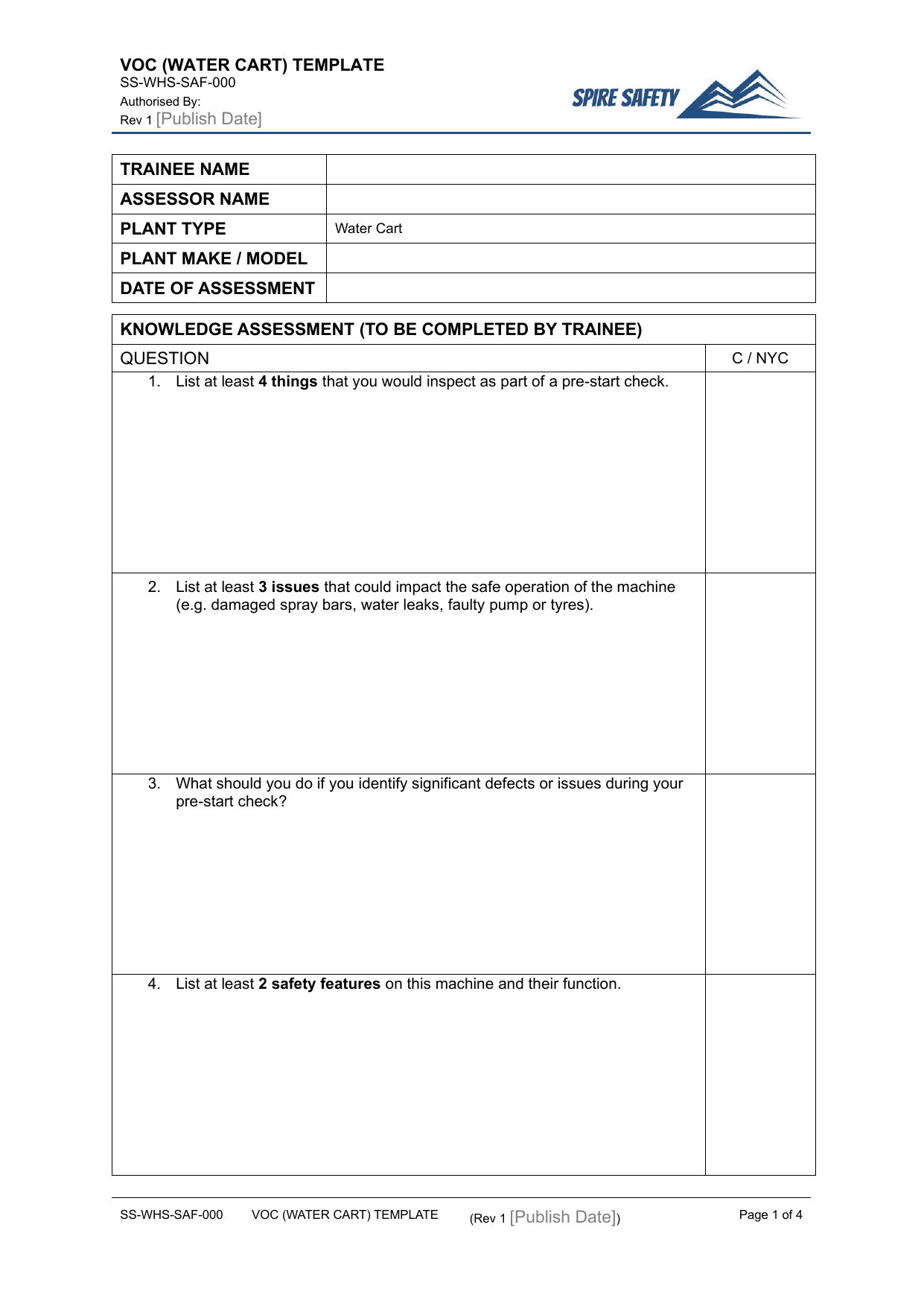
Download our free Verification of Competency (Water Cart) template to assess operator skill and safety knowledge.
Verification of Competency (Water Cart)
DOCX • 138 KB + PDF
Updated Oct 2026
No signup required
Purpose of the Verification of Competency (Water Cart)
Operating a water cart involves more than just driving; it requires skill in managing water distribution for dust suppression, understanding vehicle stability with a shifting load, and navigating complex worksites. This Verification of Competency (Water Cart) template provides a structured method for employers to confirm that an operator has the necessary skills, knowledge, and safety awareness to operate the equipment safely.
It forms a crucial part of demonstrating duty of care, helps identify any training gaps, and ensures that workers can perform their tasks without posing a risk to themselves or others. Properly implemented, VOCs are a key component of robust WHS management systems.
A formal assessment process helps standardise operator performance across your organisation. By documenting the verification, you create a clear record of an individual's competence at a specific point in time.
This is particularly important for mobile plant used on construction and civil worksites, where conditions can change rapidly. Using a specific assessment, such as this one for water carts or our Asphalt Paver VOC template, ensures the evaluation is relevant to the unique risks of the equipment.
What this Verifications of Competency covers
This document is aligned with Australian WHS principles and is designed to assess key areas of water cart operation, including:
- Pre-start checks and fault finding
- Understanding of machine controls and functions
- Safe operating techniques on various terrains
- Procedures for filling and managing the water tank
- Awareness of site-specific hazards (e.g., overhead powerlines, ground stability)
- Emergency procedures and shutdown protocols
Video walkthrough
How to use the Verification of Competency (Water Cart)
This document provides a comprehensive starting point for your assessment process. The assessment should be conducted by a competent person, such as a supervisor or experienced operator, who has the necessary knowledge and experience with water carts to make an informed judgement.
The process typically involves a combination of direct observation, questioning to gauge theoretical knowledge, and a review of the operator's practical performance in a real or simulated work environment.
Note: This is a template that must be customised to your specific workplace. We recommend you review and amend the contents to reflect your particular water cart model, site rules, unique hazards, and operational procedures before use.
For assistance in tailoring safety documents to your operations, consider engaging professional WHS consulting services.
When to use it
A Verification of Competency is not a one-off event. It should be integrated into your safety management system and used at several key points. Triggers for conducting a VOC include:
- Pre-employment or prior to starting a new role: To confirm the skills and experience claimed by a new operator.
- Introduction of new equipment: When a new make or model of water cart is introduced to the workplace.
- Post-incident: Following an accident or near miss involving a water cart to identify if a competency gap was a contributing factor.
- Identified performance issues: If a supervisor observes unsafe practices or a decline in an operator's performance.
- Periodic re-assessment: As part of a scheduled competency review program (e.g., every 2-3 years) to ensure skills are maintained. While a water cart doesn't require a high-risk work licence like some other plant, ongoing verification is a key part of managing risk, similar to the process outlined in our Free Forklift VOC (Verification of Competency) Template.
Who should use it
This resource is designed for use by managers, supervisors, and safety professionals within organisations that operate water carts. Specifically:
- Assessors: Supervisors, leading hands, or dedicated trainers who are tasked with evaluating operator competency. The assessor must be competent and confident in their own ability to operate the plant safely.
- WHS Managers/Advisors: To ensure a consistent and documented approach to competency verification across the business, which can be reviewed during routine WHS compliance auditing.
- Operators: While they do not 'use' the form themselves, operators are the subject of the verification and should understand the process and its purpose as part of their ongoing professional development.
The process is about verification, not just training. While both are critical, a VOC specifically confirms existing skills.
This is a key distinction from equipment like high-pressure cleaners, which often have their own specific assessment needs, as detailed in our Verification of Competency (Water Blaster) resource. You can find more templates and tools for a range of plant and equipment in our free WHS resources library.
Common mistakes
Common mistakes to avoid
- Treating the VOC as a simple 'tick and flick' exercise without genuine assessment.
- Using a generic template without customising it for the specific water cart model and site hazards.
- Having an assessor who is not competent or experienced with the equipment themselves.
- Failing to document the outcome and create an action plan to address any identified competency gaps.
Legal references
Legal considerations
The following legal requirements may be relevant to this type of work.
- Work Health and Safety Act (Harmonised) — Provides the primary duties for protecting workers and other people from work health and safety risks.
- Work Health and Safety Regulations (Harmonised) — Sets out requirements supporting the management of workplace hazards and risks.
The following codes may be relevant to this type of work.
- Managing WHS Risks Code of Practice — Provides practical guidance on identifying hazards, assessing risks and applying effective controls.
- Work Health and Safety Consultation, Cooperation and Coordination Code of Practice — Provides practical guidance on consulting workers and coordinating with other duty holders.
- Managing the Work Environment and Facilities Code of Practice — Provides practical guidance on safe work environments, workplace facilities and related controls.
Did you know
Slosh and Surge
The movement of water inside the tank, known as 'slosh and surge', can significantly affect a water cart's stability, especially during braking or turning, making it a critical training topic.
Water Weight
Water is heavy, weighing one kilogram per litre. A standard 12,000-litre water cart adds 12 tonnes of mobile weight to the vehicle, dramatically changing its handling characteristics compared to when it's empty.
FAQ
Frequently asked questions
01What is the difference between a Verification of Competency (VOC) and a High-Risk Work Licence?
02How often should a water cart operator's competency be verified?
03Who is qualified to conduct a water cart VOC assessment?
04Can one VOC be used for different models of water cart?
Share this resource
Verification of Competency (Water Cart)
Browse Categories
How To Use It
- 1Download and open in Word or PDF.
- 2Replace the placeholders with your business details.
- 3Get it reviewed by a WHS specialist before rollout.
Need it customised?
Our WHS consultants can adapt this template to your site, run a gap analysis, or audit what you already have in place.
Book a Free Consultation WHS consulting servicesor call 1300 156 382
Related templates
- Verification of Competency (Wood Chipper)
- Verification of Competency (Wrecker or Impact Wrench (Hydraulic))
- Free Angle Grinder VOC (Verification of Competency) Template
- Free Backhoe VOC (Verification of Competency) Template
- Free Band Saw VOC (Verification of Competency) Template
- Free Belt Sander VOC (Verification of Competency) Template