
Verification of Competency (Concrete Saw or Floor Saw) Template
Download our free Verification of Competency (Concrete Saw or Floor Saw) Template. A structured starting point for Australian WHS. Get yours today!
Verification of Competency (Concrete Saw or Floor Saw) Template
DOCX • 138 KB + PDF
Updated Oct 2026
No signup required
Purpose of the Verification of Competency (Concrete Saw or Floor Saw) Template
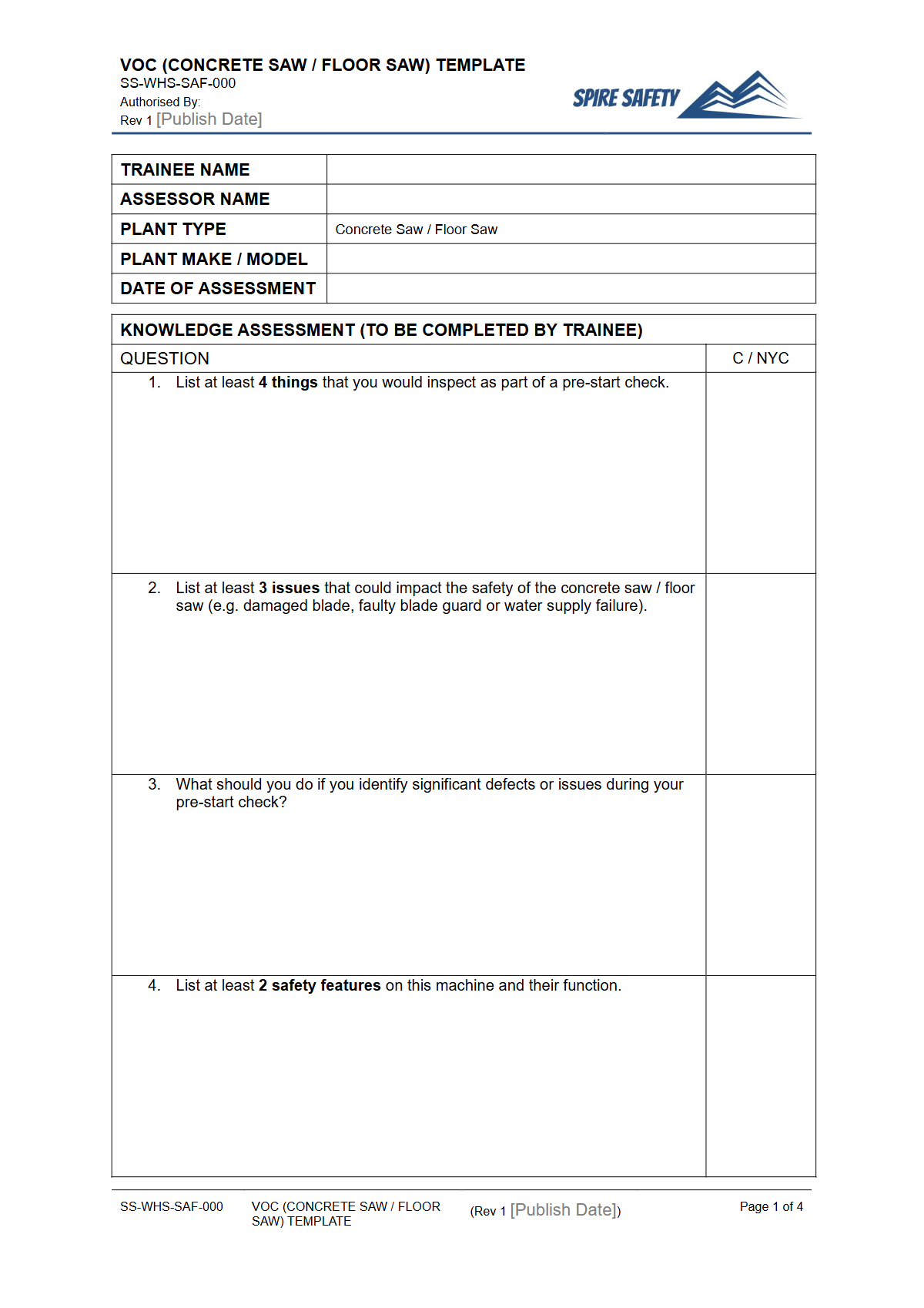
Our free WHS resources library provides this Verification of Competency (Concrete Saw or Floor Saw) Template, designed to assist Australian organisations in formally assessing and documenting an operator's competence. Operating concrete saws or floor saws involves significant risks, and ensuring workers possess the necessary skills, knowledge, and experience is paramount for workplace safety.
This template provides a structured method to evaluate an individual's ability to safely and effectively use these powerful tools.
A well-executed Verification of Competency (VOC) helps confirm that your workers can identify hazards, implement appropriate controls, and operate equipment according to manufacturer specifications and safe work procedures. This document acts as a record of that assessment, supporting your overall WHS management system by demonstrating due diligence in managing plant-related risks.
Video walkthrough
How to use the Verification of Competency (Concrete Saw or Floor Saw) Template
This Verification of Competency template is provided in DOCX and PDF formats for your convenience, offering a flexible starting point for your workplace. To effectively use the Verification of Competency (Concrete Saw or Floor Saw) Template, you must customise it to reflect your specific work environment, equipment models, and organisational WHS policies and procedures. We recommend that you:
- Review and adapt: Carefully read through the template and modify sections to match the exact concrete or floor saws you use, including specific safety features, operational requirements, and maintenance schedules.
- Define assessment criteria: Tailor the performance criteria to your site-specific tasks and expected operator behaviours. Consider incorporating elements from your WHS management systems and any relevant safe work procedures.
- Engage competent assessors: Ensure the VOC is conducted by a person with recognised expertise and experience in operating and assessing concrete and floor saws.
- Integrate with training: Use the VOC as part of a broader training and competency framework. If gaps are identified, provide additional training or supervision before re-assessment. Organisations often combine VOCs with general WHS consulting to ensure a holistic approach.
Remember, this template is a structured starting point. Your organisation is responsible for ensuring it is fully adapted and implemented in a manner that genuinely confirms operator competency and aligns with Australian WHS practice.
When to conduct a VOC
Employers should conduct a Verification of Competency for concrete saw or floor saw operators in several key situations to maintain high safety standards. This includes:
- New Employees: When a new worker is hired who claims to be competent in operating concrete or floor saws.
- New Equipment: Introduction of new models of concrete or floor saws, even if operators are familiar with similar equipment.
- Changes in Work Practices: Significant changes to work procedures, site conditions, or types of materials being cut, which might introduce new hazards.
- Refresher Training: As part of a periodic review cycle, especially if the equipment is used infrequently or if there have been incidents involving concrete or floor saws.
- After Incidents: Following any incident, near-miss, or safety deviation involving concrete or floor saws, to re-evaluate operator competency.
Regular VOCs, including for other plant such as a Mitre Saw VOC or a Reciprocating Saw VOC, are a proactive measure to manage risks associated with plant operation.
Potential hazards of operating concrete and floor saws
Operating concrete and floor saws exposes workers to various hazards that require careful management. Understanding these risks is crucial for developing effective controls and ensuring operator safety. Common hazards include:
- Dust Exposure: Significant generation of respirable crystalline silica (RCS) dust, which can lead to severe respiratory diseases like silicosis.
- Noise Exposure: High noise levels capable of causing permanent hearing damage.
- Vibration: Hand-arm vibration syndrome (HAVS) from prolonged exposure to tool vibration.
- Flying Debris: Risk of eye injuries or impact wounds from dislodged concrete, aggregate, or blade fragments.
- Cuts and Lacerations: Direct contact with the rotating blade or accidental cuts during handling or maintenance.
- Ergonomic Issues: Musculoskeletal injuries from manual handling of saws, awkward postures, or repetitive movements.
- Electrical Hazards: For electric models, risks of electric shock, especially when working in wet conditions or with damaged cords.
- Kickback: Sudden and violent thrusting of the saw towards the operator due to pinching or binding of the blade.
- Burns: From hot engine components on petrol-powered saws or from friction-heated blades.
- Fire/Explosion: With petrol saws, risks associated with fuel handling and engine operation.
Effective training, proper plant operator verification, and adherence to safe work procedures are essential to mitigate these significant risks.
Who should use this VOC template?
This Verification of Competency (Concrete Saw or Floor Saw) Template is primarily intended for:
- WHS Managers/Officers: To implement and oversee competency assessment processes.
- Supervisors/Team Leaders: Responsible for direct oversight of workers operating concrete or floor saws.
- Trainers/Assessors: Individuals tasked with evaluating worker competence.
- Business Owners/Employers: To supports your compliance efforts with WHS duties and demonstrate due diligence in managing plant safety.
- Project Managers: To ensure all personnel on construction sites using such equipment are appropriately verified.
It's a critical tool for anyone responsible for ensuring that workers operating high-risk plant are qualified and capable, aligning with their responsibilities for workplace health and safety.
Common mistakes
Common mistakes to avoid
- Not customising the VOC template to specific equipment or workplace conditions.
- Allowing unqualified personnel to conduct the competency assessment.
- Failing to provide refresher training when new hazards or equipment are introduced.
- Not documenting the VOC outcomes or keeping records readily accessible.
Legal references
Legal considerations
The following legal requirements may be relevant to this type of work.
- Work Health and Safety Act (Harmonised) — Provides the primary duties for protecting workers and other people from work health and safety risks.
- Work Health and Safety Regulations (Harmonised) — Sets out requirements supporting the management of workplace hazards and risks.
The following codes may be relevant to this type of work.
- Managing WHS Risks Code of Practice — Provides practical guidance on identifying hazards, assessing risks and applying effective controls.
- Work Health and Safety Consultation, Cooperation and Coordination Code of Practice — Provides practical guidance on consulting workers and coordinating with other duty holders.
- Managing the Work Environment and Facilities Code of Practice — Provides practical guidance on safe work environments, workplace facilities and related controls.
Did you know
Silicosis Risk
Exposure to respirable crystalline silica (RCS) dust generated when cutting concrete can lead to incurable lung diseases like silicosis. Proper dust suppression and respiratory protection are vital.
Noise-Induced Hearing Loss
Unprotected exposure to the high noise levels produced by concrete saws can cause permanent noise-induced hearing loss. Hearing protection is a critical control measure.
FAQ
Frequently asked questions
01What is a Verification of Competency (VOC)?
02Why is a VOC important for concrete and floor saw operators?
03How often should a VOC be conducted for concrete saw users?
04Can this VOC template be used for all types of concrete saws?
Share this resource
Verification of Competency (Concrete Saw or Floor Saw) Template
Browse Categories
How To Use It
- 1Download and open in Word or PDF.
- 2Replace the placeholders with your business details.
- 3Get it reviewed by a WHS specialist before rollout.
Need it customised?
Our WHS consultants can adapt this template to your site, run a gap analysis, or audit what you already have in place.
Book a Free Consultation WHS consulting servicesor call 1300 156 382
Related templates
- Verification of Competency (Die Grinder) Template
- Verification of Competency (Diesel Generator) Template
- Verification of Competency (Electric Hoist or Chain Block) Template
- Verification of Competency (Floor Grinder) Template
- Verification of Competency (Floor Scrubber) Template
- Verification of Competency (Gas Cutting Torch) Template