
Verification of Competency (Die Grinder) Template
Download our free Verification of Competency (Die Grinder) Template. A structured starting point for assessing worker competence. Get yours now!
Verification of Competency (Die Grinder) Template
DOCX • 138 KB + PDF
Updated Oct 2026
No signup required
Purpose of the Verification of Competency (Die Grinder) Template
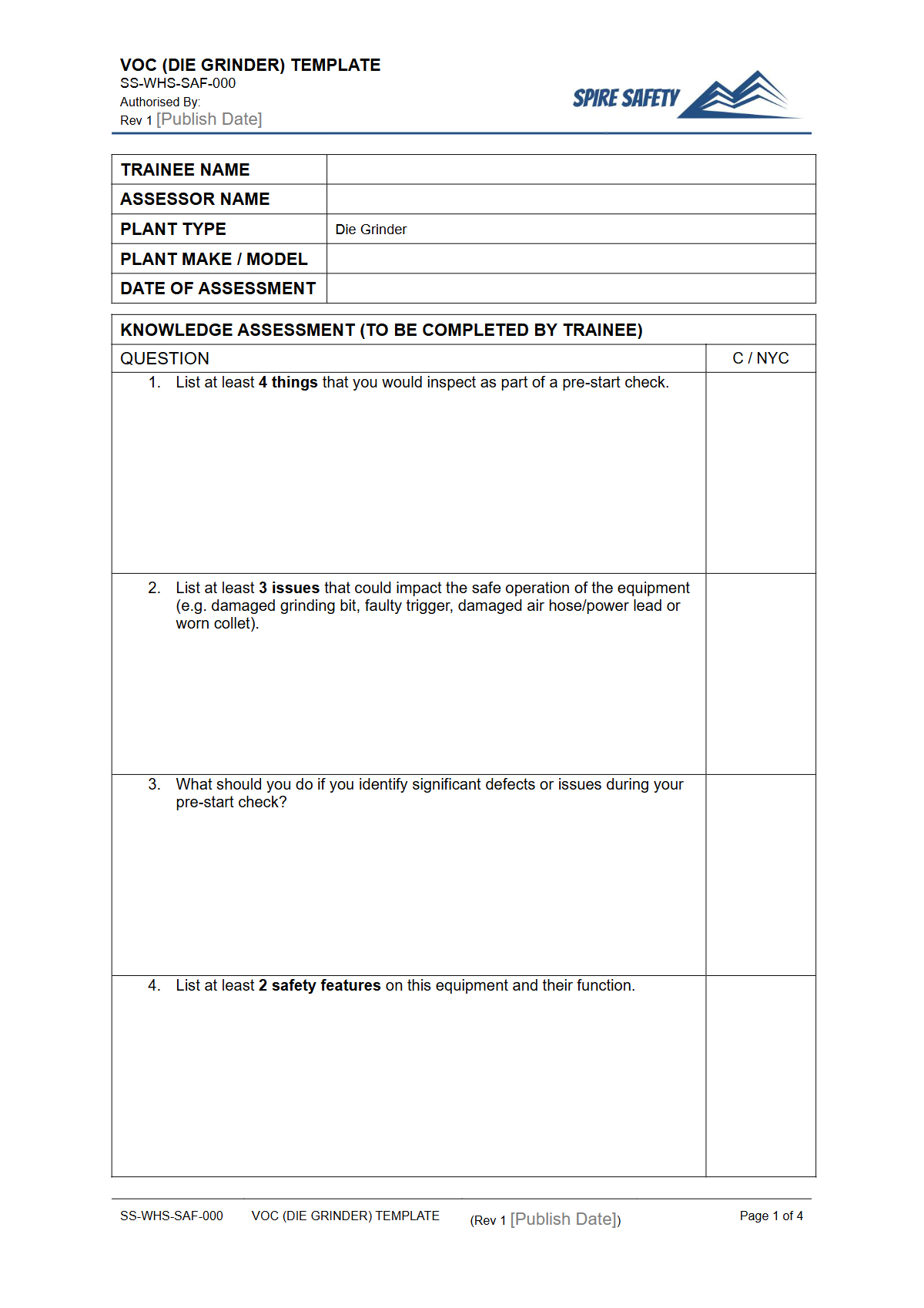
This free WHS resource provides a structured Verification of Competency (VOC) template specifically for die grinders. In Australian workplaces, ensuring that workers operating high-risk plant and equipment like die grinders are competent is a critical component of WHS risk management.
This template assists in formally assessing and documenting a worker's ability to safely and proficiently use a die grinder, aligning with Australian WHS practice. It helps organisations confirm that individuals possess the necessary knowledge, skills, and experience to operate this equipment without undue risk.
A well-executed Verification of Competency for die grinders demonstrates a proactive approach to safety, helping to minimise the risk of incidents and injuries. By using this template, you can systematically review and confirm that your workers understand safe operating procedures, pre-operational checks, hazard identification, and appropriate control measures related to die grinder use.
This process supports a robust safety culture and contributes to overall workplace safety.
Video walkthrough
How to use the Verification of Competency (Die Grinder) Template
Our Verification of Competency (Die Grinder) Template is provided in both DOCX and PDF formats for your convenience. The DOCX version is fully editable, allowing you to tailor it to your specific organisational requirements and the unique characteristics of the die grinders used in your workplace. This template is designed as a starting point; it must be customised to your workplace, specific die grinder models, and the tasks workers perform.
To effectively use the template:
- Download the DOCX file and adapt the content to reflect your specific operational procedures, safety induction processes, and the types of die grinders your workers use.
- Review the competency criteria to ensure they accurately cover all critical aspects of safe die grinder operation relevant to your industry.
- Incorporate specific site conditions, work environment considerations, and any unique hazards associated with die grinder use in your workplace.
- Ensure the assessment method aligns with your training and assessment policies.
- Integrate the completed VOC into your broader WHS management systems to maintain comprehensive records of worker competency. Regular reviews and updates are essential to reflect changes in equipment, procedures, or WHS regulations.
When to use it
A Verification of Competency for die grinders should be conducted at several key times to ensure ongoing safety and compliance:
- Initial Assignment: Before a worker operates a die grinder for the first time in your workplace, even if they hold previous qualifications.
- Periodic Review: As part of a scheduled review process, typically every 2-3 years, or as dictated by your organisation's WHS policy, to ensure skills remain current.
- After Incidents: Following any incident or near-miss involving a die grinder, to determine if competency gaps contributed to the event.
- New Equipment: When new models or types of die grinders are introduced that have different operating characteristics or safety features. This is similar to assessing competency for a bench grinder VOC.
- Changes in Work Practices: If there are significant changes to work procedures or the work environment that could impact the safe operation of a die grinder.
- Evidence of Performance Issues: If a worker's performance or behaviour indicates a potential decline in their competency or a lack of adherence to safety protocols.
Who should use it
This Verification of Competency (Die Grinder) Template is an invaluable tool for a range of WHS professionals and managers in Australian workplaces, including:
- WHS Managers and Officers: To supports your compliance efforts with WHS duties regarding plant and equipment operation.
- Supervisors and Team Leaders: Responsible for overseeing workers who operate die grinders and ensuring their teams are competent.
- Trainers and Assessors: To provide a structured framework for conducting competency assessments.
- HR Departments: For maintaining comprehensive employee training and competency records.
- Business Owners and Directors: To fulfil their primary duty of care in providing a safe working environment and ensuring workers are competent in their roles.
- Consultants: To assist clients in establishing robust competency assessment processes, particularly those involved in general WHS consulting.
Common mistakes
Common mistakes to avoid
- Not customising the template to specific workplace conditions and equipment models.
- Failing to conduct practical assessments alongside theoretical knowledge checks.
- Not reviewing or updating VOCs regularly, especially after incidents or changes in equipment.
- Treating VOCs as a one-off event rather than an ongoing part of WHS management.
Legal references
Legal considerations
The following legal requirements may be relevant to this type of work.
- Work Health and Safety Act (Harmonised) — Provides the primary duties for protecting workers and other people from work health and safety risks.
- Work Health and Safety Regulations (Harmonised) — Sets out requirements supporting the management of workplace hazards and risks.
The following codes may be relevant to this type of work.
- Managing WHS Risks Code of Practice — Provides practical guidance on identifying hazards, assessing risks and applying effective controls.
- Work Health and Safety Consultation, Cooperation and Coordination Code of Practice — Provides practical guidance on consulting workers and coordinating with other duty holders.
- Managing the Work Environment and Facilities Code of Practice — Provides practical guidance on safe work environments, workplace facilities and related controls.
Did you know
Die Grinder Safety
Die grinders, while versatile, can pose significant hazards like kickback, flying debris, and noise. Proper technique and personal protective equipment are crucial for safe operation.
FAQ
Frequently asked questions
01What is the primary goal of a die grinder VOC?
02Is this die grinder VOC template legally binding?
03How often should die grinder competency be verified?
04Can this template be used for other types of grinders?
Share this resource
Verification of Competency (Die Grinder) Template
Browse Categories
How To Use It
- 1Download and open in Word or PDF.
- 2Replace the placeholders with your business details.
- 3Get it reviewed by a WHS specialist before rollout.
Need it customised?
Our WHS consultants can adapt this template to your site, run a gap analysis, or audit what you already have in place.
Book a Free Consultation WHS consulting servicesor call 1300 156 382
Related templates
- Verification of Competency (Diesel Generator) Template
- Verification of Competency (Electric Hoist or Chain Block) Template
- Verification of Competency (Floor Grinder) Template
- Verification of Competency (Floor Scrubber) Template
- Verification of Competency (Gas Cutting Torch) Template
- Verification of Competency (Hydrovac or Vacuum Excavator) Template