
Verification of Competency (Floor Grinder) Template
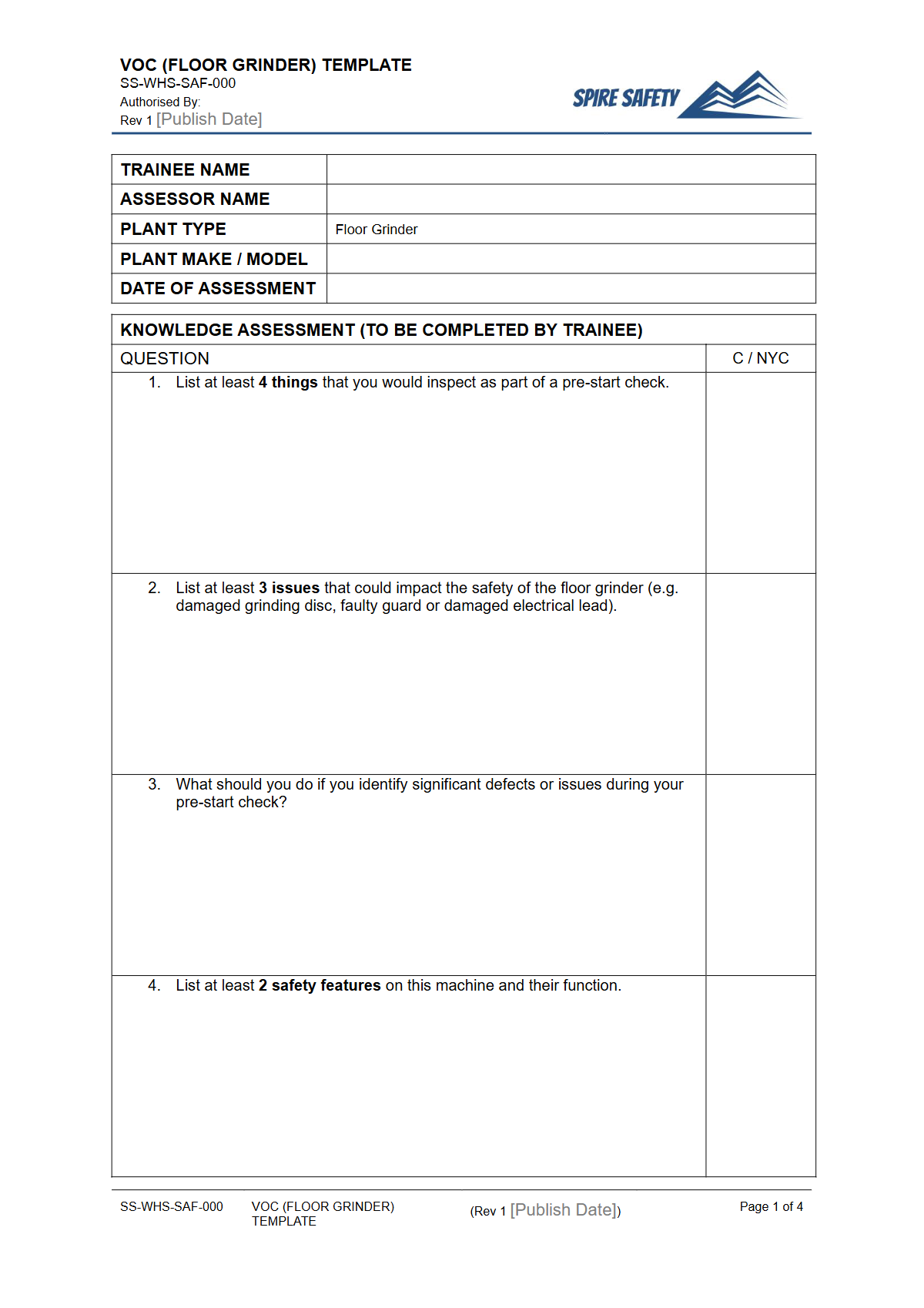
Download our free Floor Grinder Verification of Competency (VOC) template. A structured starting point for assessing worker skills. Get yours now!
Verification of Competency (Floor Grinder) Template
DOCX • 138 KB + PDF
Updated Oct 2026
No signup required
Purpose of the Verification of Competency (Floor Grinder) Template
This free Verification of Competency (Floor Grinder) Template provides a structured framework for Australian workplaces to assess their workers' ability to safely operate a floor grinder. Operating floor grinders involves inherent risks, and it is crucial to confirm that individuals possess the necessary knowledge and skills to perform tasks competently.
This template is designed to help organisations document and verify that a worker can apply their training and experience to the specific tasks and hazards associated with floor grinding equipment, promoting a safer working environment and supporting good WHS practice. The template is aligned with Australian WHS practice for managing plant risks and ensuring workers are adequately trained.
Video walkthrough
How to use the Verification of Competency (Floor Grinder) Template
Our free Verification of Competency (VOC) for Floor Grinders is available for download in both DOCX and PDF formats. The DOCX version allows for easy customisation using Microsoft Word or compatible software. To effectively use this template, follow these steps:
- Download: Choose either the DOCX for editing or PDF for a ready-to-print version of the template.
- Review and Customise: Go through the template and adapt it to your specific workplace conditions, the particular model of floor grinder being used, and the unique tasks involved. This includes adding specific operational knowledge, safety procedures, and site-specific hazards. Remember, this is a starting point; it must be customised to your workplace's specific requirements, machinery, and WHS management system.
- Assessor Selection: Ensure the VOC is conducted by a competent person who has expert knowledge of both floor grinder operation and safe work practices, as well as assessment principles. This assessor should be able to objectively evaluate a worker's performance and knowledge.
- Practical and Knowledge Assessment: The template includes sections for both practical demonstration and theoretical knowledge assessment. During the practical component, observe the worker performing tasks with the floor grinder in a controlled environment, focusing on safe startup, operation, shutdown, and handling of potential issues. The knowledge assessment can be completed via questioning.
- Documentation: Record all assessment details, including observations, scores, and any identified areas for improvement. Both the assessor and the worker should sign the completed form.
- Action and Review: Based on the VOC outcome, provide any necessary remedial training or further instruction. Regularly review your VOC processes and revisit worker competencies, especially after incidents or introduction of new equipment. For comprehensive support in managing your WHS obligations, consider our WHS management systems consulting services.
For other equipment, you may find our Angle Grinder Verification of Competency Template or Bench Grinder Verification of Competency Template useful.
When to conduct a Verifications of Competency
Verifications of Competency should be conducted in various situations to ensure ongoing workplace safety. Key times to perform a VOC for floor grinder operators include:
- New Employees: When a new worker is employed and expected to operate a floor grinder, even if they have prior experience or qualifications.
- Prior to Work on New Equipment: If an existing worker is assigned to operate a different model or type of floor grinder than they are accustomed to.
- Refresher Training: Periodically, as part of a scheduled WHS consulting program, to ensure skills and knowledge remain current.
- After an Incident: If a worker is involved in an incident or near-miss while operating a floor grinder.
- Observed Unsafe Practices: When there are observations of unsafe work practices or concerns about a worker's competency.
- Changes in Procedures: Following significant changes to work procedures, site conditions, or WHS regulations that impact floor grinder operation.
Who should use this resource
This resource is invaluable for any individual or organisation responsible for workplace health and safety where floor grinders are used. This includes:
- Employers and Business Owners: To fulfil their duty of care and legally mandated requirements to ensure workers are competent to perform tasks.
- WHS Managers and Officers: For implementing and maintaining robust WHS procedures and records.
- Supervisors and Team Leaders: To directly assess the competency of their team members and identify training needs.
- WHS Consultants: As a tool to assist clients in developing and implementing effective competency verification programs.
- Training Providers: To structure their assessment processes for practical skills.
Common mistakes
Common mistakes to avoid
- Not customising the VOC template to specific workplace conditions or grinder models.
- Using an unqualified or inexperienced person to conduct the VOC.
- Failing to provide refresher training after a VOC identifies skill gaps.
- Not properly documenting the VOC outcomes or keeping records readily accessible.
Legal references
Legal considerations
The following legal requirements may be relevant to this type of work.
- Work Health and Safety Act (Harmonised) — Provides the primary duties for protecting workers and other people from work health and safety risks.
- Work Health and Safety Regulations (Harmonised) — Sets out requirements supporting the management of workplace hazards and risks.
The following codes may be relevant to this type of work.
- Managing WHS Risks Code of Practice — Provides practical guidance on identifying hazards, assessing risks and applying effective controls.
- Work Health and Safety Consultation, Cooperation and Coordination Code of Practice — Provides practical guidance on consulting workers and coordinating with other duty holders.
- Managing the Work Environment and Facilities Code of Practice — Provides practical guidance on safe work environments, workplace facilities and related controls.
Did you know
Floor Grinder Hazards
Floor grinders can generate significant dust containing crystalline silica, a hazardous substance that can cause serious respiratory diseases like silicosis. Adequate dust control and <a href="/resources/free-whacker-packer-voc/">PPE</a> are essential.
Plant Registration
While floor grinders generally do not require specific registration in all states and territories, the broader WHS Regulations (s203) place duties on PCBUs to manage risks associated with all plant, including ensuring safe operation and maintenance.
FAQ
Frequently asked questions
01What is a Verification of Competency (VOC) for a floor grinder?
02Is a VOC a legal requirement in Australia for floor grinders?
03How often should a floor grinder VOC be conducted?
04Does this template make my workplace 'WHS-aligned'?
Share this resource
Verification of Competency (Floor Grinder) Template
Browse Categories
How To Use It
- 1Download and open in Word or PDF.
- 2Replace the placeholders with your business details.
- 3Get it reviewed by a WHS specialist before rollout.
Need it customised?
Our WHS consultants can adapt this template to your site, run a gap analysis, or audit what you already have in place.
Book a Free Consultation WHS consulting servicesor call 1300 156 382
Related templates
- Verification of Competency (Floor Scrubber) Template
- Verification of Competency (Gas Cutting Torch) Template
- Verification of Competency (Hydrovac or Vacuum Excavator) Template
- Verification of Competency (Impact Driver) Template
- Verification of Competency (Magnetic Drill) Template
- Verification of Competency (Metal Cut-Off Saw) Template